
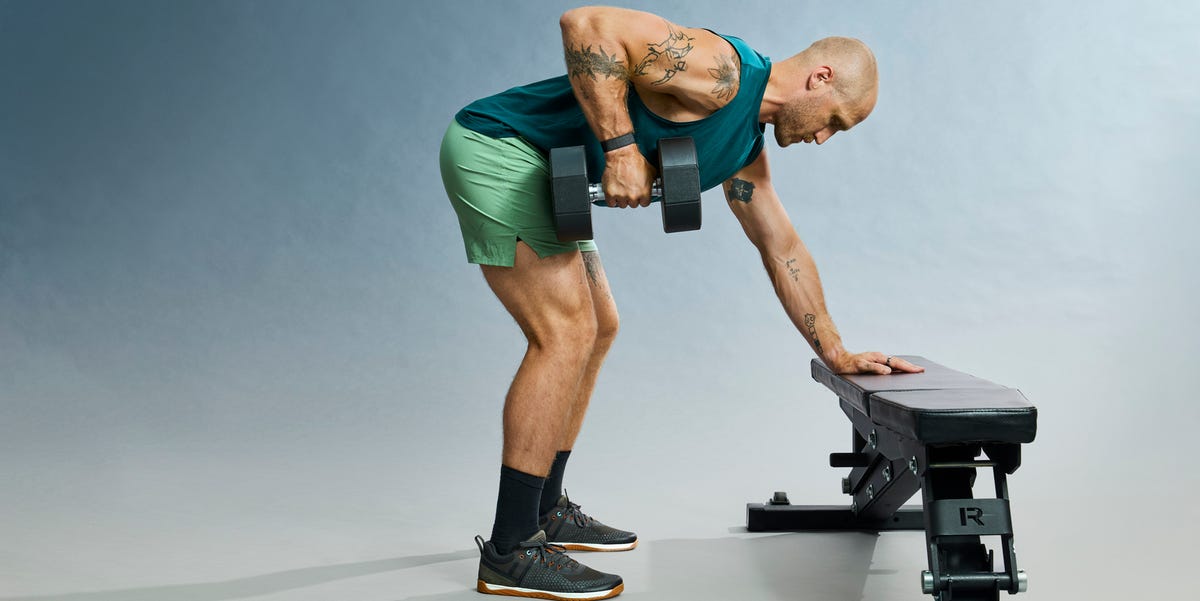
Our product picks are editor-tested, expert-approved. We may earn a commission through links on our site. Why Trust Us?JUSTIN STEELE5 min readHIT THE FREE weight floor at any gym and you're bound to bump into at least one guy with his knee up on a weight bench, pulling at a dumbbell like he's yanking a lawnmower's starter cord. They're doing a staple back training exercise: the dumbbell row. As foundational as the dumbbell row is for all kinds of strength training splits, it's still an exercise that lots of guys get wrong. The main issue isn't that the movement is overly complicated. The problem lies in laziness, a lack of focus, or impatience. The row is best performed with solid posture, and if you're not paying attention and rush sloppy reps, you can put yourself in a disadvantaged position that can seriously limit your potential gains and even put yourself at risk of injury. One simple fix will take you out of that stereotypical dumbbell row position and move your orientation on the bench. You'll put yourself in a much better spot for focused, intentional reps—so you can attain the back muscle and strength you're training to build. Here, Men’s Health fitness director Ebenezer Samuel, C.S.C.S. and MH senior editor Brett Williams, NASM-CPT break down the dumbbell bench row so you can avoid common mistakes that are taking away from your gains.How to Do the Dumbbell RowTHE BIGGEST ISSUE most guys make when they do the dumbbell row is to work from a position with their knee on top of the bench. This puts the spine in a poor spot, according to Samuel, which can both take away from the back muscles you're looking to recruit and open yourself up to potential injury. Instead, he says that you should move your knee off the bench, instead working from a hinge position. You'll still use the bench for support—but you'll be in a much more balanced stance.Stand with your feet at shoulder width apart in front of the bench. Push your butt back and lower your torso down, extending your off arm to rest your palm on the bench. Make sure your shoulders stay above your hips.Grab the dumbbell with your working hand. Squeeze your glutes and abs to create full-body tension. Your back should be flat, with your head in a neutral position.Squeeze your mid-back muscles to drive your elbow up, rowing the weight. Keep your shoulders level and avoid rotating your lower back.Pause for a beat, then lower the weight back down.Follow these tips from Samuel for more detailed form cues.Row With a Better StanceEb says: There's nothing inherently wrong with the way most people do the dumbbell row, with one knee and one hand on the bench, but that position does invite a lot of inconsistency through the hips, and resultantly, through the spine. Especially when you start learning the dumbbell row, it's important to learn to be in control of your hips and spine. That's why a better starting point for beginners is with one hand on a bench and an even stance with your feet.From here, you want to think about keeping your hips square to the ground the entire time; that means keeping your core active as you row. Make sure your shoulders are slightly higher than your hips, too; you'll have to turn on your back extensors to do this and it will protect your lower back from lifting the weight. Want some more info about this wrinkle? Check out the details here.Maintain Mid-Back TensionEb says: The first move when you do the row: Squeeze your shoulder blades. Doing so is will prevent you from doing the row with a rounded upper back, and it'll help protect your shoulders in the long term. If you forget to do this, which a lot of new gym-goers do, you wind up trying to row from a position that invites the head of the humerus (your upper arm bone) to get close to the clavicle (your collarbone), a situation that can bug both labral and rotator cuff tendons. That shoulder blade squeeze will help prevent that from happening. It also insures you get more out of the row; now you get a chance to activate both your lats and your rhomboids on each rep. Make this squeeze of the shoulder blades intentional at first on every rep; as you progress, it'll happen as one fluid motion.Pull With Your Back, Not Your BicepsEb says: Once you're in position, it's easy to underestimate the row: Just pull the dumbbell up. But how you pull is key. It's easy to over-involve the biceps, but this is a lat- and rhomboid-focused move. Avoid that by thinking only of pulling your elbow as high as you can—try to imagine that your forearm as a large hook that's gripping the dumbbell. Your biceps will be involved in the row either way, but it shouldn't be the dominant mover on every rep.Benefits of the Dumbbell RowBuild back muscle and strengthBetter range of motion than other implementsSafer position"Rowing movements are ideal for training your back because they directly offset the horizontal push positions that everyday life puts us in," Men's Health fitness director Ebenezer Samuel, C.S.C.S. says. "Throughout your day, you’re extending your arms out in front of you when you type at your computer, drive your car, or open a door. When you row, you don’t just hit your lats, but you also build your rhomboids and rear delts, key muscle groups that offset all the pushing motions of life."Using a dumbbell for rows is particularly effective compared to performing variations with barbells or other fixed implements. You'll be working with a better range of motion using the unilateral tools, allowing you to work the full movement path of the muscles.Muscles Targeted By the Dumbbell RowRhomboidsLatsTrapsYou'll work your major back muscles when you do the dumbbell row, including your rhomboids, lats, and traps.You can take on the dumbbell row in a bent over position with care to keep your back in spine-safe posture—but more commonly, you'll hit the bench for support as you go about your workout.Common Dumbbell Row Mistakes to AvoidTHE MOST COMMON dumbbell row mistakes come from poor posture. We've already covered the knee on the bench position, which makes it easier to throw your spine out of alignment.Once you're in a hinge position, some guys bend over too far, so that their hips are higher than their shoulders. Don't do that; instead, keep your hips below the shoulders. Also, avoid rotating the shoulders and raising the head. When you row up, engage your mid-back, rather than swinging your arm or curling the weight up. Once you've developed strong form, you can stretch your lat to work within a wider range of movement—but be careful to avoid rotating at the lower back. Keep your core tight to stay in good shape.How to Include the Dumbbell Row in Your WorkoutsTHE DUMBBELL ROW should be a back training staple. Include it in your back and upper body training days for 3 sets of 8 to 12 reps per arm. Once you're more accustomed to the movement, you can pick up heavier weights and cut the reps (think 6 to 8 reps) to really build muscle and strength.The Dumbbells We RecommendAmazon Basics Hex Dumbbell (20 lbs)Now 26% OffCAP Barbell Hex Dumbbell Set with Vertical Rack (150 lb)Now 16% OffBest Value Adjustable DumbbellsBowflex Results Series 552 SelectTech (52.5 lbs)Now 5% OffBrett Williams, NASM-CPT, PES, a senior editor at Men's Health, is a certified trainer and former pro football player and tech reporter. You can find his work elsewhere at Mashable, Thrillist, and other outlets.
How to Do Dumbbell Rows the Right Way
Full Article
Original Source
Read the full article at Menshealth →KhanList aggregates and links to publicly available news content. We do not host full articles from third-party sources. Always verify important information with original sources.