
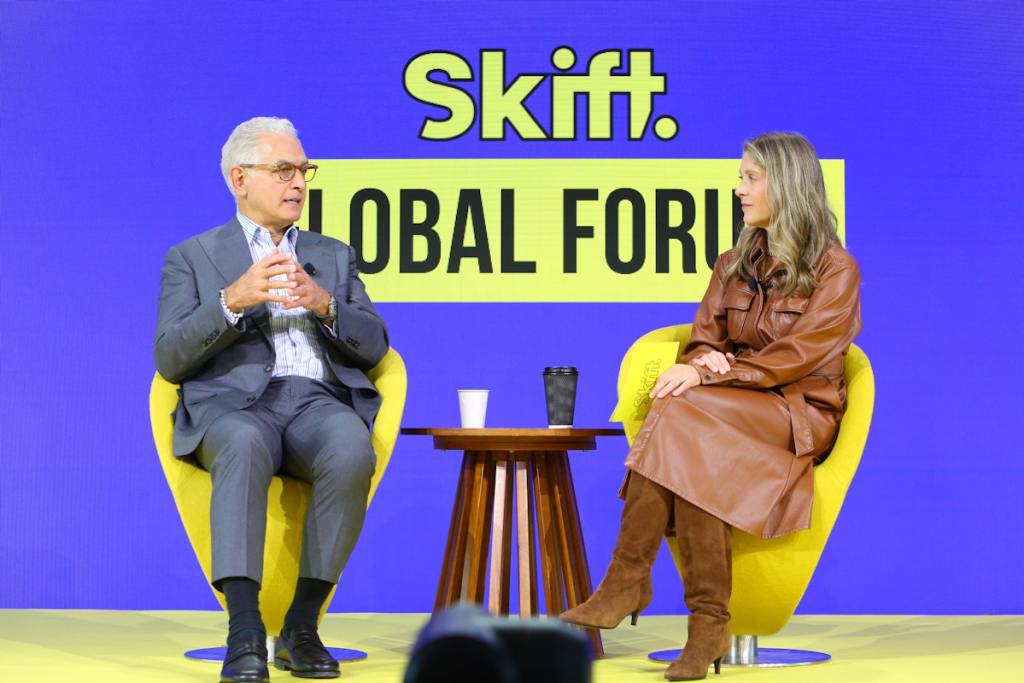
The Decision Brief Mark Hoplamazian, Chairman, President & CEO, Hyatt Hotels Corporation Moderated by Sarah Kopit, Editor-in-Chief, Skift THE VERDICT Most hotel companies talk about owner value. For 67 of Hyatt’s 70 years of existence, the company has been the largest owner of its own hotels, and that history shapes a fundamentally different set of decisions. Hoplamazian said Hyatt replaced all four core hotel operating systems simultaneously, delivered 40% savings on the property management system, and absorbed the entire cost — “we did that without sending a bill for even one penny to any of our owners.” The companies that invest on behalf of owners build a different kind of customer loyalty. PATHS FORWARD Absorb investment and let owners see savings. Hoplamazian said Hyatt changed its central reservation, property management, revenue management, and point-of-sale systems all at once. He called it “our infinite idiocy,” but the result was 40% cost savings flowing directly to hotel operators with zero pass-through cost. Brands can earn owner trust by absorbing risk. Shift demand mix deliberately through acquisition. Hoplamazian said Hyatt’s proportion of leisure travel moved from around 35% in 2017 to closer to 55% by 2025, driven in part by the $2.7 billion acquisition of Apple Leisure Group during COVID. He said the all-inclusive model removes “transactional friction” and lets both staff and guests “get to be themselves.” The acquisition was a deliberate repositioning of the entire company. Build well-being into the operating model. Hoplamazian said mindfulness practices have been infused into corporate meetings through Together by Hyatt, generating what he said was about a billion dollars in meetings business over the past couple of years. He said the approach is about practices that “really actually affect the human experience.” Travel companies treating well-being as an amenity may be undervaluing what it can do as an operating principle. WHAT TO WATCH Hoplamazian said he is building a personal AI that mimics his decision-making and plans to test it for six months before offering it to his team. He said “it needs a lot more learning” and that he’s feeding it everything he writes and says. Whether a CEO’s AI avatar can meaningfully extend leadership judgment — or whether it becomes a novelty — is a question the industry will answer as more executives follow Chesky’s and Hoplamazian’s lead. Hoplamazian said the vast majority of travel decisions are made by women, the vast majority of travel advisors are women, and by 2040 or 2050, over 60% of US wealth will be held by women. He said women remain “vastly underrepresented” in travel leadership and called it “the most obvious choice” the industry is still failing to make. Whether the industry closes that gap — or keeps talking about it at conferences — will be visible in executive appointments over the next few years. Access all the Skift Takeaways from this event, as well as full session videos, presentation documents, and more editorial coverage at our Skift Global Forum attendees hub.
How to Create Value for Owners and Guests
Full Article
Original Source
Read the full article at Skift →KhanList aggregates and links to publicly available news content. We do not host full articles from third-party sources. Always verify important information with original sources.