
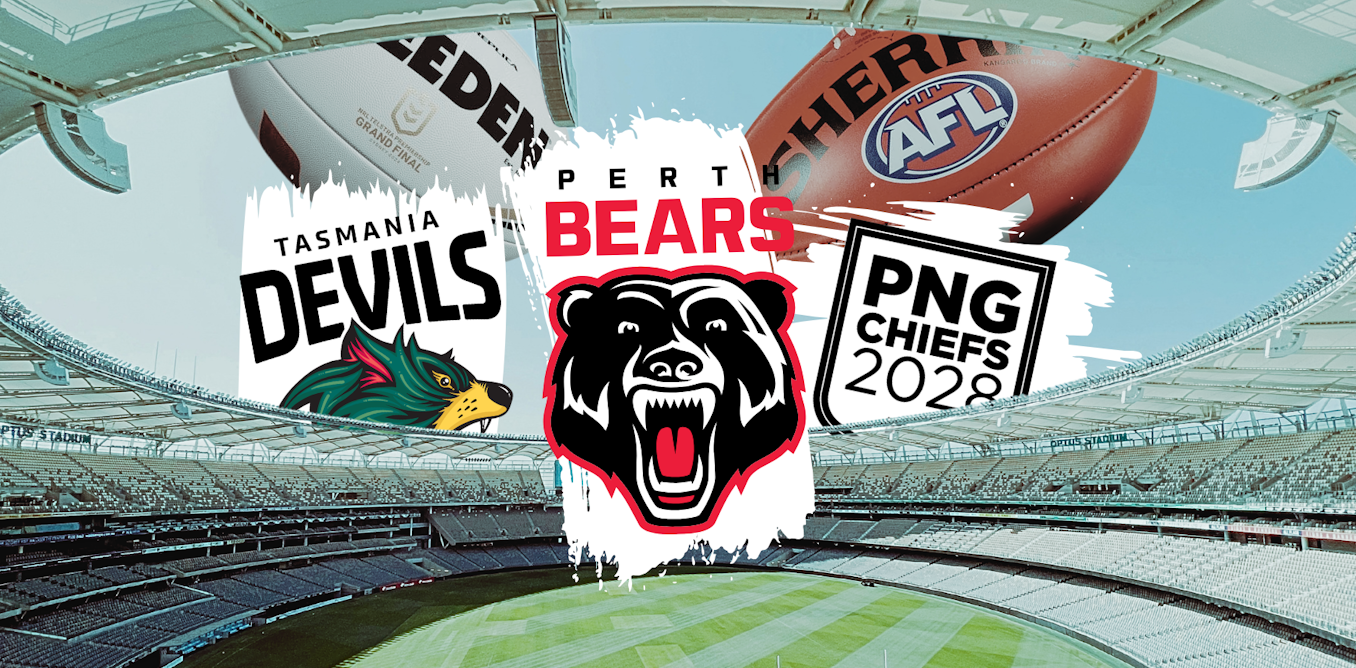
The 2026 Australian Football League (AFL) and National Rugby League (NRL) seasons have finished in a blaze of glory for the Brisbane Lions and Sydney Roosters. But as the premiers celebrate, three new teams are working to reshape Australia’s two biggest football codes. In the next 18 months, three clubs will launch: the Perth Bears (NRL and NRLW) in 2027 and the Papua New Guinea Chiefs (NRL) in 2028. The Tasmania Devils will join the AFL/AFLW in 2028. I’ve researched league expansion and the challenge of establishing new teams in Australian and New Zealand sports. Here are the astronomical challenges, and opportunities, these upstart clubs face. Three clubs, three completely different landscapes Professional sports are typically stable: expansion is infrequent and the decision to add new teams is not taken lightly. The Bears, Devils and Chiefs are emerging thanks to the involvement of the Australian state and federal governments. Tasmania is a traditional Australian football-loving state that lobbied for decades for its own license before finally getting the green light in 2023. However, it lacked a contemporary stadium and critical mass to underpin a viable business model. The Tasmanian government’s solution was to underwrite the club: tipping in a reported A$12 million per year and paying the bulk of the new $1 billion-plus stadium. The Perth Bears are also a strategic play. The expansion allows the NRL to increase its geographic footprint beyond the east coast states of New South Wales, Queensland and Victoria. The team uniquely incorporates relocation and resurrection. As well as expanding into new territory, the NRL has revived the moniker of one of the league’s foundation clubs: the North Sydney Bears, which were excluded from elite-level rugby league competition after the 1999 season. The “new” Bears team blends the historic red-and-black identity of the foundation club with a newly established WA fanbase. The WA government committed an estimated $85.6 million to help establish the club. As for the Chiefs, the NRL had for many years flirted with the PNG government’s aspiration to establish a team in Port Moresby. Rugby league is, of course, PNG’s national sport. But the financial model never stacked up. NRL boss Peter V’landys – lauded and criticised simultaneously for his ability to extract money from government – recognised that PNG lacked the capacity to fill the gap. He sought and subsequently acquired the necessary funding from the Australian federal government: an estimated $600 million. This federal funding comes as Australia tries to thwart China’s efforts to build influence in the Pacific. Read more: Sports diplomacy: why the Australian government is spending $600 million on a new NRL team in PNG Early focuses So what do these fledgling teams need to focus on straight away? First, there is the obvious, difficult and uncontrollable thing: trying to win. In sport, winning takes care of everything. It can paper over many cracks. Winning builds fan bases, and attracts and retains talent (both on and off the field) and sponsors. The challenge, of course, is that all the other, more experienced teams in the leagues are determined to stop this from happening. Then there is the less obvious, still difficult but arguably controllable thing: developing a strong, stable and supportive high-performance culture. A new team is an open book. Early decisions can establish an enduring culture, including attitudes towards accountability and leadership norms. There are also decisions regarding fan and stakeholder expectations. Do club leaders raise expectations by suggesting premierships are soon to follow, or do they seek patience and assert publicly that success may take time? Commercial revenues may be the most visible but they ultimately depend on a strong and engaged fan community. My study on how best to create a fan base highlights group experiences that forge a sense of affiliation, history and heritage, rituals and traditions, and physical facilities are important enablers of a fan community. Problematically for expansion teams, these elements are likely in short supply in the early days. Lessons from recent history The biggest unknown is how the Bears, Chiefs and Devils will fare once they take the field. Some expansion teams establish themselves very quickly, such as the NRL powerhouses Melbourne Storm (playing in the finals in their first year and winning a premiership in their second) and Brisbane Broncos (finals in second year, premiership in fifth). In the AFL, West Coast played finals in its second year and claimed a premiership in its fifth. But others, such as VFL/AFL teams Brisbane (nine years before playing finals) and Gold Coast (14 years before playing finals), were slower to find their September feet. So far, the high-calibre player and coach recruitment bodes well for these teams. Both NRL teams have momentum: the Bears have lured Josh Curran, Gehamat Shibasaki and Corey Horsburgh to the west. All are gun players. Coach Mal Meninga is an icon but last coached an NRL team before most of his players were born. The Chiefs have recruited Zac Lomax, Jarome Luai and Alex Johnston. More guns. Willie Peters is a successful British Super League coach, but is untested in the NRL environment. The Devils say they have “entered into arrangements” with several recruits, but haven’t publicly named them. While history will rightly recognise the Lions and Roosters as winners this season, the Bears, Chiefs and Devils will hope to look back on 2026 as the year they started to assemble premiership-winning squads.
How to build an expansion club: the challenges and opportunities for the new NRL and AFL teams
Full Article
Original Source
Read the full article at Theconversation →KhanList aggregates and links to publicly available news content. We do not host full articles from third-party sources. Always verify important information with original sources.