
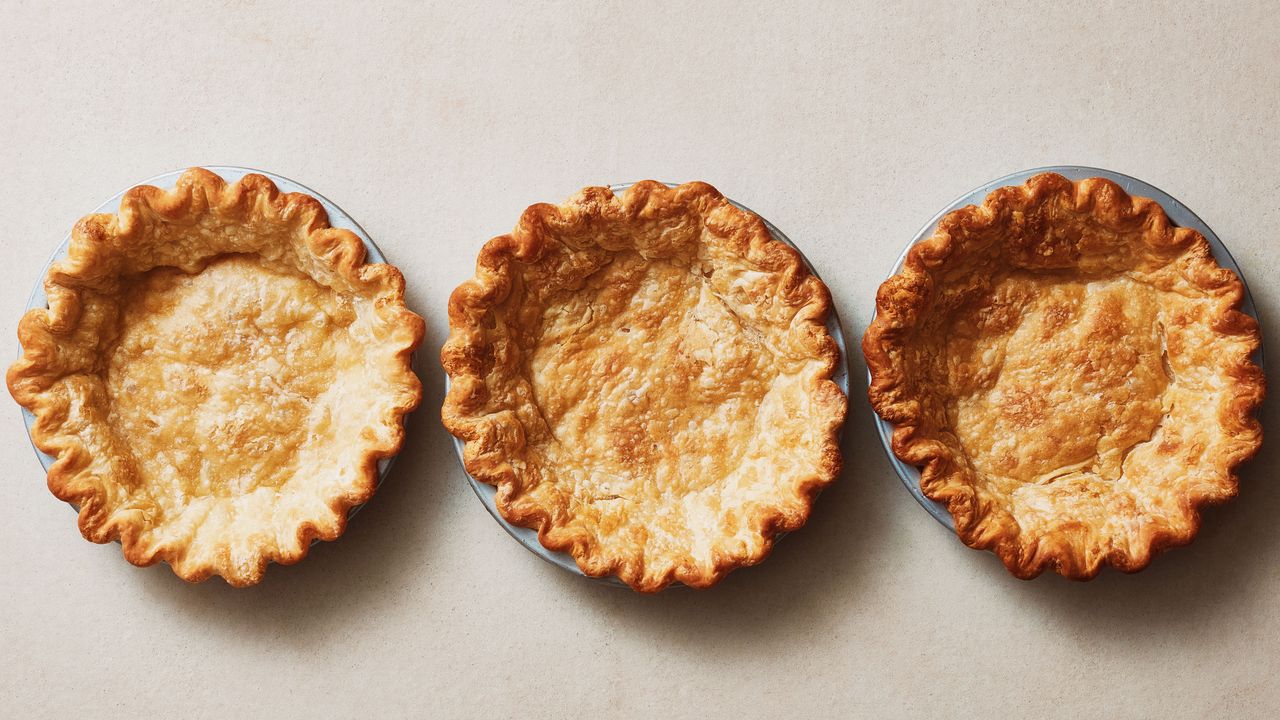
The road to pie perfection is paved in pitfalls. I’ve fallen into plenty of them throughout my baking career. The infamous “soggy bottom” is among the most common, but it’s easy to avoid. Blind-baking—baking the crust before adding the filling—helps prevent an underbaked crust by giving the pastry a head start in the oven or cooking it completely before the filling goes in.But getting the crust to the right color depends on what you’re planning to fill it with. A pale, partially baked shell might be perfect for one pie, while another needs a deep golden-brown crust before you add even a spoonful of filling. Here’s how to know when enough color is enough.When should you blind bake pie crust?Blind-baking is especially useful when the filling needs less time in the oven than the crust does. For custard pies, like pumpkin pie, partially baking the shell gives the pastry a head start so it doesn’t end up uncooked beneath a set filling. For pies with no-bake fillings, such as chocolate pudding pie or cranberry curd pie, the crust needs to be fully baked before it’s filled.Most traditional fruit pies don’t need blind-baking. Their fillings and crusts spend enough time in the oven together for the pastry to cook through. There are exceptions, particularly single-crust fruit pies topped with a crumble. Our Peach-Blueberry Pie, for example, starts with a thoroughly blind-baked shell before the filling goes in. Follow your recipe’s instructions rather than assuming every fruit pie needs the same treatment.How to blind bake pie crustStart with a good pie dough. Roll it out, fit it into the pie plate, and crimp the edge. Chill the shaped shell for at least 15 minutes before baking; cold dough holds its shape better in the oven, reducing the risk of shrinking or slumping.Next, line the shell with parchment paper and fill it with pie weights. Crumpling the parchment first, then unfolding it, helps it conform to the shell. The weights hold the dough against the pan while it bakes, preventing the bottom from puffing up and the sides from collapsing.What can you use for pie weights?You can buy ceramic pie weights or use dried beans, rice, or stainless-steel ball bearings. I’m partial to the ball bearings: They’re small enough to settle into the corners of the pie plate and heavy enough to hold the dough firmly in place.Not everyone in the Bon Appétit Test Kitchen agrees. Editors Jesse Szewczyk and Rebecca Firkser prefer lighter alternatives. In their experience, heavy metal weights can compress the dough, limiting the expansion of the buttery layers that make pie crust flaky. Jesse uses dried beans or rice; Rebecca prefers dried chickpeas or even granulated sugar, a technique popularized by baking expert Stella Parks.All of these options can work. Whichever you choose, fill the parchment-lined shell generously, supporting the sides all the way to the rim. Leave the weights in place until the crust looks dry and set and the parchment releases easily; removing them too soon can cause the sides to slump.Blind-Baked Pie Crust: The MethodThis method uses our Perfect Pie Crust dough and makes one 9"-diameter pie shell. It produces an evenly golden crust; if your pie calls for a paler or more deeply browned shell, follow its specific baking instructions and use the visual guide below.Ingredients1 disk Perfect Pie Crust dough, chilledAll-purpose flour, for dustingSpecial Equipment: pie weights, dried beans, or ricePreparationRemove 1 disk Perfect Pie Crust dough from the refrigerator and let sit at room temperature about 5 minutes, until just pliable. Roll out on a lightly floured surface to a 12" round, about ⅛" thick. Brush off excess flour and transfer to a 9"-diameter pie plate, preferably metal. Gently ease the dough into the bottom and sides without stretching it. Trim, leaving about 1" overhang. Fold the overhang onto itself, pressing to seal, and crimp as desired. Chill 15 minutes.Place a rack in the lower third of the oven; preheat to 375°F. Set the pie plate on a parchment-lined rimmed baking sheet. Crumple 2 sheets of parchment paper, then unfold them so they'll fit more easily against the crust. Line the crust with the parchment and fill to the edges with pie weights, dried beans, or rice.Bake until the edges are golden brown and the bottom looks set and opaque when you carefully lift the parchment to check, about 30–35 minutes. Remove from the oven and reduce the oven temperature to 325°F. Carefully lift out the parchment and weights.Return the crust to the oven and bake until the bottom and sides are evenly golden brown all over, 12–18 minutes more. If you’re using the shell for a pie that requires further baking, follow that recipe’s instructions for the appropriate doneness. For a no-bake filling, make sure the shell is fully baked before filling.Some pie recipes call for docking (pricking the bottom and sides of the dough with a fork) before baking. This allows steam to escape and helps prevent uneven puffing, but doesn’t replace the support of pie weights. Follow your recipe’s instructions; docking isn’t necessary for every blind-baked crust.Do ahead: A fully blind-baked crust can be made up to 2 days ahead. Let cool completely, wrap well, and store at room temperature until ready to fill.How long should you blind bake pie crust?The short answer: It depends on what you’re putting inside. Some pies need only a partially baked crust, while others call for a shell that’s deeply golden brown.Oven temperatures vary, different pie plates conduct heat differently, and the filling determines how much additional baking the crust will get. Use the recipe’s timing as a guide, but watch the color and texture of the pastry. Here’s what to look for.Pale: For Pies That Will Keep BakingPhoto by Travis Rainey, Food Styling by Kaitlin Wayne, Prop Styling by Maggie DiMarcoFruit pies need a pale base because they bake a looong time. Or at least, that’s often the thinking. If you’re making a single-crust variety topped with a crumble, such as our Blueberry Crumble Pie, and the recipe calls for blind-baking, you might want to start with an anemic crust. It’ll have plenty of time to brown as the juices thicken.A pale, partially baked crust should look set rather than raw. The bottom should look set and opaque, with some light golden patches, while the crimped edge may already be noticeably browned. The crust will continue to develop color once the filling goes in.Don’t assume fruit pies always need a pale shell. Our Peach-Blueberry Pie, for example, calls for a well-browned crust before the fruit and crumble go in. And many double-crust fruit pies don’t need blind-baking at all.A lightly baked shell can also be appropriate for custards that have a substantial bake ahead. BA’s Best Pumpkin Pie starts with a partially baked crust before the custard goes in for at least another hour.The goal is to give the crust enough of a head start without taking it so far that the edges burn before the filling finishes cooking.Golden: For Pies That Need a Head StartPhoto by Travis Rainey, Food Styling by Kaitlin Wayne, Prop Styling by Maggie DiMarcoCustard pies, such as chess and our Lemon Buttermilk Pie, often have shorter bake times than fruit pies, so the crust needs a solid golden base layer to develop enough color by the time the filling sets.Here, you’re looking for more than a crust that’s simply dry and set. The bottom should be evenly golden, with no pale, translucent patches, and the sides should have taken on some color too. The rim will generally be a little darker than the bottom, but the whole shell should look well on its way to being fully baked.Our Perfect Pie Crust recipe produces this kind of shell. It calls for baking the weighted crust until the edges are golden, then removing the weights and continuing until the bottom and sides are evenly browned.And some pies need an even more substantial head start. Our Bourbon-Date Pecan Pie takes the crust to a dry, golden finish before adding a filling that bakes for another 45–55 minutes.The point isn’t that every custard pie needs the same color. It’s that the crust should be baked far enough that it won’t be left pale and doughy by the time the filling is done.Dark: For No-Bake FillingsPhoto by Travis Rainey, Food Styling by Kaitlin Wayne, Prop Styling by Maggie DiMarcoBake the crust to a dark golden-brown if you’re adding a no-bake filling, like a pudding or curd. You’re going for a toasty, burnished color, so don’t be gun-shy.Because the filling won’t return to the oven, this is the crust’s one chance to bake all the way through. You want deep color across the entire bottom and up the sides—not just a dark rim surrounding a pale center. The pastry should look dry, crisp, and well browned, without any doughy or translucent spots.After removing the pie weights, continue baking until the shell is fully browned, checking frequently toward the end. Depending on the dough and oven temperature, that might take another 15–20 minutes or longer. Don’t pull it simply because the timer has gone off.Our Cranberry Meringue Pie uses this approach: The crust is baked until golden and dry before the cranberry curd filling goes in. A fully baked shell develops a richer, toastier flavor and is better equipped to stand up to a moist filling.Should you egg-wash a blind-baked crust?Some recipes, including our pumpkin pie, call for brushing a thin layer of beaten egg onto the partially baked shell and returning it to the oven briefly to set. This, ostensibly, creates a barrier between the pastry and the filling, but not all bakers believe the hype.While it can be a useful extra precaution, it is by no means a universal requirement. If your recipe doesn’t call for it, there’s no need to add another step.Time to preheat the oven:Editor’s note: This story was originally published in May 2016 and has been updated with additional reporting and expanded instructions by Phoebe Fry.
How to Blind Bake Pie Crust—and When You Need To
Full Article
Original Source
Read the full article at Bonappetit →KhanList aggregates and links to publicly available news content. We do not host full articles from third-party sources. Always verify important information with original sources.