
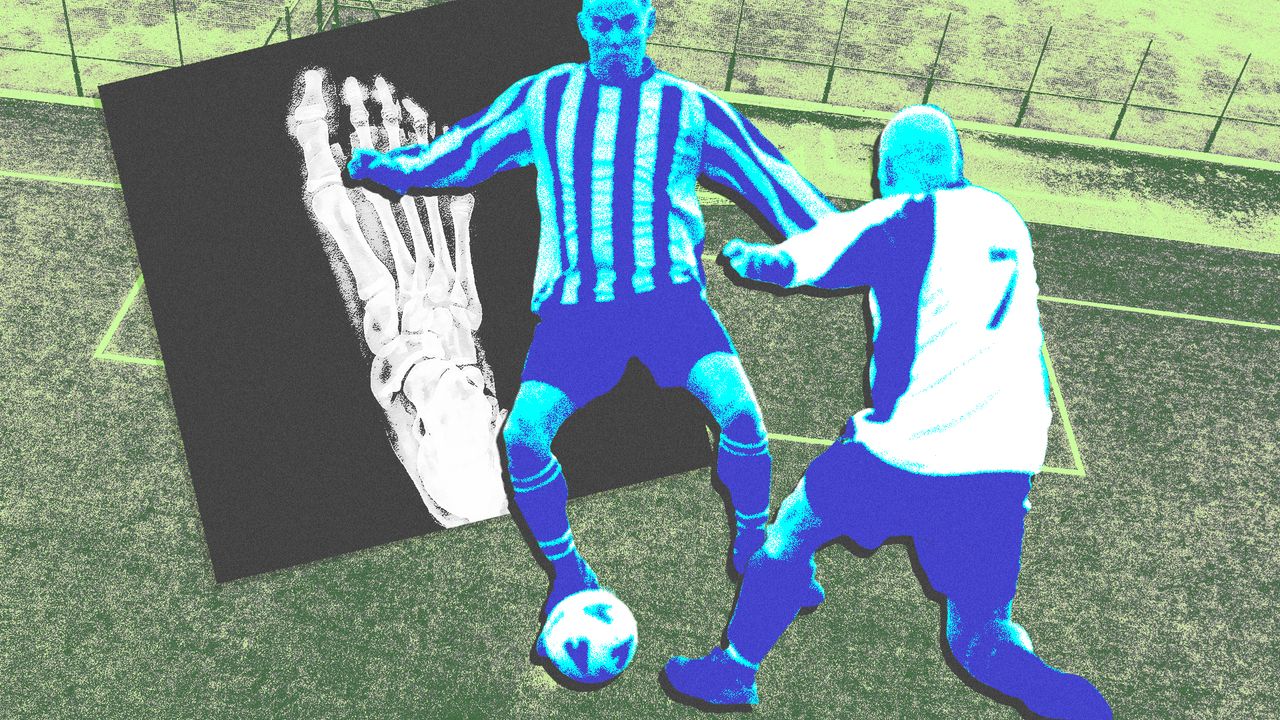
You may not be able to halt the march of time, but you can slow its toll on your body. Experts share the best training techniques to keep you off the bench.Composite: GQ / GettyAt 38 years old, I’ve been fortunate enough to go most of my life without being bothered by sports injuries, despite being consistently and competitively active for the better part of three decades. On the soccer field, I’ve played on and off at club level since primary school. (I’m currently holding it down as a winger on my local club’s 30+ “seniors” team.)Meanwhile, as a health journalist and all-around enthusiastic exerciser, I’ve thrown myself at countless physical challenges—mostly for fun, sometimes to help pay the rent. Marathons, trail races, triathlons, 24-hour relays, mud runs, obstacle course races, Hyrox—you name it, I was probably obsessed with it for a time. And through it all, the only injury I ever incurred was a torn meniscus (the undignified result of attempting a wildly above-my-paygrade basketball dunk on a charitably lowered rim, at a promotional event). If only the surgeon could have extracted the memory of that day along with the frayed connective tissue he removed from my knee. I’m pretty sure I was wearing jeans, too.All of this to say, everything was smooth sailing for a very long time, until it suddenly wasn’t. Somewhere around the age of 35, for reasons beyond my comprehension at the time, the wheels started to come off the bus. First, a stress fracture to my foot. I noticed it one night in bed and couldn’t tell you when it happened. Regardless, it put me in a boot for three months.Next, a torn hamstring during a routine game of pick-up football, making the same run I’d made so many times before. I thought I’d just pulled it, so I kept playing, which of course only made it worse. That decision cost me six months. Then a strained calf muscle at a gentle session of run club. And, finally, shin splints. I don’t even remember how many months that one took me out for, but it felt like forever.This barrage of sports injuries—all sustained within a roughly two-year period—was unrelenting, each overlapping pang seemingly passing the baton to the next. Needless to say, I was miserable. And the worst part was that I couldn’t understand why this was happening to me. I had been maintaining the same activity level, same diet, same supplements, and the same sleeping habits.You always hear people talking half-jokingly about how getting older takes its toll on the body. But nothing really prepares you for that moment when you start to actually experience it for yourself. It’s existential. Brutal. Depressing, honestly. Sometimes the best way to deal with these spiral-inducing moments is to simply talk to other people dealing with the same thing. So I recently asked my, er, seasoned soccer team’s group chat: What do you do to avoid and manage sports injuries as you get older?Kevin, 40, chimes in first: “There’s no avoiding, mate. Just managing.”“Funnily enough, I’ve actually started doing yoga, which has been great for mobility and stretching out my lower back,” writes Chris, 35, who battles with a recurring quadratus lumborum (QL) issue. “I was always a bit hesitant to give it a go—not because I didn't think it would help, but because I couldn't get past the fact that I'd essentially be following a similar exercise plan to my mum! I think that’s been one of the bigger adjustments as I’ve gotten older: accepting that looking after your body sometimes means doing things you might have previously associated with an entirely different generation.”“For me, I think the most important thing is to keep going in general,” adds Brian, who recently turned 42. “I remember when I was around 20 years old, my manager at the time, who was in his late 30s and retired from playing, was doing some running on his own before the team training session started. The lads were joking and teasing him about making a comeback, but I remember him saying, ‘If you stop moving at my age, you won't be able to start again.’ I think that’s good advice.”In some way, I suppose it’s comforting to know that this is something we all have to deal with, whether you’re a Sunday league bench warmer or in contention for the Ballon d’Or. "With age, there’s just a higher incidence of soft-tissue injuries as your muscles lose strength and elasticity,” says Dr. Brian Forsythe, a sports medicine surgeon, associate professor at Rush University Medical Center, and recreational soccer player himself. According to Forsythe, who also serves as head orthopedic officer for MLS team Chicago Fire FC and president of the Professional Soccer Physicians Society, over time athletes across the skill spectrum will ultimately begin running into the same injuries.You may not be able to halt the inevitable march of time, but there are certainly ways to minimize and slow its toll on your body. This requires some work but could ultimately be the difference between hanging up your boots and kicking on for another 10, 20, or even 30 years.“It's up to you to take some responsibility,” Forsythe says. “Think about the lifestyle you had when you were 17 or 18—how you took care of your body and what you looked like. Then look in the mirror and ask yourself, ‘How much of my life now resembles what it was then?’ If you’re going out and having a few pints, understand that that inhibits your recovery and decreases protein synthesis. If you’re overweight, that has effects beyond just not looking great in your clothes. It’s increased joint load, increased rotational torque. You’re more likely to get injured. So you have to set realistic expectations of what your body is capable of doing. But you can definitely still do a lot.”If you’re not ready to call time just yet, here are a couple of strategies you can start implementing today, courtesy of Forsythe and a handful of other experts.5 ways to avoid getting injuredSpend less time sitting“Number one, and it should be obvious, is just general conditioning,” says Forsythe. Being a slightly less sedentary human being during the work week means you won’t send your body into total shock when you decide to get going over the weekend.“A lot of injuries come from that mismatch between what we do all week and the intensity we demand from our bodies on the weekend,” says sports medicine physician Dr. Alex McDonald. As Dr. James B. Chen, orthopedic surgeon at DISC Sports and Spine Center, puts it: “The biggest risk isn't necessarily your age, but your schedule.”Get your weight under control“When you think about playing in your teens and twenties, you were probably close to your ideal body weight,” says Forsythe. Ideal body weight, or IBW, refers to the weight at which your body is able to function most efficiently and without a heightened risk of injury. “All of the forces across your joints are multiplied almost exponentially with additional pounds on your frame,” says Forsythe. For example, “the force across your knee can be up to six times your body weight.”“If you've ever been overweight and you climb up and down stairs and notice that the front of your knee hurts, that's because of those increased pressures and forces,” adds Forsythe.Train the way you playJogging a couple of miles a week may help you get through your Sunday workout our pick-up game, but it’s not doing anything to prevent in-the-moment injuries. To do that, you have to train the way you play—whatever game that is. “It's changes of direction," says Forsythe. It's rapid acceleration and deceleration. It's pivoting, twisting, turning.” Basically, bring back whatever drills you used to do on your sports team when you were younger, and adjust them for the demands of the sport you currently play.Never skip the warm-upNo matter how frequently and comprehensively you train, a complete warm-up before any big athletic event is a non-negotiable. "It helps dramatically, which is why you'll always see professionals warm up for 30-45 minutes before a match,” says Forsythe. When it comes to soccer, FIFA actually has developed a warm-up program, called FIFA ll+, specifically for injury prevention. “It’s a free routine that only takes about 20 minutes, and includes running drills plus strength, balance, and landing exercises such as Nordic hamstring curls and single-leg balance work,” says McDonald. “It’s been shown to cut injuries by about a third, but it needs to be done at least twice a week—ideally three or four times a week—to really reduce the risk of injury.”Stretching after your warm-up is important, too, but just be careful not to overdo it. “If you stretch too aggressively, you can actually predispose yourself to muscle tendon injuries,” says Forsythe. “First warm up, and then stretch out within your range of comfort. But right before a game is not the time to all of a sudden correct tight hamstrings.”Give yourself time to recover and healOften, being sidelined by an injury can be more painful than the injury itself, causing guys to get back out there earlier than they probably should. “A common issue that I see is when someone sustains a minor sprain or strain, and they return to sport-specific activity too early,” says Chen, “which can result in either worsening the injury or even picking up a secondary injury.” As annoying as it might be to sit out for 2 or 3 weeks with a strained hamstring, turning that into a tear will bench you for far longer. Believe me.Playing sports in your 30s, 40s, and beyond also means coming to grips with your body’s increasing need for routine recovery between training sessions and games. "You have to recognize that your body needs more time to recover,” says Forsythe. You may have great cardiovascular fitness and feel ready to play on consecutive days, but your muscles and connective tissues need time to bounce back. “It’s important to respect fatigue, and ensure proper recovery after games or training,” says McDonald.To be fair, this is universally sound guidance regardless of age. But it's advice that tends to take decades to sink in. “I think that one of the key advantages of playing as you get older is that you know your body better in your 30s and 40s,” Brian’s response concluded. “You understand what it's saying to you now. You might not have even listened when you were 21!”A version of this story appeared in British GQ.Not a subscriber? Join GQ to receive full access to GQ.com.Dean Stattmann is a writer for GQ, where he covers health, fitness, and wellness. An award-winning magazine editor and writer with over a decade covering men's lifestyle, Dean has profiled A-listers like Hugh Jackman and Jamie Foxx, reported from behind the scenes at the Tour de France, and skateboarded with ... Read More
How to Avoid Sports Injuries in Your 30s, 40s, and Beyond
Full Article
Original Source
Read the full article at Gq →KhanList aggregates and links to publicly available news content. We do not host full articles from third-party sources. Always verify important information with original sources.