
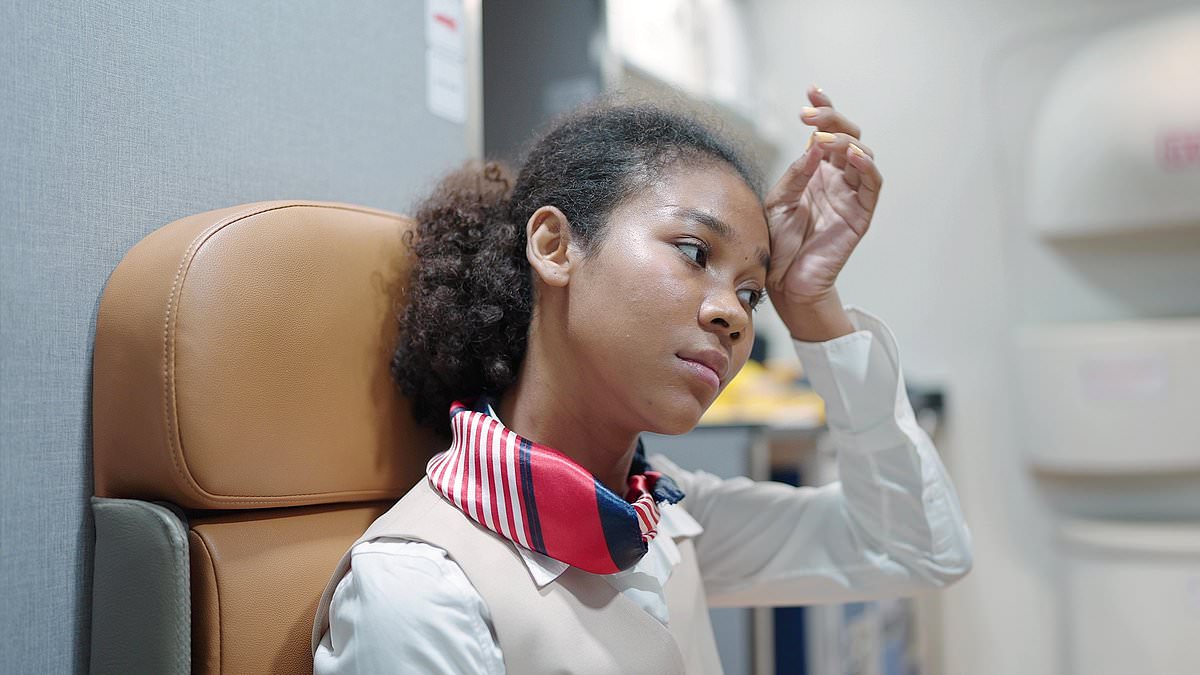
It's no secret that cabin crew work all hours.From 4am starts to overnight international flights and multiple countries in a single day, aviation staff are known for having jam-packed – and unconventional – schedules.But in contrast to careers where the hours are seemingly unlimited (think: banking), pilots, flight attendants and crew have to follow strict regulations when it comes to their time on the clock.And it's not quite as simple as a catch-all rule or an hourly limit.Here, the Daily Mail has spoken to experts and dug into the limitations on aviation staff working conditions, to deduce just how tired your pilot might be. The UK has something called Flight Time Limitations to manage pilot tirednessSo, exactly how long can staff on board a flight work for?Here in the UK, we have something called Flight Time Limitations: regulations designed to manage the risk of crew fatigue in commercial air transport operations. The UK Civil Aviation Authority (CAA) explains them as such: 'They establish limits on flight duty periods, flying hours and standby duties, and set minimum rest requirements to ensure crew members are sufficiently rested before undertaking safety-critical duties. 'FTL requirements apply to commercial air transport operators conducting operations under a UK Air Operator Certificate (AOC).'Different fatigue management requirements apply to certain types of operation, including certain helicopter, air taxi, emergency medical service and single-pilot operations.'This means crew members need to understand the requirements, make appropriate use of rest opportunities and report fatigue hazards and fatigue-related concerns in accordance with company procedures.EASA, which governs European airlines, says: 'The total duty periods to which a crew member may be assigned shall not exceed 60 duty hours in any seven consecutive days, 110 duty hours in any 14 consecutive days; and 190 duty hours in any 28 consecutive days, spread as evenly as practicable throughout that period.''The total flight time limitations for pilots during a month and year are as follows: "100 hours of flight time in any 28 consecutive days, 900 hours of flight time in any calendar year, and 1,000 hours of flight time in any 12 consecutive calendar months."'The number of hours in a row in one day depends on start and end times. Monica Badra, founder and CEO of aviation software firm Aero NextGen, told the Daily Mail: 'Pilot and cabin crew working hours are among the most tightly regulated aspects of commercial aviation. The rules are in place in order to protect anyone working on board'Fatigue is consistently identified as a contributing factor in aviation incidents, which is why regulators on both sides of the Atlantic set strict limits.'In Europe, she summarises, maximum annual flight time is capped at 900 hours.Daily flight duty periods are limited to 13 hours under standard conditions. Minimum rest between duty periods is 12 hours.But what about cabin crew?Monica says: 'Rules are slightly less prescriptive [for cabin crew] than for pilots. Under FAA Part 121, flight attendants must receive a minimum nine-hour rest period between duty periods, with a maximum 14-hour duty day. EASA rules align more closely with pilot limitations.'How much rest do pilots need between flights?'Generally speaking, pilots need 12 hours rest or the length of the preceding duty if it was more than 12 hours. If a pilot was on duty for 8 hours, they would need 12 hours rest, but if they were on duty for 16 hours, they would need 16 hours rest,' according to Flight Deck Friend.The CAA says there is a minimum rest of 12 hours at home base or ten hours away from base, even where the standby may have been up to 16 hours. Early starts, long journeys and demanding tasks can make the job tiringAre there any exemptions? In short, yes.The CAA excludes: 'Air Taxi operators (where they operate aeroplanes of 19 seats or less), Emergency Medical Services, and Single Pilot Operations will be covered by a future rulemaking task.'So, how tired might pilots and crew be on board?Monica says: 'The fatigue reality: the regulations set a floor, not a ceiling. Long-haul operations, back-to-back early starts, and transatlantic flights disrupt circadian rhythms in ways that leave crews within legal limits but genuinely fatigued. Are there any other surprising rules for working on board? Height requirements! Most airlines look for cabin crew between 4 feet 11 inches and 6 feet 4 inches tall.Cabin crew must wear watches for emergency procedures, to help them keep track of the exact time. Some airlines prohibit their crew from certain activities between routes, such as bungee jumping 'Airlines are now also required to implement Fatigue Risk Management Systems beyond basic hour counts.'Joji Waites, director of flight safety, policy and regulation at The British Airline Pilots' Association, BALPA, has issued a stark warning: 'At BALPA, our members are experiencing increased demand for flights and tighter schedules, both of which are contributing to a growing risk of fatigue. 'We are increasingly seeing Flight and Tuty Time Limitations (FTL) treated as targets rather than the absolute maximums they are intended to be. 'This raises questions about whether the current rules, and how they are interpreted, remain fit for purpose. The ongoing CAA FTL review provides the opportunity for such questions to be considered.'We are working with our members to build a representative picture of fatigue levels across the industry. 'This evidence will help us continue to push for meaningful FTL improvements and ensure that fatigue management keeps pace with the realities of modern aviation.'
How tired is your pilot? Experts lift the lid on the strict rules designed to prevent fatigue in the cockpit
Full Article
Original Source
Read the full article at Dailymail →KhanList aggregates and links to publicly available news content. We do not host full articles from third-party sources. Always verify important information with original sources.