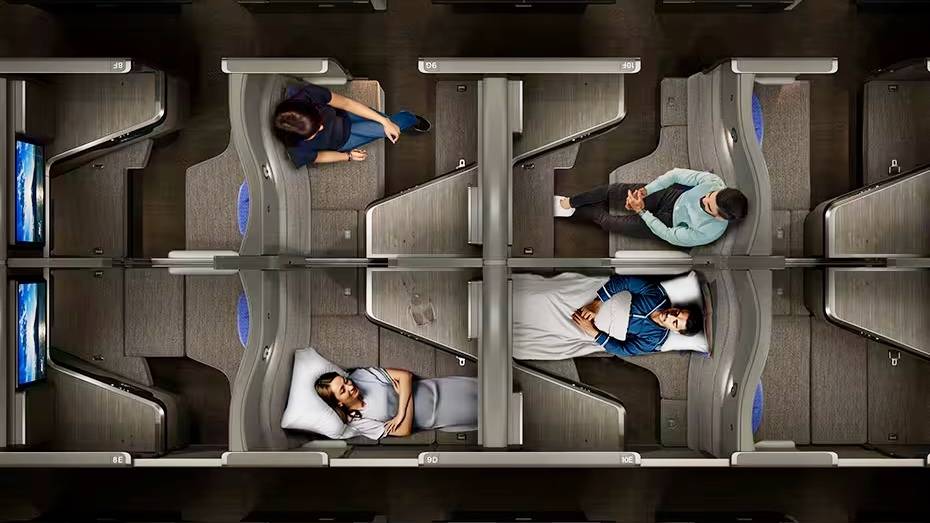
Published Jul 18, 2026, 1:00 AM EDT Brandon's passion for aviation started at a young age. Growing up, he was involved in the flight simulator and VATSIM communities, and he went on to earn his private pilot license while in college. Brandon holds a BSE in computer science and currently works as a software engineer. Outside of work, he continues to build flight hours and explore new airports around the country. ANA's "The Room" business class, available on select Boeing 777-300ERs since 2019, is one of the widest business class products in commercial aviation. The suite measures up to 38 inches (97 cm) at its widest point, roughly double the width of most competing business class seats, achieved through a sofa-style design and a lower seat count than the industry standard. In August 2026, ANA will begin flying an evolved version of the product on the Boeing 787-9. The Room FX adapts the sofa concept for the 787's narrower fuselage and is even wider than the 777's original at up to 41.5 inches (105 cm), with a longer bed and updated technology. Three aircraft will carry the product by year-end, with retrofits of 16 existing 787-9s starting in 2027. What ANA's "The Room" On The 777 Looks Like ANA introduced The Room on its Boeing 777-300ER fleet in 2019, and it remains one of the widest business class products in commercial aviation. The suite measures up to 38 inches (97 cm) at its widest point, with a waist-area width of 27 inches (69 cm). The bed extends to approximately 72 inches (183 cm) in length. ANA installs 64 of these suites in a 1-2-1 configuration, giving every passenger direct aisle access. Each suite includes a privacy door. The reason The Room is so much wider than competing business class seats comes down to what ANA chose to prioritize. Most airlines optimize their business class cabin to fit as many lie-flat seats as possible within the available fuselage width, typically installing 30 to 48 seats in the same space. ANA went in the other direction, reducing seat count to 64 on the 777-300ER and giving each suite a floor area that competitors reserve for first class products. The lower density means fewer business class fares per flight, which affects revenue on routes where demand would support a tighter layout. ANA accepted that trade-off in exchange for a product that stands apart from everything else in the category on raw dimensions. The Room is currently installed on 10 of ANA's 13 international 777-300ERs, operating long-haul routes from Tokyo to destinations including New York, London, Frankfurt, and Los Angeles. Since its launch, it has consistently ranked among the best business class products in the world in industry surveys and passenger reviews, competing directly with Qatar Airways' QSuite for the top position. The product's reputation is built primarily on the width and overall sense of space in the suite rather than on technology or soft product, though both are competitive. Why The Sofa Design Produces More Space Than A Conventional Lie-Flat Seat Credit: Shutterstock A conventional business class lie-flat seat is a chair that reclines backward into a bed via an electric motor and track mechanism. The reclining hardware sits underneath and behind the seat, and the width of the sleeping surface is constrained by the width of the chair it converts from. A seat that measures 21 inches (53 cm) wide in the upright position produces a bed that is the same width in the flat position. The Room on the 777 still uses an electric recline mechanism, but ANA achieved its width advantage primarily through lower cabin density. By installing 64 seats where other airlines would fit 80 or more, each suite gets a larger share of the available cabin width. The result is a suite that is roughly twice as wide as most competing products despite using the same basic reclining hardware. The Room FX on the 787 goes a step further by removing the recline mechanism entirely. The seat uses a pre-reclined sofa-style design with a fixed backrest, similar to Finnair's AirLounge concept. When a passenger wants to sleep, the leg rest flips upward manually to create a flat surface. Eliminating the motors, tracks, and articulating frame reduces the seat's weight and structural footprint, which is part of how ANA achieved a suite that is 41.5 inches (105 cm) at its widest on the 787's narrower fuselage. The trade-off is that some passengers prefer a traditional electric recline to a fixed backrest position, and the no-recline design has been a point of debate since Finnair introduced the concept. What Changes With The Room FX On The 787-9 Credit: All Nippon Airways The Room FX adapts the sofa concept for the Boeing 787-9, which has a narrower fuselage than the 777-300ER. The 787-9's interior cabin width is approximately 18 feet (5.5m) compared to the 777's 19 feet 3 inches (5.9 m), which means the suite design had to be reworked rather than simply scaled down. ANA developed The Room FX in partnership with Safran Seats and British design firm Acumen, the same team behind the original product. The FX designation stands for Future Experience. The Room FX measures 27 inches (69 cm) at the waist and up to 41.5 inches (105 cm) at its widest point, which is actually approximately 4 inches (10 cm) wider than The Room on the 777. The bed extends to 76.5 inches (194 cm), a meaningful improvement over the 777 version's 72-inch (183 cm) bed that was frequently cited as the original product's main shortcoming for taller passengers. ANA achieved the wider suite and longer bed on a narrower aircraft through thinner privacy doors and partition walls, curved backrests that use less space, and an alternating forward and rear-facing seat arrangement that allows each suite to occupy a larger share of the available cabin width. Each suite includes a full-height privacy door, a 24-inch (61 cm) entertainment screen with Bluetooth audio pairing, wireless charging, and USB-C and USB-A ports. The leg rest flips upward manually to convert the suite into a flat bed. ANA will install 48 suites per 787-9 in a 1-2-1 layout, with only 24 seats between doors 1 and 2. Total aircraft capacity drops from 215 seats on current 787-9s to 206 on Room FX-equipped aircraft, with the reduction coming entirely from economy. How The Room FX Compares To Competing 787 Business Class Products Credit: ANA The Room FX enters the 787 business class market, where several other carriers are also introducing new products in 2026 and 2027. The comparison illustrates how differently airlines can use the same fuselage. United's Elevated 787-9 carries 64 Polaris Suites and 8 Polaris Studio suites, for a total of 72 lie-flat business class seats. The seats measure approximately 20 inches (51 cm) wide with beds of 76-77 inches (193-196 cm) in standard Polaris. American Airlines' 787-9 Flagship Suite configuration features 51 business class seats at approximately 22.5 inches (57 cm) wide. Riyadh Air's 787-9 carries 32 business class seats, including 4 larger Business Elite seats, measuring 22.5 inches (57 cm) wide and 78 inches (198 cm) in bed length. The difference in density is most visible in the forward cabin section between doors 1L and 2L, where most airlines concentrate their business class. ANA installs 24 business class seats in that section, eight fewer than United's 32 Polaris Suites in the same space on its Elevated 787-9. Both aircraft have the same fuselage cross-section and the same distance between the two door sets. ANA uses that space for wider suites with more floor area per passenger. United uses it to fit a third more seats. The choice reflects fundamentally different commercial strategies. United maximizes premium seat count to generate revenue across as many positions as possible. ANA reduces seat count to deliver a suite that is measurably wider than anything else on the aircraft type. The bed length comparison is closer. The Room FX's 76.5 inches (194 cm) is comparable to United's 76-77 inches (193-196 cm) and slightly shorter than American's 78 inches (198 cm) and Riyadh Air's 78 inches (198 cm). Where The Room FX separates from the field is width. No other 787 business class product comes close to matching it on that dimension, which is the metric ANA has built its premium identity around. When & Where Passengers Can Fly The Room FX Credit: Shutterstock ANA expects the first Boeing 787-9 equipped with The Room FX to enter service in August 2026, with three aircraft delivered and flying by the end of the year. All three are new deliveries from Boeing rather than retrofitted existing aircraft. ANA has not confirmed which routes will receive the product first, though Tokyo Haneda departures to North American and European destinations are the most likely candidates given ANA's existing long-haul 787-9 network. The retrofit program covers 16 existing international 787-9s and is scheduled to begin in 2027. ANA has not committed to a completion date for the full retrofit, and the pace will depend on how long each aircraft is out of service for the cabin installation. The airline currently operates 35 international 787-9s, with an additional 27 on order. All future deliveries in the international configuration will carry The Room FX as standard, meaning the product will eventually cover a significant share of ANA's long-haul network rather than remaining limited to a handful of aircraft as The Room has been on the 777.
How This Major Airline Is Creating The Most Spacious Business Suite In The Sky
Full Article
📰 Original Source
Read full article at Simpleflying →KhanList aggregates and links to publicly available news content. We do not host full articles from third-party sources. Always verify important information with original sources.