
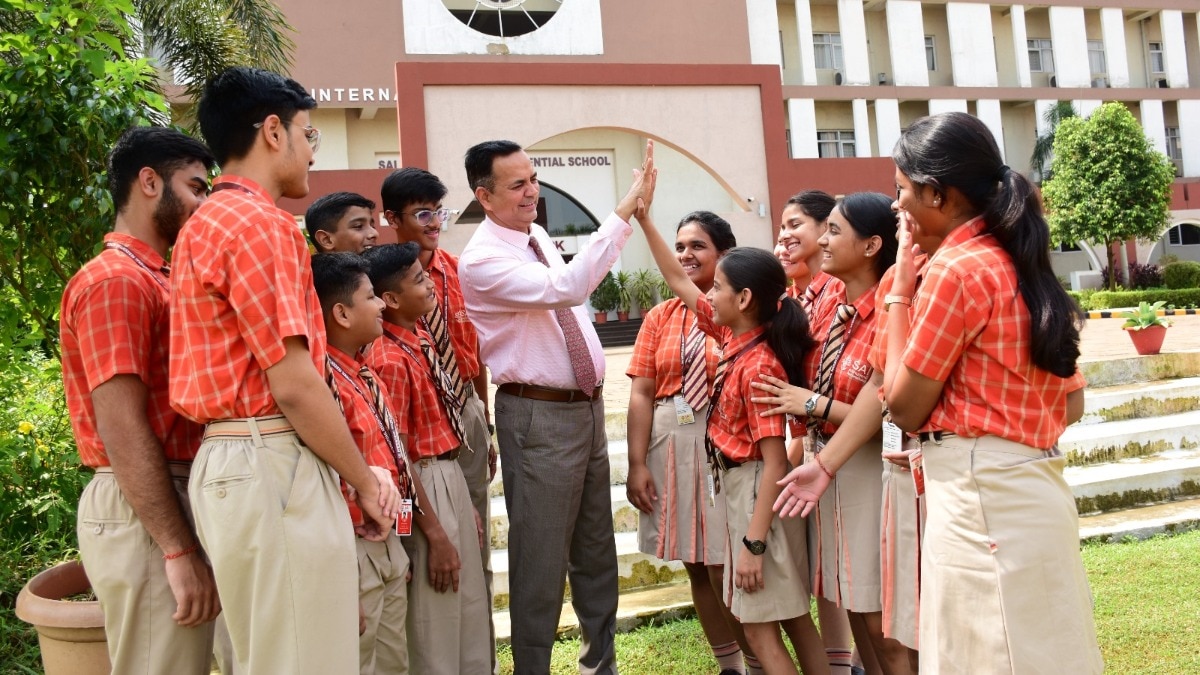
At SAI International Residential School, students are encouraged to treat setbacks as part of learning. The approach aims to build resilience, empathy and independent thinking beyond marks.SAI International School headmaster with students (Image: Special arrangement)In a school system where marks, ranks and exam results can often become the measure of a child’s success, Amitabh Agnihotri wants his students to learn something else too: how to fail without feeling defeated.The Headmaster of SAI International Residential School in Cuttack, Odisha, believes a setback should not become a verdict on a child’s ability. Instead, students should be encouraged to experiment, make mistakes, reflect on what went wrong and try again. Agnihotri has over three decades of experience in education.“Failure is a part of the journey, never the destination,” Agnihotri says.That philosophy is reflected in the way students at the residential school are encouraged to explore interests beyond the conventional academic path. The idea is not to remove academic rigour, but to give children enough freedom to discover where their strengths lie. SAI International School students discussing a project (Image: Special Arrangement) THE SHY CLASS 9 STUDENT WHO FOUND HER CONFIDENCEOne of the examples Agnihotri cites is Manvi Agarwal, the school’s first Head Girl.Manvi joined SAI International Residential School in Class 9 as a shy and unassuming student. "Through grit, perseverance, self-belief and opportunities available to me, I went on to top both Classes 10 and 12 and eventually secured admission at the IIT Madras," Manvi says.Her journey, Agnihotri adds, shows why schools should not assume that a child’s potential is immediately visible through marks or classroom performance.The discovery of a student’s “spark”, he says, often comes through exploration and trial and error. At the school’s annual Founder’s Celebrations, for instance, a child hesitant to go on stage may discover a passion for performing, another may find confidence through sport, while someone else may uncover an intellectual interest in the classroom."The role of the school is not to decide what that spark should be, but to create the space for students to find it themselves," he adds.Dr Silpi Sahoo, Chairperson of SAI International Education Group, believes this requires schools to rethink how they define success in the first place. Marks, she says, are only one measure of learning and cannot capture a child’s abilities, potential or worth.“Every child has different abilities, interests, strengths and ways of learning,” she says, adding that students should also get opportunities to demonstrate their abilities through research, sports, arts, leadership, communication, community engagement and real-world problem-solving. Schools under SAI International Education Group (Images: Special Arrangement) THE COMMERCE STUDENT WHO EXPLORED SPACE SCIENCEA more unusual example is Class 11 student Miththu Kanu.A Commerce student, Miththu pursued an interest in astronomy outside his academic stream. He qualified for the Tata Steel Young Astronomer Talent Search Programme through an astronomy quiz and a model presentation based on the Gaganyaan mission.He emerged among the top finalists and earned an educational exposure visit to the Indian Space Research Organisation. At the Satish Dhawan Space Centre, he got to see the Mission Control Centre, launch pads, rocket systems and tracking facilities.The experience, Agnihotri says, became a moment of discovery for Miththu, strengthening his scientific curiosity and interest in innovation.It is precisely this kind of exploration that the school wants to encourage — even when a student’s interest does not neatly fit into the stream they have chosen. The idea extends beyond academic curiosity.“I have a strong inclination towards the business field, so I chose Commerce. But I was also interested in the ISRO project and wanted to do it. I just felt like exploring something different from what I study. I thought it would be interesting to take up the project and see where it leads, so I went for it," says Mithu, on why he took up the project despite being a Commerce student.At SAI, empathy is also seen as an essential part of preparing children for the future."Education must nurture the human dimension — empathy, integrity, resilience, communication, leadership and respect for diversity — alongside academic and technical skills," Dr Sahoo says. Dr Sahoo with students Vikram Aditya Sahoo, Director–Research and Innovation at SAI International Education Group, similarly stresses the importance of listening with empathy, understanding people and communities, and using what students learn to make a difference."For the school, therefore, learning to fail is not only about becoming resilient; it is also about becoming more understanding, grounded and responsible," Vikram adds.WHEN A MISTAKE BECOMES THE BEGINNINGDr Sahoo says moving beyond a marks-driven culture does not mean lowering academic expectations. Instead, schools need to recognise that academic excellence and holistic development can coexist.At SAI, she says, the teacher’s role is also changing. A teacher is not simply someone who supplies answers, but a facilitator who asks questions and creates an environment where students feel comfortable expressing ideas, making mistakes and trying again.That approach extends into everyday classroom learning."Science lessons can involve experiments and questions rather than simply recalling concepts. Mathematics can allow students to explore different ways of solving a problem instead of searching for one prescribed method. Literature and social sciences can encourage students to form opinions and question assumptions," the headmaster says, adding that through platforms such as SAITED, students can work on scientific and technological challenges. SAIMUN gives them opportunities to develop research, critical thinking, negotiation and diplomacy, while UNWIND allows them to create, perform, collaborate and lead. Activities by SAI Angan (kindergarten school of SAI) (Image: Special Arrangement) Students also work on publications including SAI Arthashastra, Vistarika, Aitihya and Chakravyuh, taking ideas through research, writing, design and editing to finished magazines. Business-model competitions similarly ask students to examine whether a problem is real, who it affects and whether their proposed solution can create value, he adds.The larger message is that an unsuccessful prototype, an idea that needs redesign or an attempt that falls short is not necessarily a dead end. It can be the point at which learning begins.The larger purpose, according to Dr Sahoo, is to help children become independent thinkers who can navigate uncertainty rather than students trained only to produce correct answers. Students participating in other activities (Image: Special arrangement) FAILURE WITHOUT THE FEAR OF FAILUREAgnihotri is careful not to present failure as something students should seek for its own sake. The message is that failure is inevitable when children experiment — and it should not automatically damage their confidence.At a residential school that brings together children from different backgrounds, experiences and aspirations, he says the responsibility is to understand each child and help them find their own path.“A child who is happy, confident and at peace with oneself is far more successful than one caught in an endless pursuit of achievement,” he says.Students are encouraged to set meaningful goals and work hard towards them, but also to accept setbacks with grace. Falling short of a target is not considered shameful; what matters is what the student learns from it and how they respond.This philosophy also aligns with the school group’s broader emphasis on experiential learning. Students are encouraged to identify problems, experiment with solutions and understand that an unsuccessful prototype or an idea that needs redesign is not necessarily a failure in the final sense.Vikram describes this as part of being “future-ready”. Students need curiosity, creativity, critical thinking, adaptability and resilience because the future rarely comes with clear instructions.For Agnihotri, the ultimate competition is therefore not between one student and another. Students in a science lab “Every child at SIRS is being groomed to become a Champion – not by competing against others, but by becoming a better version of oneself,” he says.In a system where children can easily begin to equate a score with their self-worth, his message is simple: failing at something does not make a child a failure.It simply means there is still something left to learn, change and try again.- EndsPublished By: Mridusmita DekaPublished On: Aug 28, 2026 15:06 IST
How this headmaster is teaching students that it is okay to fail
Full Article
Original Source
Read the full article at Indiatoday →KhanList aggregates and links to publicly available news content. We do not host full articles from third-party sources. Always verify important information with original sources.