
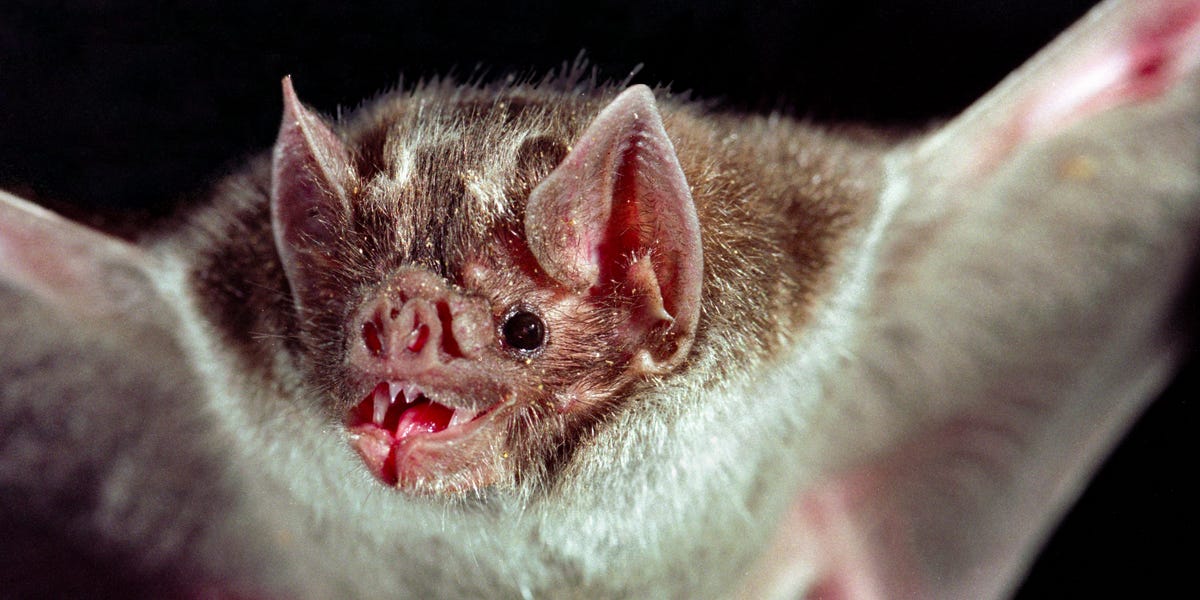
Misunderstood and often maligned, vampire bats are saddled with a reputation akin to that of Nosferatu and Dracula just because they feed on blood. But unlike the vampires of movies and folklore, they don’t drain their victims. These tiny creatures couldn’t possibly hold all the blood that’s inside the much larger mammals they feed on after dark. Still, they can still consume a seemingly supernatural amount because their stomachs are built to expand.Because vampire bats only feed on blood, they’re the only obligate sanguivores among mammals and, in fact, among all tetrapods—since their wings are modified forelimbs, they still count as four-limbed animals. When night falls, they fly out to forage, sometimes drinking up to half their own body weight in blood, thanks to those expandable stomachs and kidneys that quickly get rid of excess fluid. The problem is that blood is a poor diet. It’s mostly water, with plenty of protein but potentially toxic levels of iron, and only traces of sugar and fat. Even so, it’s the only food vampire bats will ever know. Once the young of all three living species are weaned off milk, they switch entirely to blood. They start sinking their teeth into unsuspecting victims, mostly sleeping livestock, which feel little more than a mosquito bite.Evolutionary genomicist Michael Hiller of the Senckenberg Research Institute in Frankfurt, Germany, wanted to learn how these fascinating creatures are genetically programmed to live on blood alone. He and his research team set out to identify the changes in genes and gene expression that made this possible. They analyzed the genomes of the common vampire bat (Desmodus rotundus), the hairy-legged vampire bat (Diphylla ecaudata) and the white-winged vampire bat (Diaemus youngi), and compared them with the genomes of other bat species. By analyzing gene expression in six major organs, including the stomach, they found several anomalies. Vampire bats’ stomachs were so different from those of other bats, and other animals, that they were almost a different organ entirely.“Extreme dietary specializations impose strong and persistent selective pressures in nature, forcing organisms to reconcile severe nutritional imbalances with existing physiological and metabolic constraints,” Hiller and his colleagues wrote in a study recently posted to the preprint server bioRxiv. “Deciphering how genomes adapt to such conditions reveals general principles of the evolutionary processes that remodel metabolism and physiology.”Among the roughly 30,000 known tetrapod species, dependence on blood, known as obligate sanguivory, has evolved only once. Because blood offers so few calories for its volume, vampire bats have to drink large amounts of it. Because it also contains so little sugar, the bats have low baseline insulin levels and release little insulin after a meal. Some aspects of this metabolic situation resemble type 2 diabetes in humans, so studying these bats could lead to better treatments in the future. Much like fictional vampires, vampire bats also need to feed often. They have a very limited ability to store fat and glycogen, so they can starve if they go 48 to 72 hours without a blood meal. To prevent this, bats that have fed successfully sometimes regurgitate blood for roost mates that haven’t eaten that night.The genomic shifts behind vampire bats’ sanguivory include changes in genes for digestion, metabolism and immunity, as well as the loss of bitter taste receptors. The vampire bat stomach in particular has adaptations found only in these three species. Its enlarged size is linked to three upregulated genes. These genes are also thought to play a role in the bats’ unusually shaped gastric glands and in extra connective tissue that makes such huge expansion possible. Most mammals use stomach acid to digest food, but vampire bats’ genes for producing gastric acid are suppressed. Digesting so much blood would take an enormous amount of acid, and the specialized mucus lining their stomachs leaves them vulnerable to acid damage. So over the course of their evolution, their stomachs shifted from digesting food to absorbing it.Adaptations elsewhere in the body also help these winged vampires survive on their unusual diet. Insect-eating bats have an enzyme for digesting insect sugars that their vampire relatives lack. Vampire bats get hardly any sugar, so they have no need for it, which fits with their low insulin output. Vampire bats have also lost several genes that control gut movement in other species, but that matters little for an animal whose diet is a single liquid with little, if any, indigestible material. Similarly, having fewer fat-digesting enzymes is no disadvantage, since blood contains hardly any fat. Meanwhile, genes for coping with blood’s excess iron are enhanced. Vampire bats also rely more on their intestines to absorb amino acids and on their kidneys to reabsorb them, which keeps amino acids from being lost in urine.Studying genomes and gene expression across several organs together was key to these findings. “This integrative approach was essential for obtaining a comprehensive view of the molecular changes associated with sanguivory in vampire bats,” Hiller said. “More generally, our work demonstrates how genome-wide, integrative analyses can yield molecular insights into the evolution of adaptive traits.”Elizabeth Rayne is a creature who writes. Her work has appeared in Popular Mechanics, Ars Technica, SYFY WIRE, Space.com, Live Science, Den of Geek, Forbidden Futures and Collective Tales. She lurks right outside New York City with her parrot, Lestat. When not writing, she can be found drawing, playing the piano or shapeshifting.
How This Creepy Critter Evolved Its Way to Surviving on Blood Alone
Full Article
Original Source
Read the full article at Popularmechanics →KhanList aggregates and links to publicly available news content. We do not host full articles from third-party sources. Always verify important information with original sources.