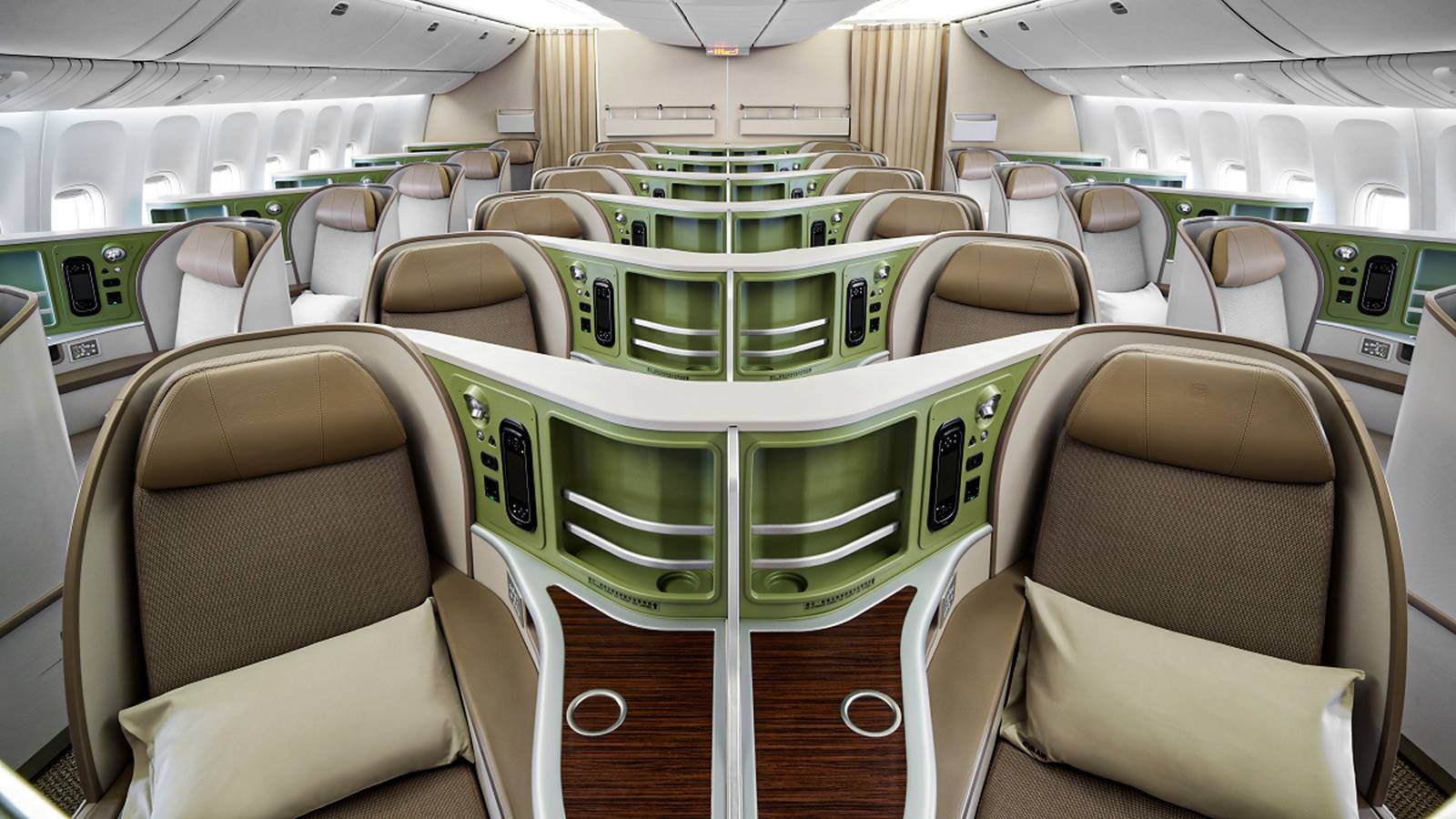
Published Jul 18, 2026, 11:00 PM EDT Louis is a military historian and the staff writer for History of War magazine, a leading military history monthly. He also has an interest in private and commercial aviation. EVA Air's routes from Taipei Taoyuan International Airport (TPE) to John F. Kennedy International Airport (JFK), lasting 17 hours, make use of the carrier's Boeing 777-300ERs. These aircraft have 38 or 39 of EVA's Royal Laurel business class seats onboard. They are configured in a 1-2-1 reverse herringbone layout, ensuring each passenger has direct access to the aisle. Most of the long-haul premium aviation industry looks to firms like Singapore Airlines and Qantas. They offer business class seats on routes exceeding 19 hours. Meanwhile, EVA has quietly built a market for routes of almost this length and a higher premium density. The Ultra-Long-Haul Routes Offering This Premium Density Credit: Shutterstock There are three flagship ultra-long-haul routes that make use of the premium-dense 777-300ER. It is also common for these routes to use the Boeing 787-9. The first is from TPE to JFK. This route has a flight time of 17 hours and 15 minutes. Around an hour shorter is the route from TPE to Toronto Pearson International Airport (YYZ), Canada's largest and busiest aviation hub. At 15 hours and 30 minutes is the route from TPE to Chicago O'Hare International Airport (ORD). There are a number of additional destinations that EVA flies its premium dense 777-300ERs to, all of which are in North America. Examples in the US include Dallas/Fort Worth International Airport (DFW), Houston George Bush Intercontinental Airport (IAH), and Washington Dulles International Airport (IAD). The latter is being introduced this summer. 777-300ERs also fly to Vancouver International Airport (YVR) north of the border. The high business aviation market between Taiwan and North America is driven by the close geopolitical and economic relationship shared by the USA and Taiwan. Taiwan is currently the USA's ninth-largest trading partner, while the US is Taiwan's second-largest trading partner. The linchpin of this relationship is Taiwan's position in the microchip and superconductor industries, and the research & development partnerships that the two countries share. The Premium 777-300ER Credit: Shutterstock The 777-300ER entered EVA's fleet due to its first major long-haul fleet renewal, which began in 2000. The airline purchased four firm commitments for the aircraft, with an additional eight options, giving it a position as one of the jet's launch customers. It converted the eight options into firm orders in 2004, and the airline's first 777-300ER came into service in July 2005. The carrier now has 41 Boeing 777s in its fleet, according to Planespotters.net data, making it EVA's most numerous family of aircraft within its fleet of 89 jets (including 72 widebody planes). The table below shows the number of seats available in each class for each of EVA's 777-300ER layouts. It makes use of data from EVA's seat map. While the Royal Laurel offering is consistent, there is more variation in what is available for premium economy and economy passengers: Layout Royal Laurel (business) Premium economy Economy Total capacity 77M 38 64 221 323 77A 39 56 238 333 77B 39 56 258 353 2007 saw the carrier introduce a major ultra-long-haul 777-300ER route for which premium dense 777-300ERs would be essential. The flight was from Taipei to Newark Liberty International Airport (EWR). EVA is now looking to move away from this aircraft in its passenger fleet. It has begun work to convert three 777-300ERs into freighters. The airline has also made orders for 24 Airbus A350-1000s to replace its outgoing 777-300ER and notably has made no Boeing 777X orders. EVA Was Also The First Carrier To Introduce Premium Economy On Long-Haul Flights Credit: EVA Air | Simple Flying Also available on EVA's premium dense 777-300ERs is premium economy, which is unsurprising given that the airline was the first to introduce premium economy to the long-haul market. It was introduced on a Boeing 747-400 flight from Taipei to Los Angeles International Airport (LAX) under the name Evergreen Deluxe Class. The title is sometimes given to Virgin Atlantic, but EVA was the first to have a true premium economy product with unique catering, seating, and amenities. These passengers also had personal television screens available. EVA's product was quickly successful, showing that passengers without the means or desire to fly in business class could be motivated to pay an additional 20% to 30% for an increase in comfort and service quality. EVA is now on its fourth generation of premium economy products. The table below shows what is available for EVA premium economy passengers flying on the carrier's 787-9s. All the figures represent a substantial improvement from what has been available in each previous generation: Configuration 2-3-2 Seat pitch 42 inches (107 cm) Seat width 19.5 inches (49.5 cm) Screen size 15.6 inches (39.6 cm) HD touchscreen Recline 8 inches (20.3 cm) The fourth-generation premium economy is only available on EVA's Dreamliners. Passengers using the product aboard its 777-300ER will be sitting in its previous-generation premium economy. This has a 2-4-2 layout, meaning that more passengers per row don't have direct aisle access. An Overview Of The 777-300ER Credit: Shutterstock EVA is able to offer its passengers such a premium dense layout aboard its 777-300ERs because of the aircraft's unique capabilities. This plane developed on the 777 family, which debuted with United Airlines in 1995. It expanded on the Boeing 777-200ER, which had added fuel capacity and maximum takeoff weight to allow carriers to fly the jet further. The 777-300ER featured an upgraded General Electric GE90 engine, without Pratt & Whitney and Rolls-Royce options, a strengthened landing gear, and raked wingtips for better efficiency. This aircraft has a maximum takeoff weight of over 700,000 lb (318 tons). It has now become the best-selling 777-300ER variant with 833 delivered, although this figure will be overtaken by the Boeing 777-9, if the 521 ordered ever get delivered. The 777 is the widest operational commercial aircraft in production. The vertical sidewalls also create the impression of more room. This width allows carriers like EVA to cram more seats into the cabin without high-paying premium passengers feeling claustrophobic. EVA is committed to giving passengers space across all classes. Alongside Singapore Airlines, Japan Airlines, and Air India, EVA is one of few airlines that doesn't force economy class 777 passengers into ten-abreast seating. What Is Available Aboard EVA's 777-300ER Business Class? Credit: Josh Wood | Simple Flying EVA's 777-300ER business class seats are in a 1-2-1 reverse herringbone configuration. Each seat is set 60 inches (152 cm) back from the seat in front, with the pitch growing substantially when the seat is converted into lie-flat. Things are more cramped if you fly in Royal Laurel aboard EVA's A330s. These seats are in a 2-2-2 layout. Superb amenities are available to all Royal Laurel passengers. This includes an amenity kit with premium skincare products, loungewear, and noise-canceling headphones, along with plush bedding. Adjustable light settings also help you to get comfortable when it's time to sleep. EVA's business class cabin crew are known for providing attentive and efficient service, which is sensitive to the cultural needs of each passenger. They'll be particularly helpful during meal times. The exact food available will depend on the route you are flying on and when. EVA has built a menu working with famous Taiwanese restaurants like Kanpai Classic, the nation's first restaurant specializing in Australian Wagyu, and Kanpai Yakiniku Restaurant. An example of delicacies commonly available includes the braised beef noodle soup and the lychee and strawberry bread. On the ground, Royal Laurel passengers have access to exclusive lounges to enjoy a relaxing pre-flight meal or show, or get some work done. EVA operates lounges at TPE, Kaohsiung International Airport (KHH), and Bangkok Suvarnabhumi Airport (BKK), and you'll be able to use Star Alliance member lounges when flying from other airports. What Simple Flying's Trip Reviewers Are Saying About EVA's Business Class Credit: EVA Air Creating a large business class cabin is meaningless if passengers are not being offered a high-quality product. Last summer, Simple Flying's Sumit Singh flew from London to Taiwan, via Bangkok, aboard EVA's 777-300ER business class. Sumit began his experience by making use of the United lounge at London Heathrow Airport's (LHR's) Terminal 2. Lounges like this are available to EVA's business class passengers due to its position in Star Alliance. After being shown to his seat, Sumit was impressed by the roomy 26 inches (66 cm) of width and 82 inches (208 cm) of pitch available. He was able to get comfortable easily when fully reclined, aided by the cushion, designer pajamas, mattress, and duvet. Sumit also enjoyed the food and wine available during the meal service, particularly given his gluten intolerance. Sumit concluded his review by writing, "Europe to Southeast Asia is always a long-haul stretch, no matter the route, but there aren't many better ways to sit back and enjoy the ride than EVA Air's Royal Laurel Class." Simple Flying reader Cloudswimmer agreed with Sumit's sentiments, commenting, "I flew that exact same route from LHR to TPE a few years ago and it was definitely the best business class experience of my 2.5 million miles of worldwide air travel."
How This Airline Packs 39 Business Class Seats Into A 17-Hour Flight Nobody Talks About
Full Article
📰 Original Source
Read full article at Simpleflying →KhanList aggregates and links to publicly available news content. We do not host full articles from third-party sources. Always verify important information with original sources.