
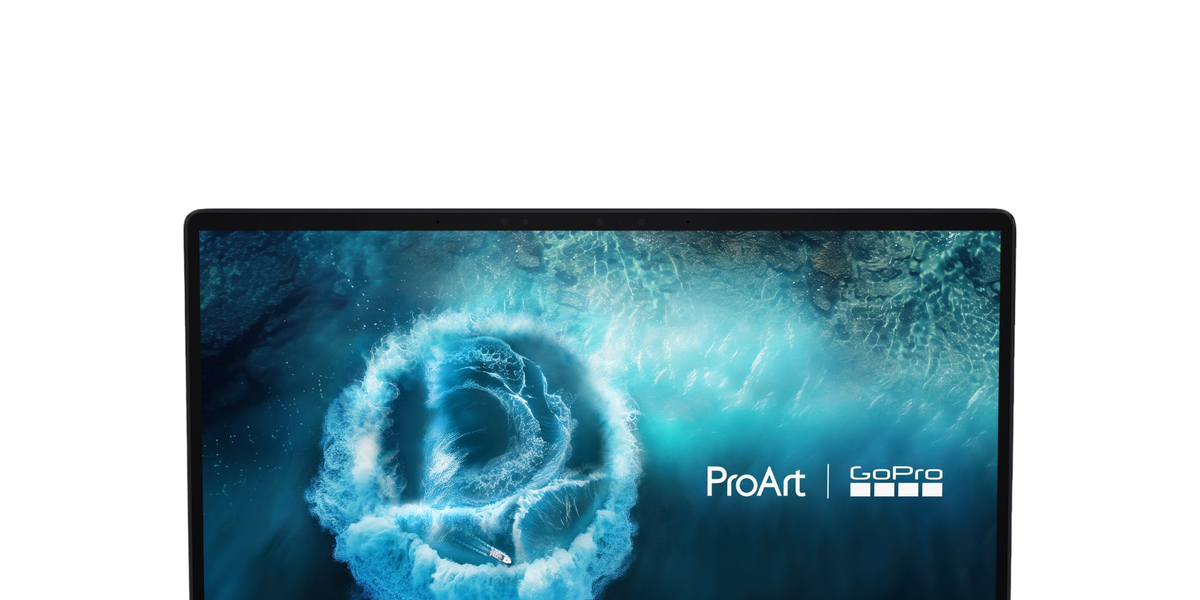
4 min readAction sports give a filmmaker one take. The wave breaks once; the trick lands or it doesn’t. Which is why the most important minutes of Chris Rogers’ day come after the light goes—when a full day of unrepeatable footage rides on a card smaller than a postage stamp—and the first thing he does is get it somewhere safe.“After a day of filming, I’ll offload all the GoPro content onto the laptop,” he says. Because the ProArt GoPro Edition (PX13) carries a built-in microSD reader, the same card that lives inside a GoPro, that handoff takes seconds. “I just pop the memory card out of the camera and straight into the laptop. No need for cables or card readers,” he adds. One less dongle in a bag that’s already full of them—and wherever he’s landed that night, whether that’s a hotel room, an airport gate, or the back of a truck, the edit is already loading.From there it’s the editing software. For 360 footage, Rogers relies on the GoPro Reframe plugin, steering spherical shots into camera-like moves with keyframes—drawn by hand on the 13.3-inch 3K OLED touchscreen. When a sequence needs a closer look, he flips the hinge all the way around. “Being able to fold the laptop completely over so that I’m using the entire screen like a tablet has been such a useful feature for reviewing and editing 360 GoPro content,” he says.The panel earns its keep at the finish, too. PANTONE Validated with a Delta E below 1, it’s accurate enough that the grade he sets at midnight—“a bit of color grading with my LUTs and some sound design,” as Rogers describes his last touches—survives to the final export. Underneath, AMD’s Ryzen AI Max+ 395 processor keeps the bulky files moving. “The ProArt really impressed me with its color-accurate display and its ability to play back my high-res footage,” he says.Turning Adventure Into a CareerThat machine-to-mountain shorthand took a decade to perfect. “My filming journey really started as a hobby that quickly turned into a passion,” Rogers says. He began shooting music festivals for travel money while he was at university, before a turning point in early 2017, about a year after graduation, “when everything really felt like it started to click.” These days, he keeps a simple quota. “The goal is always to try to do two or three projects a month,” he says. And when a shoot runs long, he squeezes more films from the one trip.His assignments have carried him from Turks and Caicos, where filming with a local water sports crew delivered “the perfect combination of action and adventure that I’m always chasing,” to Sri Lanka, where a week-long project in a country he knew little about became one of his biggest surprises. He’s clear about where the work is won. “I have always considered myself a better cinematographer than an editor,” he says. The camera rarely sits still, and once the action starts his focus narrows to framing—folding himself into whatever position the angle demands and, around water, “making sure I’ve taken the precautions and prepped my lens those 10 seconds before the action so that I don’t have any water drops ruining my shot.”The advice he gives aspiring action-sports filmmakers is fairly straightforward. When chasing a friend down a mountain on skis, a snowboard, or a skateboard, “get your GoPro as close to the ground as possible while framing your subject,” he says. The blurred foreground exaggerates speed, and the rider becomes, in his words, the “hero of the frame.” He’d send anyone to the Swiss Alps to practice it. His second rule is greed, professionally applied: “Film as many different angles and POVs as possible. The more you have, the better your travel video will turn out.”Gear That Keeps UpYears of editing wherever he lands have hardened Rogers’ requirements into a short list of non-negotiables. A machine has to be “quick and easy to set up,” with “enough internal storage for all my footage and a color-accurate display for editing,” he says, adding that it has to disappear into a pack: “I really liked how small and compact the laptop was for traveling and going on adventures with.” It also has to be able to take a beating. Rogers points to the “military-grade materials” that give the ProArt GoPro Edition “a more rugged feel”—ASUS builds it to US MIL-STD-810H standards—while the GoPro DNA lives in the details: a textured grip modeled on the GoPro HERO13’s housing, with blue and cyan accents threaded through the device.ASUSThe ProArt GoPro Edition’s 360-degree hinge lets Rogers review and edit footage in tablet mode.For a man who travels for a living, Rogers’ bucket list has somehow stayed full—a snowboarding trip to Japan sits “very high” on it. But his oldest dream idles on Lake Powell: a week aboard a houseboat on the Utah–Arizona reservoir where the wakeboard movies of his childhood were filmed, this time with his own friends and athletes in the frame. “Helicopters, wakeboarding, and cliff jumping. The location looks like nothing else I’ve ever seen before,” he says.Knowing his routine, the edit will be rolling before the houseboat ever docks. That’s defined the flow of Rogers’ career: Chase the shot all day, shape the story that night, then board the next flight with everything he needs packed into a laptop that weighs just about three pounds.See what Chris Rogers packs in his bag here.
How This Action-Sports Filmmaker Runs a Three-Pound Film Studio
Full Article
Original Source
Read the full article at Esquire →KhanList aggregates and links to publicly available news content. We do not host full articles from third-party sources. Always verify important information with original sources.