
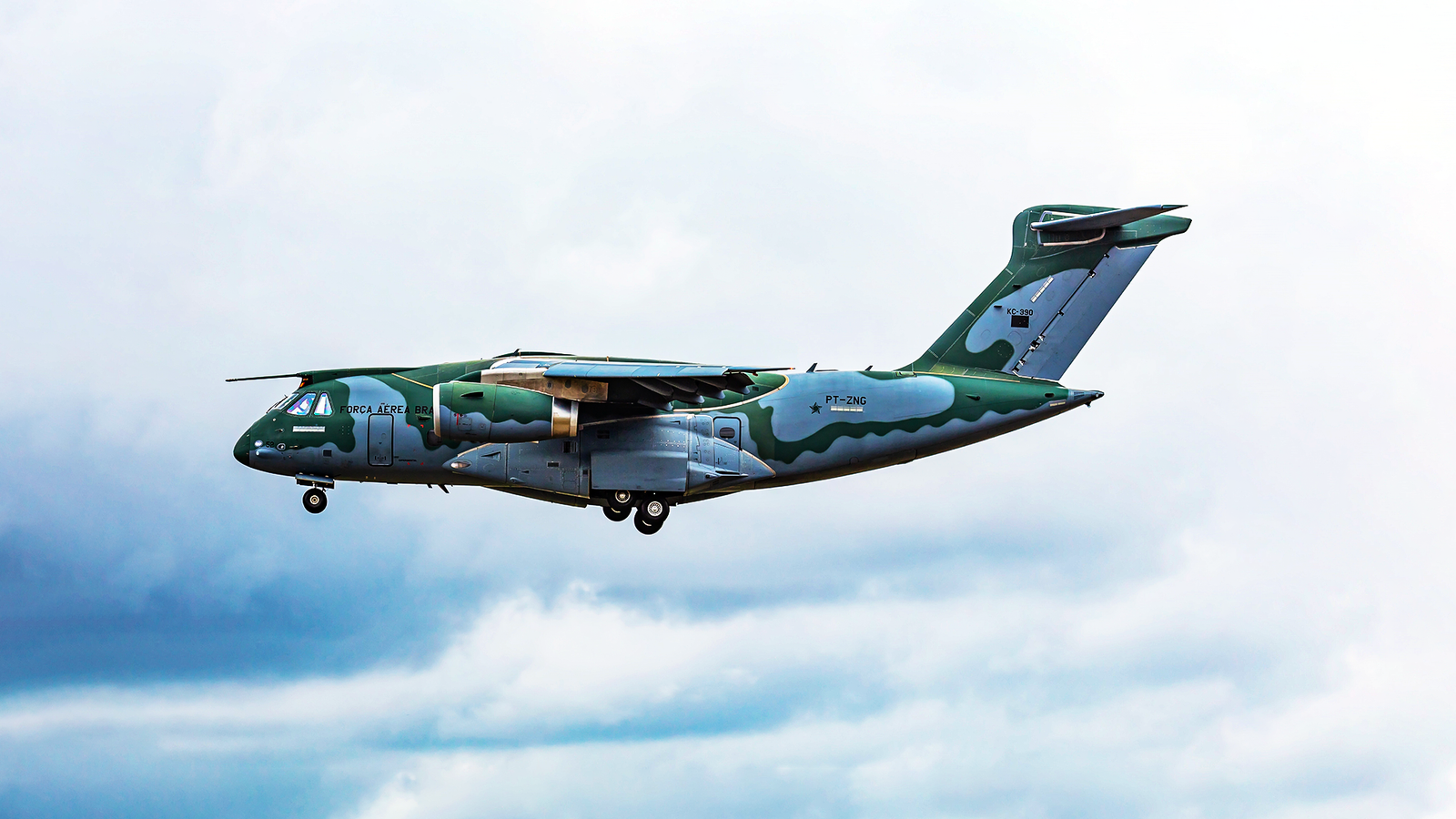
Published Sep 4, 2026, 8:00 PM EDT Luke Diaz is a freelance military writer with experience with active duty experience in the US Navy as well as defense and industrial engineering. He is a former Naval Flight Officer who performed tactical air control on the carrier-based E-2 Hawkeye. It may be true that everyone loves the underdog, but there are precious few examples of such cases leading to successful military aircraft in the modern era. However, as the new Boeing KC-46 Pegasus tanker continues to struggle with technological problems years after its debut, a slim opening exists that could offer such a chance. Waiting in the wings to pounce on the opportunity is the Embraer KC-390 Millennium multirole tanker twin jet. The big Boeing is based on a 767 widebody airframe and therefore has more payload and range. Yet, the narrowbody sized KC-390 is much less expensive while offering strong capacity and range for its size. Another important aspect is that while the KC-390 has half the fuel capacity, it is also able to take off and land from much shorter airstrips in rugged conditions. That makes it an excellent candidate to bolster the US Air Force's ongoing transition toward a fleet optimized for agile combat employment. Analysts estimate Embraer can make the jets for as low as $50 million, which would be about one-third of the FlyAway cost of a Pegasus. However, with the host of upgrades expected for the partnership with Northrop Grumman, that price is likely to be closer to $150 million. It still beats out being the 'all-in' lifetime price of a Pegasus, which is almost $300 million. A large-scale contract with the USAF, however, would allow for optimized production and give Embraer the chance to achieve peak efficiency. The Avenue Of Entry For Embraer's Aerial Tanker Credit: Department of Defense There is more than one hurdle to Embraer landing a successful bid to produce its tankers for the US Air Force. One of the most significant is legal requirements that bind it to defense contracting policies of large scales, such as aerospace projects like air-to-air tanker jets. This is where Northrop Grumman comes in with the potential solution. In February of this year, the two plane makers signed a memorandum of understanding entering a joint bid for upcoming aerial refueling programs. The USAF has committed to procuring more KC-46 jets despite the rising cost and problematic rollout of the fleet. In the future, it is expected that the service will be looking to develop a Next-Generation Air Refueling System, which remains to be specified. The preceding NGAS stealth tanker initiative has been virtually abandoned, with all the funding redirected to fixing deficiencies in the Pegasus fleet and upgrading their countermeasure systems. This leaves the opening for an ACE-optimized multirole tanker a possibility. Short takeoff and landing performance is a very valuable quality in the Indo-Pacific theater, which the entire US Armed Forces, and especially the USAF, is currently restructuring many elements of its equipment and infrastructure for. The Department of Defense is rebuilding airfields across the first and second island chains to accommodate its latest and greatest jets, but many of the smaller islands remain rugged and austere. These fields can only accommodate the turboprop Lockheed KC-130 Hercules multirole tanker as flown by the US Marines. In a future high-end conflict against a near-pure adversary like the People's Republic of China, rapid deployability of everything from fighter jets, drones, airlifters, and tankers to dispersed sites across the Western Pacific is a strategic priority. The Hercules remains a very useful piece of equipment for its ruggedness; however, the Millennium offers a better-suited refueling platform for stealth fighters like the Lockheed F-35 Lightning II, which is a linchpin of ACE doctrine. The Right Size For The Job: Agile Combat Employment Credit: Department of Defense The strategic argument behind the partnership is not about replacing the Air Force's existing tankers, it's about reaching runways they cannot use. That framing lines up with a problem the Air Force has been wargaming for years under its ACE doctrine, which calls for dispersing aircraft, crews, and fuel across a wide network of smaller operating locations. The KC-390 would allow for a distributed tanker force that is not concentrated at easily targeted hubs like Andersen Air Force Base on Guam. Both the Boeing KC-135 Stratotanker and KC-46 are large aircraft that generally require long, established runways and substantial ground infrastructure. Embraer's data puts unprepared-runway landing distance at around 3,280 feet (1,000 meters) at sea level with a 26-ton load, a figure the Brazilian Air Force validated in short-landing trials at Anápolis Air Base and at Rio de Janeiro's 1,323-meter Santos Dumont runway. In April, Embraer completed a major 70-day, 11-country global demonstration tour with the KC-390. The jet logged over 140 flight hours across 54 flights, proving its capability to operate from diverse, austere, and dispersed locations. NGAS: Collaborating To Craft Next-Gen Tankers Credit: Department of Defense The MOU, signed at Northrop's Melbourne site, commits the two companies to jointly develop what they are calling the KC-390 Multi-Mission Tanker. The Millennium, powered by two International Aero Engines V2500-E5 turbofans generating roughly 31,330 lb (14,211 kg) of thrust apiece, already carries up to 57,320 lb (26,000 kg) of cargo or 80 passengers, cruises at Mach 0.80 (470 knots), and has a range of up to 4,570 nautical miles. It carries up to 35 metric tons of fuel with 23 tons in wing-mounted pods and 12 tons in additional tanks within the cargo hold. The new Millennium variant will be an evolution of Embraer's existing twin-engine transport that adds a centerline aerial refueling boom to the aircraft's current underwing hose-and-drogue pods. Grumman has folded this pitch into a broader concept it calls a "family of systems" approach to the Air Force's long-planned Next-Generation Air Refueling System: a large, likely blended-wing tanker at the high end, the KC-390 as a tactical mid-size tanker, and a small uncrewed tanker below that. Under the USAF's emerging vision for future aerial refueling, a single large, vulnerable tanker cannot survive near contested airspace. The Grumman-Embraer teamwork addresses this by pitching the KC-390 as the crucial middle tier of a modular three-part refueling network. To make this system of systems work, Grumman is focusing heavily on upgrading the aircraft's software and mission suites along with the new boom, which is necessary to be compatible with many US airframes. Northrop Grumman Connects The Millennium To The Combat Cloud Credit: Department of Defense Instead of relying entirely on a human operator to manage a manual boom on the KC-390, Grumman is engineering an autonomous centerline refueling boom. This system utilizes advanced vision sensors and automated software to detect, track, and contact receiver aircraft hands-free. This fits perfectly into a combat environment where human operators are already managing high cognitive workloads. The upgraded KC-390 will feature modular electronics, meaning it can quickly change its role from a standard cargo transporter to aerial refueler or even an airborne relay hub in a matter of hours. At the same time, a system of systems is entirely dependent on data sharing. Grumman is embedding its signature advanced communications, 'combat cloud,' and countermeasure suites. The Enhanced KC-390 will act as a flying data-routing node in the broader 'kill web.' Like these stealth fighters, it will refuel and ingest telemetry, radar, and threat data from forward-deployed platforms. Whether that data comes from another airplane, a naval vessel, or ground unit, it can process and share it with every other interconnected unit. The same data link equipment can also stream back to strategic command centers or other elements of the Joint Force via secure, jam-resistant datalinks. The Price Of Air Dominance Credit: Department of Defense When Embraer first started pitching the base C-390, a stripped-down flyaway version was frequently estimated at around $50 million to $55 million. Adding on all the new technology that Grumman is going to develop over the next few years is likely to inflate that much closer to $150 million, or even more. Still, if the USAF orders large numbers of jets, the economy of scale could provide Embraer with the ability to bring that figure down closer to its original price tag. There is also the additional cost of the compliance factor to deliver jets to the USAF that are 'made in the USA' and not Brazil. Even with support from Grumman, building a factory in Melbourne, Florida, and sourcing over 50% domestic parts to comply with the Buy American Act means paying US aerospace labor rates instead of Brazilian ones, which adds cost. Even at $150 million to $180 million for a fully upgraded, US-built variant, the KC-390 remains an attractive financial and operational option next to the Boeing KC-46. The Pegasus program has been plagued by billions in corporate losses and heavy technical overruns fixing its Remote Vision System. When including total lifetime development, engineering, and support costs spread across the fleet, the program acquisition unit cost climbs closer to $287 million per KC-46. The realistic path forward for the KC-390 Multi-Mission Tanker runs through NGAS, not around it. The Air Force's FY2026 budget allocated roughly $13 million to NGAS as a placeholder, not a program of record and a fielding target as distant as 2036. That affords Embraer the time needed to refine a mature platform with a full proposal to make a bid for the big leagues.
How This $150 Million Tanker Plans To Undercut Boeing's Troubled KC-46
Full Article
Original Source
Read the full article at Simpleflying →KhanList aggregates and links to publicly available news content. We do not host full articles from third-party sources. Always verify important information with original sources.