
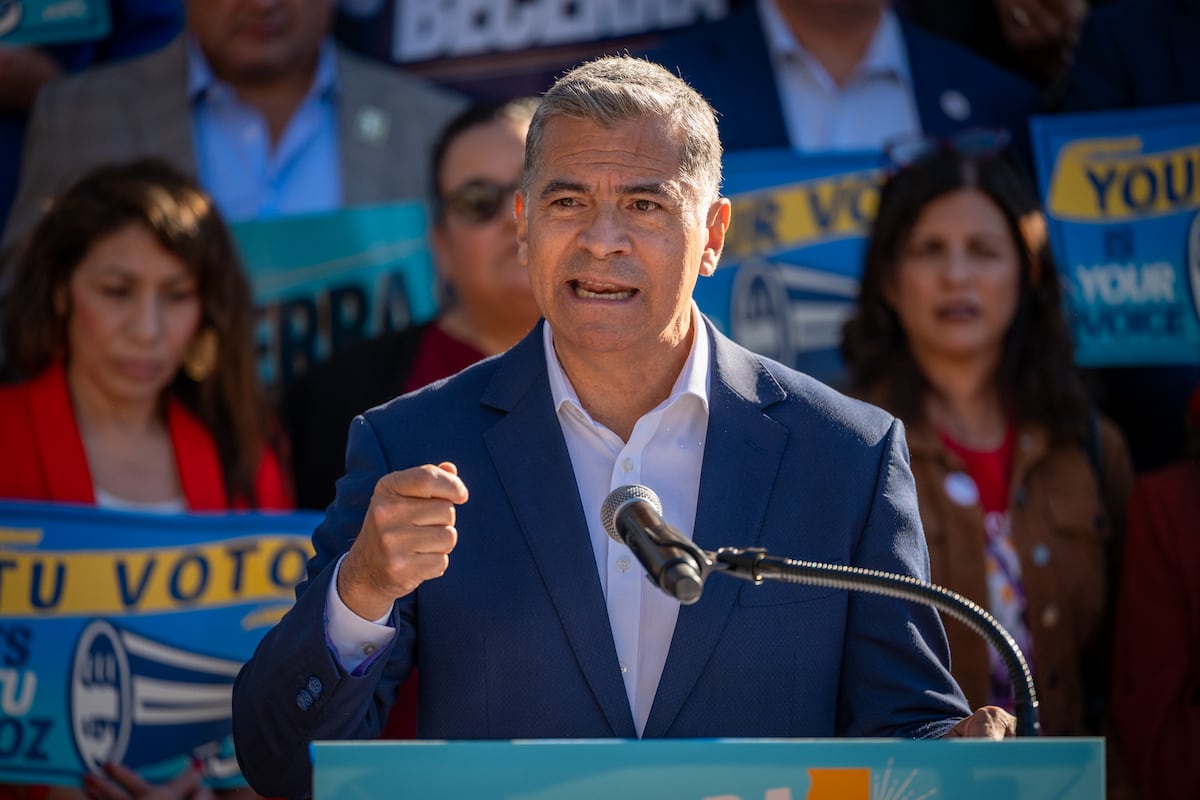
Xavier Becerra was still a freshman member of Congress when, in 1994, California became the testing ground for one of the toughest anti-immigrant measures pushed by Republicans: Proposition 187. Backed by then‑governor Pete Wilson, the measure won voter approval and sought to deny educational and health services to undocumented people.The initiative never took effect, but it triggered a mobilization that paved the way for a new generation of Hispanic leaders who, over time, would occupy important government posts. Thirty‑two years later, one of them, Xavier Becerra, buoyed by voters’ rejection of the rhetoric of a man widely seen as a contemporary version of Wilson — President Donald Trump — would win the California governorship. It can only be read as the culmination of what Proposition 187 was meant to prevent.Becerra, who has spent almost half of his 68 years in elective office, beat his Republican rival, Steve Hilton — a conservative TV political commentator endorsed by Trump — by a hefty margin of more than 29 points, according to preliminary returns. If that gap holds, it would be one of the largest victories for a California gubernatorial candidate since 1994. The Democrat would thus shatter a glass ceiling, helped by a “bluenami,” as the decisive Democratic win in the midterms has been dubbed. No other Hispanic person has served as governor since 1875.“You have now entered the Becerra era,” the Democrat said in Sacramento, the state capital, last Tuesday night, minutes after projections showed him as the winner. “I didn’t run to make history,” he added. “I ran to make a difference for anyone and everyone who calls California home — whether you voted for me or not.”Becerra’s era will, he said during the campaign, be a frontal clash with the immigration policies advanced by the Trump administration. In one campaign video he declared himself “Trump’s worst nightmare.” After the blue wave, the president had adopted a conciliatory tone and said he was willing to sit down and negotiate with Democrats. “We could work with them on immigration,” he told Fox News last Wednesday. But on Friday, true to his habit of abrupt reversals, he pivoted and appointed Stephen Miller — the architect of some of the harshest immigration measures of his first and second terms, including a plan to deport one million undocumented people a year — as chief of staff.This suggests that in January, when Becerra takes office as governor, he will inherit the mantle as one of the main leaders of the anti‑Trump movement, a role outgoing governor Gavin Newsom has played over the past two years and that clearly positions him to seek the Democratic presidential nomination.As a symbolic gesture, Becerra’s campaign chose Placita Olvera — a few blocks from an immigration detention center in downtown Los Angeles — to hold a campaign event in mid‑October. That site was the birthplace of the first community that would grow into what is now the nation’s second‑largest metropolis and is today a place where tourists buy traditional Mexican goods. “Vote against the policy that attacks us, even though we have the right to be here,” Becerra urged.The battle against TrumpCalifornia is home to the largest undocumented population in the country: around 2.3 million people, according to the Pew Research Center. That is why it was here — especially in Los Angeles — that Trump’s immigration agents unleashed a sweeping operation against undocumented people in the summer of 2025. From January 2025 through last July, about 50,000 immigrants were detained in the state by agents of U.S. Immigration and Customs Enforcement (ICE), according to an analysis by the Deportation Data Project at the University of California, Berkeley.Becerra calls ICE agents “mercenaries” and has repeatedly urged the federal administration to stop separating families, terrorizing neighborhoods, and hitting industries that depend on immigrant labor. He has warned that — just as he sued Trump more than 120 times during the Republican’s first term when Becerra served as California attorney general — he will continue to confront him from his new office in Sacramento.In favor of immigration reformThe governor‑elect says immigration is personal. The son of a Mexican immigrant and a man born in Sacramento who spent several years living in Tijuana, Becerra often credits his parents’ effort for his achievements; he has recounted that they arrived in California as a couple with just $12 between them. In 1980 he became the first in his family to earn a college degree — a bachelor’s in economics from Stanford University. Earlier, in 1978 and 1979, he studied at the University of Salamanca in Spain. In 1984 he received his law degree from Stanford Law School.“It’s good to have a regulated immigration system for those who come to our country, including California. It’s something I have always championed. It’s wrong when migrants are separated from their children, when they are killed indiscriminately,” Becerra said at a political debate last month, where he defended a “regulated” border to ensure greater security. “I do not support treating migrants like animals and I support recognizing the migrants who drive and build our state.”Becerra not only opposes mass deportations but also supports an amnesty that would bring out of the shadows the more than 10 million undocumented people living in the U.S. — an outcome that looks distant in the current turbulent political landscape. “We should have an immigration reform that allows us to choose who stays and who goes,” he said.Sign up for our weekly newsletter to get more English-language news coverage from EL PAÍS USA Edition
How the xenophobia that marked California in 1994 ultimately led a son of immigrants to become governor
Full Article
Original Source
Read the full article at English →KhanList aggregates and links to publicly available news content. We do not host full articles from third-party sources. Always verify important information with original sources.