
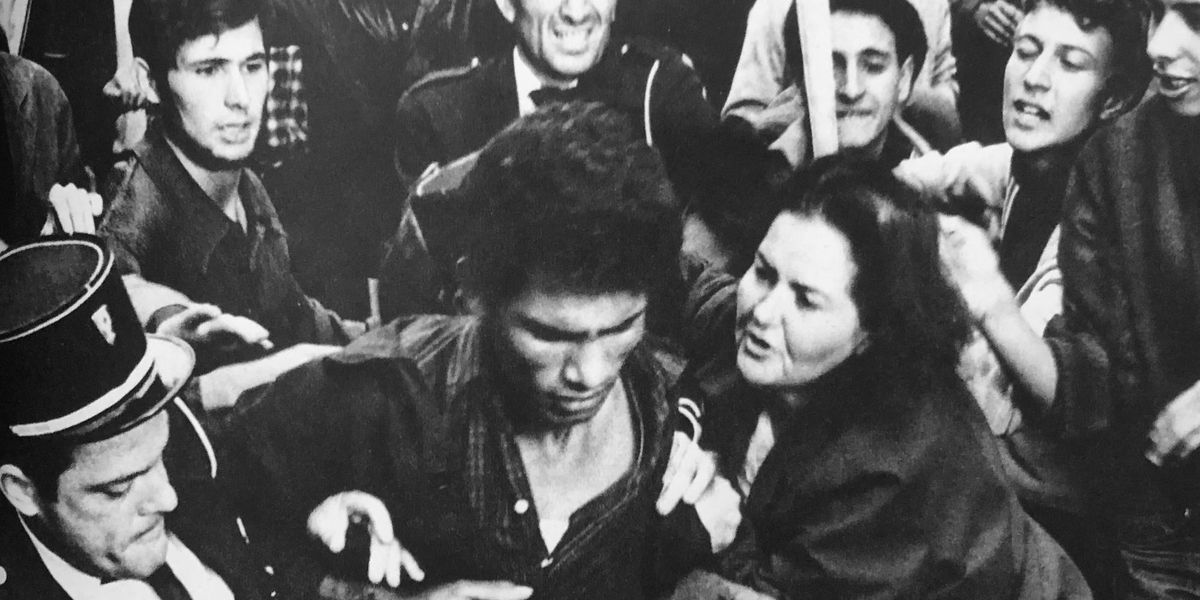
The stern Colonel Mathieu, in shades and camouflage, stands cross-armed as flashbulbs pop a few feet away. The photographers’ lenses and newsreel cameras are focused on a handcuffed resistance leader standing next to him.An officer barks, “No more photographs,” as one of the journalists packed into the military command room rises from his seat. “Mr. Ben M’hidi, isn’t it cowardly to use your women’s baskets to carry bombs, which have taken so many innocent lives?”A bespectacled Larbi Ben M’hidi coolly responds, “Isn't it even more cowardly to attack defenseless villages with napalm bombs that kill many thousands of times more? Obviously planes would make things easier for us. Give us your bombers, sir, and you can have our baskets.”A second reporter asks, “Does the FLN still have some chance of defeating the French army?” “The FLN has more of a chance of defeating the French army than the French have of changing the course of history,” Ben M’hidi answered.If the offended French delegates to the Venice Film Festival had gotten their way 60 Septembers ago, this important scene in a remarkable film may not have entered cinematic history. But festival management did not succumb to their pressure, and on Sept. 10, 1966, “The Battle of Algiers,” directed by the Italian neorealist Gillo Pontecorvo, won the prestigious Golden Lion award. The film was banned in France.Long after the height of decolonization, “The Battle of Algiers” still scintillates in grainy black and white. With only one professional actor among the cast, Pontecorvo enlisted hundreds of ordinary Algerians, their memories fresh, to recreate the Front de Libération Nationale’s (FLN) existential battle against their colonizers. Saadi Yacef’s role must have come naturally. He was the FLN’s military chief in Algiers. The struggle — both in real life and as depicted in Pontecorvo’s masterpiece, shot in the narrow passageways of the Casbah — inspired national liberation movements, such as the Palestine Liberation Organization, while raising questions that continue to confront our modern world.When is armed resistance legitimate? When does resistance become terrorism? Can torture ever be justified? Why do colonial or imperial powers wage asymmetrical “forever wars” against weaker yet stubborn foes? As soon as the film debuted in the summer of ‘66, French critics attacked Pontecorvo for romanticizing the FLN’s heroes who had much innocent blood on their hands.The elite paratroopers under the fictional Colonel Mathieu (a composite character based on two real commanders) ruthlessly crushed the FLN’s terror network in the Casbah in 1957. But les colons did not change the course of history. The colonizers eventually gave way to the decolonizers, ending 132 years of French rule when they departed Algeria in 1962. Their defeat flowed from the methods they used to put down the revolt, namely torture and disproportionate retaliation. They could not, in the end, impose a political solution through violence against insurgents committed to expelling them from their country.As Americans reflect on the failures of the “global war on terrorism,” it is worth remembering that U.S. military leadership once tried to learn from Pontecorvo’s film. As Iraq disintegrated into chaos in late 2003, the Pentagon held a screening of “The Battle of Algiers” to “discuss the implicit issues at the core of the film – the problematic but alluring efficacy of brutal and repressive means in fighting clandestine terrorists in places like Algeria and Iraq,” according to the New York Times. The officers in attendance would have seen Pontecorvo’s searing depiction of torture. They must have noted the French commanders, utterly inured to civilian deaths, congratulating themselves upon the apparent success of their counter-insurgency campaign: “The FLN is decapitated in Algiers. We’ll hear no more of it.” Then the dramatic finale: mass independence demonstrations suddenly broke three years of relative calm. Hundreds of women making “frightening rhythmic cries” confronting French riot police. A narrator intones, “Two more years of struggle still lay ahead. Then… the Algerian nation was born.”Did the U.S. military brass absorb the moral of Pontecorvo’s story: the impossibility of imposing your will on a foreign people, even with overwhelming firepower at your disposal? If they did, U.S. military conduct showed otherwise, undermining President George W. Bush’s claim that the United States was helping Iraq become a free society. The battle for Iraqis’ hearts and minds was lost almost as soon as it began. U.S. tactics catalyzed, rather than squelched, a gathering Sunni insurgency. “Clearing out villages and towns involved house-to-house searches that frequently violated Iraqis’ social norms of privacy (especially of women and girls) and honor (especially men). Many thousands of Iraqi men and boys were arrested in front of their families and sent to detention camps or prisons like Abu Ghraib without any evidence of wrongdoing,”the late historian John Tirman wrote in his 2011 study, “The Deaths of Others.” “Some 120,000 Iraqis were detained. In the house-to-house searches, if Iraqis resisted in any way, violence could readily follow,” Tirman continued. “The procedure itself was violent.”Photos of detainee abuse at Abu Ghraib, which had been a torture and execution center under Saddam, sparked international outrage in April 2004, while further strengthening the insurgency. Foreign jihadists flocked to Iraq to commit suicide bombings while the new Shia-dominated government in Baghdad did its part in fomenting civil war. “The Ministry of the Interior, which controlled the country’s internal security, was populated by Shia death squads who were killing Sunnis,” notes Peter Bergen in “All the Presidents’ Wars.”It took years for the Pentagon to change course. With the help of the Sunni “Awakening” movement that turned against al-Qaeda in Iraq, the Pentagon’s troop “surge” combined with the construction of concrete walls separating Sunni and Shia neighborhoods to dramatically reduce violence. Yet Bergen concludes, “the surge didn’t heal the political wounds in Iraq… you couldn’t just kill your way to peace.” The French, too, believed they had won the battle. In reality, they corrupted themselves, humiliated their nation, and lost the war. When reports of abuses in Algeria — torture, disappearances, rogue police bombings — reached France, public opinion spiraled down. “In the Algerian War what led — probably more than any other single factor — to the ultimate defeat of France was the realization, in France and the world at large, that methods of interrogation were being used that had been condemned under the Nazi Occupation,” said historian Alistair Horne in the preface to the 2006 edition of his classic book, “A Savage War of Peace.” The author sent a copy to then-Secretary of Defense Donald Rumsfeld to warn him of the evils of torture — to no avail.No analogy is perfect. The French spilled blood intending to stay in Algeria forever. The United States envisioned eventually going home while leaving a stable, democratic Iraq in its wake. It didn’t work. Washington continues to overlook the lessons “The Battle of Algiers” so effectively conveys, whether by enabling Israel’s brutality in Gaza or trying to bomb Iran into submission. Meanwhile, at this year’s Venice Film Festival, Israeli documentarians — in the tradition of Gillo Pontecorvo — are receiving 25-minute standing ovations as they try to shock their countrymen’s consciences. Where is the American Pontecorvo?
How the US tried (and failed) to learn from 'The Battle of Algiers'
Full Article
Original Source
Read the full article at Responsiblestatecraft →KhanList aggregates and links to publicly available news content. We do not host full articles from third-party sources. Always verify important information with original sources.