
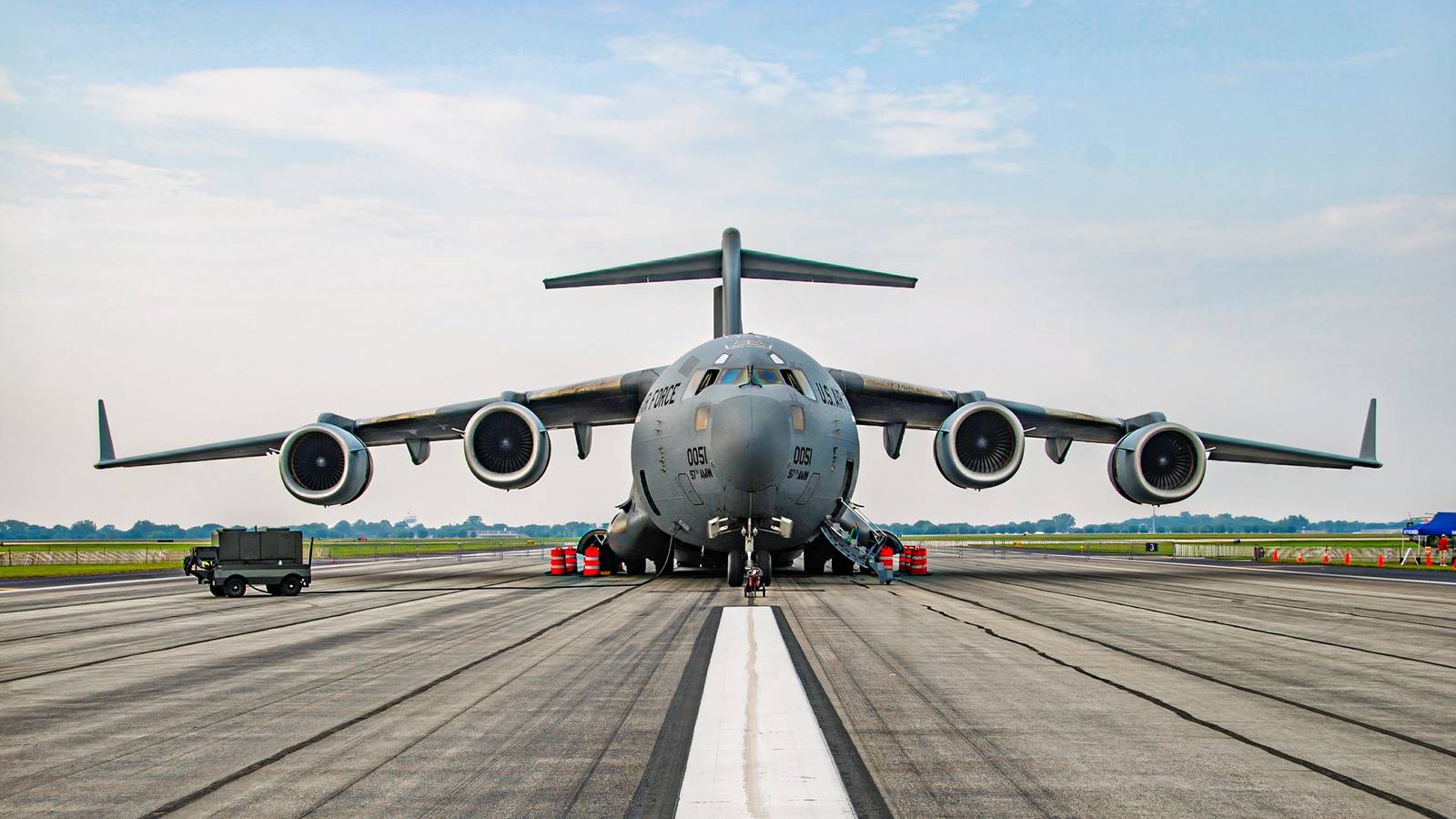
Published Oct 30, 2026, 4:00 PM EDT Chris earned a Master’s degree in Defense and Strategic Studies (Highest Honors) from the University of Texas at El Paso. His graduate work concentrated on Global and National Security, Low-Intensity Conflict, Modern Warfare, and US grand strategy. He also undertook extensive regional studies, analyzing how key regions integrate into the broader US security architecture. This rigorous program provided him with a comprehensive understanding of U.S. military operations, global strategy, and weapons systems. Additionally, he gained a strong appreciation for great power competition.—an increasingly central force shaping international relations and conflict for the foreseeable future. The Boeing C-17 Globemaster III has been a cornerstone of the United States (US) military airlift for more than three decades, transporting troops, heavy equipment, and vital supplies to locations worldwide. However, with production ending in 2015 and the fleet requiring continued sustainment and modernization, the US Air Force faces the challenge of keeping the aircraft operational for decades to come. Looking ahead, the Air Force is exploring a Next Generation Airlift (NGAL) platform intended to replace both the Boeing C-17 Globemaster III and Lockheed Martin C-5 Galaxy. With a potential replacement process beginning around FY2041, what capabilities will the next-generation airlifter need to meet the demands of future conflicts? The Boeing C-17 Globemaster III And Why It's So Important Credit: US Air Force Procurement for the Globemaster began in FY1988. It made its maiden flight on September 15, 1991, and entered operational service in June 1993. The Air Force states that it currently operates 222 of the aircraft, with 157 on active duty, 47 with the Air National Guard, and 18 allocated to the Air Force Reserve. As a highly flexible and capable airlifter, the C-17 can operate out of main operating bases and deliver cargo to remote forward operating bases. To this point, the Air Force states that the aircraft can "take off and land on runways as short as 3,500 feet (1,064 meters) and only 90 feet wide (27.4 meters). Even on such narrow runways, the C-17 can turn around using a three-point star turn and its backing capability." With its maximum payload of 170,900 pounds (77,519 kilograms), the aircraft can rapidly transport soldiers, vehicles, equipment, ammunition, and general and palletized cargo to sustain high-tempo operations. It can also evacuate wounded service personnel to rear-area care facilities. Its capabilities include carrying the 69-ton Abrams main battle tank or 102 paratroopers. To highlight the C-17's operational effectiveness, it played a crucial role in the logistical effort for Operation Joint Endeavor in 1995, the peacekeeping mission in Bosnia. During that time, Air Mobility Command flew "3,827 missions, carried over 18,539 troops and delivered more than 45,000 short tons of cargo," according to the Congressional Research Service. The report further states that, on missions from Central Europe to the Bosnia area of operations, C-17 crews flew slightly more than 26 percent of the missions; however, they delivered over 44 percent of the mission-critical cargo. Maintaining The Fleet Into The 2070s Credit: US Air Force The C-17 is a logistical necessity, bridging the gap between larger, permanent logistics hubs and forward sites that need supplies the most. So it is clear why the Air Force is investing the funding needed to keep this essential connector airworthy until roughly the 2070s, when the Globemaster is expected to be retired, according to the US Government Accountability Office. Because the fleet is now more than 20 years old on average, efforts to modernize the 200-plus aircraft have been ongoing, keeping the C-17 a viable airlift asset now and for decades to come. In October 2011, the Department of Defense (DoD) Office of Inspector General stated that ". . . the C‑17 Globemaster III Division awarded Boeing a 10‑year, $11.8 billion (£8.83bn) sole‑source acquisition contract for the C‑17 Globemaster III Integrated Sustainment Program . . ." The DoD statement further acknowledged that, in September 2021, the Air Force awarded Boeing the Globemaster III Sustainment (G3) contract, a significant follow-on agreement worth $23.8 billion (£17.8bn) that supports the C-17 through 2031. An important component of this effort is the modernization of the flight deck, which will be handled by Boeing. The estimated lifetime value of the award could reach $400 million (£302 million). This program aims to address avionics obsolescence and enhance cockpit capabilities across the fleet by introducing a Modular Open Systems Approach (MOSA), which will standardize interfaces and modular components. This should simplify future upgrades without requiring multiyear recertification. Under the program, Intellisense Systems has been selected by Boeing to provide MOSA-compliant data concentrator units built around “a high-performance multicore single-board computer architecture and advanced video interfaces designed to connect the aircraft mission computer with primary flight displays.” Intellisense will also supply the company's 15-inch multifunction display, which incorporates advanced video and data-processing capabilities alongside touchscreen and tactile bezel controls for pilot interaction. Regarding ongoing work, Air Force Technology reports that Boeing received a $166.8 million (£124.5m) contract modification for C-17 Globemaster III sustainment to cover landing gear spares for ordering period five. This modification increases the total value of the ongoing contract to approximately $8.05 billion (£6.02bn). The work under this aspect of the contract is due to be performed at several locations, including Long Beach, California; San Antonio, Texas; Robins Air Force Base, Georgia; Charleston, South Carolina; McChord Air Force Base, Washington; and various sites worldwide. Boeing is expected to complete this work by October 31, 2027. Could Production Once Again Restart For The C-17? Credit: US Air Force Boeing decided to close the Globemaster's production line in 2015 due to a lack of firm orders for the aircraft, making it difficult to justify keeping the line open. The final C-17 rolled off the assembly line at Boeing's Long Beach, California, facility in 2015. Before the closure, Boeing stated that it had built 257 Globemasters, with ". . .34 going to international partners including Australia, Canada, India, Qatar, the United Arab Emirates, the United Kingdom and the 12-member Strategic Airlift Capability initiative of NATO and Partnership for Peace nations." Given the C-17's importance to the global mobility and sustainment of the US military, and the lack of a concrete replacement, the House Armed Services Committee presented an extensive checklist in its report accompanying the latest draft of the National Defense Authorization Act. MigFlug reports that the committee wants the Air Force to ". . .assess the technical and industrial feasibility of restarting the line, including the status of tooling, supplier base viability, workforce availability, and potential reconstitution costs." Although Congress appears interested in restarting C-17 production, the cost would be substantial. A 2012 RAND Corporation report on this very topic estimated that restarting C-17A production would cost between $2.1 billion (£1.57bn) and $2.7 billion (£2.02bn) with tooling retained, or $2.7 billion (£2.02bn) to $3.3 billion (£2.47bn) without it. RAND further estimated that ". . .the nonrecurring costs for a C-17B variant would be $4.6 billion (£3.44bn) to $6.4 billion (£4.79bn) with tool retention and roughly $450 million (£336m) more without it." A final issue must be considered when discussing a potential restart of Globemaster production. In addition to the prerequisite of acquiring significant new orders, a restart would also mean rebuilding a manufacturing base that has likely atrophied. At the height of production, Boeing relied on a network of more than 650 suppliers in 44 states to supply the C-17 line with parts. That network would have to be restored, potentially presenting one of the biggest hurdles, given that no C-17 has been produced in roughly 11 years. Next Generation Air Lift Platform Credit: JetZero Regarding the future of US military airlift capabilities, the head of Air Mobility Command envisions a single platform to transport US military personnel and their equipment to global hotspots. While such an aircraft has not left the drafting table, let alone the runway, such a move would simplify maintenance procedures, storage, and the spare-parts ecosystem. Regarding the future airlifter, Air & Space Forces Magazine notes that General John Lamontagne (current Chief of Staff of the Air Force) stated, “As far as what we want in the next platform: we want agility, we want speed, we want to be able to operate in a higher threat environment . . .” The primary objective of adding a new long-haul aircraft to the fleet is to begin replacing the C-17 around FY2041. This would be needed before the Globemaster becomes difficult to operate, considering the US military's global demands. The Next Generation Airlift (NGAL) platform has been described as a replacement platform that will cover the capabilities of both the C-17 and the C-5 Galaxy. A request for information (RFI) released by the Air Force Life Cycle Management Center last June stated that the “. . . US Air Force stipulates that all proposed aircraft must possess a wingspan of strictly less than 223 feet (68 meters) and demonstrate the capability to carry a minimum payload of 160,000 pounds (72,575 kg) over a distance of at least 2,500 nautical miles (4,630 km) unrefueled.” Emphasis should be placed on baseline, as the RFI states that the parameters listed above are the baseline. Thus, contractors should aim higher to ensure enhanced expeditionary capabilities, particularly as the Pacific takes on increasing importance as an area of competition. Can The C-17 Globemaster III Remain In Service Until 2078? Credit: US Air Force The C-17 Globemaster III remains essential to US military mobility, connecting major logistics hubs with forward operating locations while delivering troops, vehicles, and critical supplies. However, sustaining the aging fleet requires continued investment in spare parts, maintenance, and flight deck modernization, particularly as Boeing's closed production line makes restarting manufacturing a costly undertaking. Looking ahead, the NGAL program could eventually reshape US strategic airlift capabilities. Until then, the Air Force must preserve the C-17's operational effectiveness while preparing for the next generation of military transport platforms. The success of these efforts will help determine whether the Globemaster can continue meeting the demands of global military operations for decades to come.
How The US Air Force Sustains 222 C-17 Globemasters With No New Builds In 2026
Full Article
Original Source
Read the full article at Simpleflying →KhanList aggregates and links to publicly available news content. We do not host full articles from third-party sources. Always verify important information with original sources.