
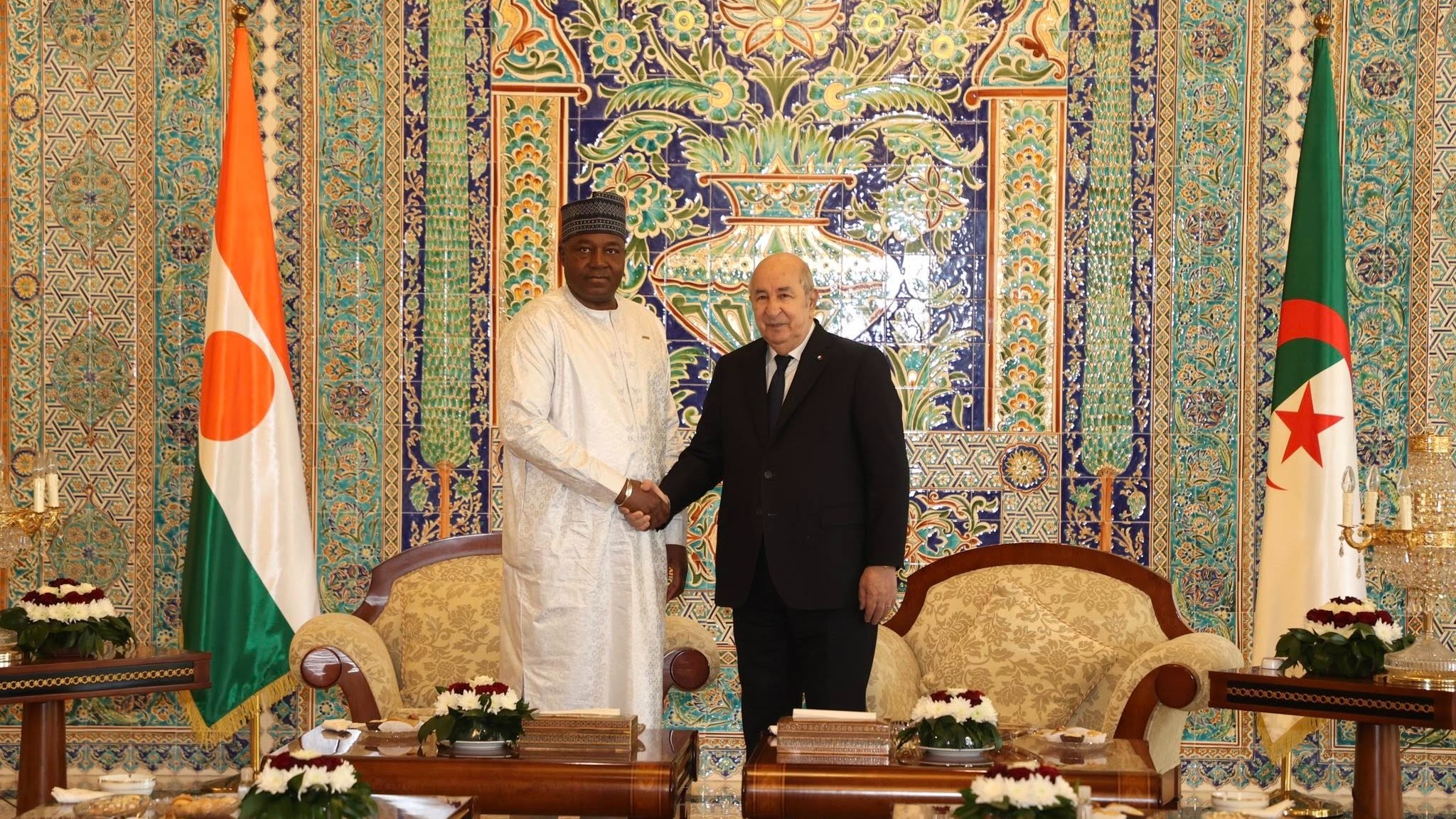
An Algerian military convoy arrived in Niger last Friday, marking the country's first deployment of forces abroad since 1973, when it supported Egypt in its war against the Israeli occupation of the Sinai peninsula. The deployment marks a major departure from Algeria’s longstanding policy of principled non-intervention. It follows Algiers’ decision to send four fighter jets to Niger on 30 August to thwart an attempted coup against President Abdourahamane Tiani. Although the North African state opposed the 2023 coup that brought Tiani to power, Algerian President Abdelmadjid Tebboune now appears willing to offer the beleaguered leader a much-needed lifeline. Tiani requested the deployment. Speaking on Sunday, Algerian Senator Belkacem Boulghiti said the troops would protect economic infrastructure and oil facilities belonging to Algerian companies. Algeria is “not sending our soldiers to wage war in Niger”, Boulghiti added. New MEE newsletter: Jerusalem Dispatch Sign up to get the latest insights and analysis on Israel-Palestine, alongside Turkey Unpacked and other MEE newsletters Retired senior Algerian diplomat Amar Belani offered a clue to Algiers’ thinking in an article published in October. Belani described growing instability in the Sahel, including Niger, as part of a “destabilisation strategy actively involving the United Arab Emirates, Morocco, Israel and certain French proxies”. Continuing instability in Niger would “directly threaten Algerian interests” and hinder the Nigeria-Niger-Algeria trans-Saharan gas pipeline project, he added. Security imperative Zine Ghebouli, a visiting fellow at the European Council on Foreign Relations (ECFR), told Middle East Eye that the situation in the region “is imposing new security imperatives on Algiers and the necessity to secure its strategic interests, particularly in the energy sector”. This evolving regional situation includes an increasingly strong presence of the United Arab Emirates, with which Algeria severed diplomatic relations in September after “exhausting all means to preserve bilateral relations”. 'Algeria has accused the UAE of being responsible for bloodshed across the region and views the Emirati role as destructive' - Zine Ghebouli, visiting fellow, ECFR The Algerian foreign ministry said it had repeatedly warned Abu Dhabi over its “hostile actions”, devoting significant effort to “drawing the attention of the Emirati side and warning it of the grave consequences that may result from its regrettable and unjustified behaviour”. “Despite these numerous warnings, the United Arab Emirates has persisted in these actions, which have reached a point where they can no longer be considered acceptable or tolerable within the framework of relations between two sovereign states, or remain unanswered,” the statement added. “The fact that Algiers took the plunge to break relations proves that Emirati manoeuvering was deemed by Algerian authorities as explosive and irreconcilable,” Ghebouli said. The UAE’s regional interventions and partnership with Israel have drawn growing opposition from governments across the region. Sudan broke ties with Abu Dhabi over its documented funding and fuelling of the country’s bloody civil war. Somalia, Libya and Yemen have also accused Abu Dhabi of threatening their territorial integrity through its support for rival armed groups and separatist forces. Analysis: How Algeria came to treat the UAE as a national security threat Read More » “For Algiers, Abu Dhabi’s diplomatic, financial and military support to several actors in the region from Libya to Sudan and the Sahel serves divisions,” Ghebouli said. “Algeria has accused the UAE of being responsible for bloodshed across the region and views the Emirati role as destructive. Also, the Emirati lobbying and pressures on regional actors to expand the Abraham Accords was another point of discord,” he added, referring to the normalisation deals with Israel and Arab states, including Morocco. In recent years, the UAE has intensively cultivated relationships with the Sahel’s military regimes through high-level diplomacy, gold trading and investment. In May 2025, Emirati minister Sheikh Shakhboot bin Nahyan met the leaders of Mali, Burkina Faso and Niger to discuss cooperation in economic development, energy and other sectors. Mali’s government explicitly included security among the subjects discussed. “The Sahel has long been considered as an extension of Algerian national security and Algiers now is actively acting based on that,” said Ghebouli. “Current geopolitical shifts and all that entails in regards to rivalry with and interventions of foreign actors mean that new tools, such as a show of presence including at the military level, are no longer a taboo and will be utilised to draw and reinforce Algeria’s redlines,” he added. Competing energy corridors Eastern Libya’s de facto ruler, Khalifa Haftar, presents another concern. The UAE backs Haftar, who commands the Libyan Arab Armed Forces (LAAF). His military expansion towards the corridors connecting Libya and Niger has heightened Algerian concerns about Emirati influence along its southern flank. 'By securing Niger, Algeria is protecting its own answer to the Morocco-UAE axis' - Dr Fatiha Dazi-Heni, senior political scientist at Irsem “Algeria has had a poor relationship with the Haftar family for several years, and the mutiny in Niger in the last days of August illustrated it,” Jalel Harchaoui, a Libya analyst affiliated with the Royal United Services Institute, told MEE. Haftar’s son Saddam supports Mahamoud Sallah, a Nigerien opponent of Tiani. “Saddam Haftar and the Algerian state are on opposing sides,” Harchaoui said of Niger. “That being said, observers mustn’t assume that Algeria is intervening in Libya. Its current effort is to deploy troops on Nigerien soil, so its mission relates to what happens inside Niger: maintaining security within a framework that will become clearer over the coming days and weeks,” he added. Turkey’s rapprochement with Haftar in October could help Algeria consolidate its foothold in the Sahel. Ankara and Algiers maintain close diplomatic relations and share interests in Libya and Sudan, potentially giving Algeria a back channel to Haftar. Rabat is also making overtures to the Haftar family, according to reports. Lieutenant General Khaled Haftar, another of Khalifa Haftar’s sons and chief of the general staff of the eastern Libyan forces, paid an official visit to Morocco last month. The Sahel, a new front in the rivalry between Algeria and Morocco Read More » Separately, energy and economic interests also underpin Algeria’s approach to Niger. Algeria’s national energy company Sonatrach, the Nigerien government and the Nigerian National Petroleum Corporation are jointly developing a 4,000-km pipeline to carry Nigerian gas through Niger and Algeria and onwards to Europe. “The troops are meant to protect energy installations, notably Sonatrach’s oil projects and the corridor of the Trans-Saharan Gas Pipeline”, said Dr Fatiha Dazi-Heni, a senior political scientist specialising in the Arabian Peninsula at Irsem in Paris and Sciences Po Lille. Morocco is promoting a rival pipeline along an Atlantic route, drawing on the same Nigerian gas reserves to supply the same European markets. Crucially, the UAE has agreed to support the Nigeria-Morocco pipeline financially and technically. “Niger is the one country the overland route cannot bypass. By securing Niger, Algeria is protecting its own answer to the Morocco-UAE axis. Rabat and Abu Dhabi clearly have an interest in the Atlantic route prevailing, and Israel indirectly through its partnership with Morocco,” Dazi-Heni told MEE. “Algeria’s traditionally cautious strategic culture” now reflects “the new strategic constraints it faces”, she added.
How the UAE-Israel-Morocco threat pushed Algiers to send troops to Niger
Full Article
Original Source
Read the full article at Middleeasteye →KhanList aggregates and links to publicly available news content. We do not host full articles from third-party sources. Always verify important information with original sources.