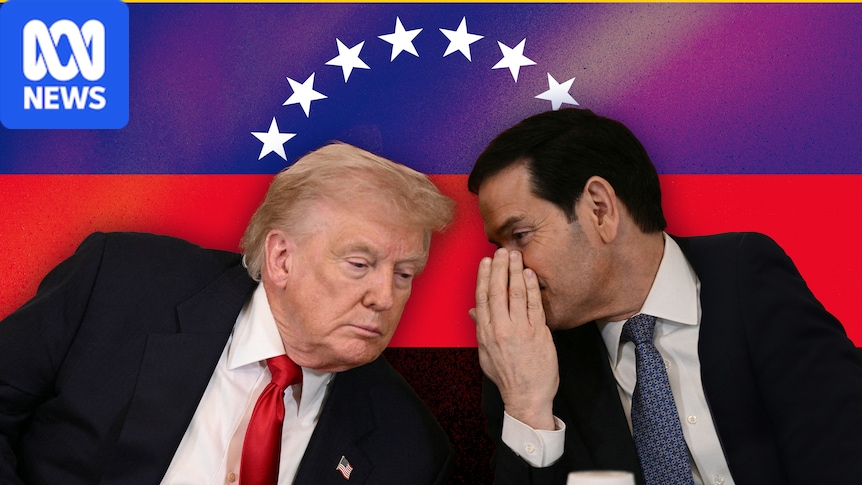
US President Donald Trump frequently boasts about how much money the United States has taken from Venezuela.Ever since the US military captured then-leader Nicolás Maduro in a brazen operation in January, major decisions about the country's future are being heavily influenced or made from Washington DC.Some experts see it as a move towards colonial administration and have labelled Venezuela a US "protectorate in all but name".A murky system of money movement has been implemented by the US too.Recent reports suggest more than $US13 billion ($18.6 billion) has been collected by the US from Venezuelan oil sales, but Mr Trump has said he thinks it is "even more than that"."We're taking in a lot of money — billions and billions of dollars from Venezuela," he recently told reporters on Air Force One.At the same time, more than half the Venezuelan population is believed to be living in extreme poverty. Venezuela has been in a severe economic depression for 13 years.Catastrophic twin earthquakes in June have only worsened the country's economic and humanitarian crises.Who is running Venezuela?When the US captured Mr Maduro and his wife, the structure of his regime and the powerful cabal of individuals below him remained in place.His vice-president Delcy Rodruiguez assumed the role as interim leader.Delcy Rodríguez is now the face of Venezuela's government, but does not have ultimate control. (Reuters: Leonardo Fernandez Viloria)Mr Trump made it overtly clear after the raid that if she did not sufficiently bow to US pressure she could face the same fate as her former leader.So, after years of hostile relations, Venezuela appears to be following American orders.But the US president is not believed to be the man pulling the strings. Rather, it is his secretary of state who is giving the orders."The decision-making seems highly concentrated in Marco Rubio's office in the White House," Benjamin Gedan, the Latin America program director at the Stimson Institute think tank, told the ABC.The New York Times reported Mr Rubio regularly messages Ms Rodriguez on WhatsApp, influencing and directing Venezuela's day-to-day operations.He reportedly has direct control over the country's export revenue and sets out the conditions on how its public funds can be spent. This gives him leverage over Ms Rodriguez, who is dependent on those funds to pay officials and keep the country running.Under this arrangement, there has been "no questioning by the Trump administration of the Delcy Rodriguez government's political legitimacy", says Francisco Rodriguez, a former economic advisor to the Venezuelan national assembly.That is despite the fact she is an unelected leader, and the government she is a part of claimed power in a widely condemned, fraudulent election in 2024.Where is the oil money?Venezuela holds the largest proven oil reserves in the world. Oil revenue makes up about a quarter of the country's GDP.But for the past six months, revenue from oil sales has been going into an American bank account, controlled by the US."In return, the US is transferring a fraction of the proceeds of those oil revenues to the government of Venezuela," says Mr Rodriguez, who is now a researcher for the University of Denver's Center for Economic and Policy Research."We don't know exactly what that fraction is. There isn't that much transparency."Donald Trump has said the US has taken "billions and billions" of Venezuela's oil profits. (Reuters: Gaby Oraa)The Venezuelan government presents regular budgets to the US for approval before money is sent over, meaning decisions for the Venezuelan people are being authorised by the Trump administration.Mr Rodriguez says this form of governance is similar to colonial administration and means Venezuela does not have the ability to use its own resources at will."The US has the Venezuelan government on a short financial leash," he says.Mr Gedan says it is "hard to justify why the United States has the legitimacy" to control the country's finances and it has no legal basis to do so.But it is "in some ways defensible", he says, because the Venezuelan government has "diverted hundreds of billions of dollars over the decades in oil revenue to buy off elites in order to preserve this unpopular regime"."Maybe the United States could better channel these monies into development projects and in a less politicised manner," he says.Is the US keeping any of the money?Mr Trump has said the money collected from Venezuela is going towards "running the country".But he has also claimed that, through holding Venezuela's oil revenue, the US has been reimbursed for its military operation to capture Mr Maduro "many times over"."There's these sorts of bizarre cryptic remarks from Trump that suggest maybe the US is siphoning some of these funds, retaining them," Mr Gedan says."[That] gives the impression that actually the United States is keeping some of this money. We just don't know."Aid groups warn Venezuela will need international help for years to come following the twin quakes. (ABC News: Cameron Schwarz)Mr Rodriguez says there is "next to no transparency in the use of these funds", but "the US has not, to the best of our knowledge, taken money out of the accounts"."If the US was using money out of these accounts for the purposes of government spending, then this would be considered an appropriation in US law and therefore should be approved by Congress."The US State Department did not respond to detailed questions about how it was managing Venezuela's money and whether the US was keeping any.Mr Rubio told Congress in June that the oil sales were being monitored by accounting firm KPMG and that "every single disbursement" was audited.He committed to providing the audit to members of Congress in June, but so far it has not been shared publicly.Will Venezuela transition to a democracy?Earlier this year Mr Rubio outlined a three-phase strategy for the country — stabilisation to prevent social collapse, economic recovery, and then a transition to democracy.More recently he declared that transition process would begin in early August.The initial steps are set to include talks between the current interim government and a group representing the 2015 legislature, the last group the US recognises as being legitimately elected."They have agreed to set up a format and a forum not just for reconciliation talks but to begin the transition process, which is what the people of Venezuela need," Mr Rubio said recently.But there are concerns this process could drag on and not lead to a timely and meaningful election.The US-backed talks will also not include the leader of the opposition, Nobel peace prize recipient Maria Corina Machado, or the widely recognised winner of the 2024 election Edmundo González Urrutia, who lives in exile in Spain.Mr Trump recently hosed down suggestions that elections in Venezuela would occur soon."They're not really ready for them yet, but boy, a lot of progress has been made. Delcy's been doing a fantastic job," he said in July.Mr Gedan believes while Mr Rubio holds immense influence over Venezuela, it could be limited by Mr Trump's very different view of the country."When Donald Trump sees Venezuela, he sees it as this cash cow that can provide opportunities for the US mining and oil companies," he says."He's much less interested in the regime type and the political transitions that might occur."He seems clearly pleased to be working with Delcy Rodriguez, he praises her constantly … provides all sorts of services to her."They've been protecting her from litigation in US courts, they've advocated for her at the International Monetary Fund, they've been twisting arms for countries to restore diplomatic relations with Delcy Rodriguez."None of this is conditioned on political change."What's next for the Venezuelan people?Despite America's tight grip and control over Venezuela's finances there have not been significant material changes in the country's economy or living standards.The country is deeply in debt and has the highest inflation in the world.According to the Central Bank of Venezuela, the first quarter of 2026 marked the slowest economic growth rate the country had experienced in five years."So after the US took out Maduro, Venezuela's economy did not improve. It deteriorated," Mr Rodriguez says."On top of that now we have the earthquakes, and there has to be a major step-up effort to help reconstruct Venezuela. We are not seeing it."Aerial images taken a month after the earthquakes showed the city of La Guaira remained devastated. (Reuters: Leonardo Fernandez Viloria)The devastating natural disaster in June that killed more than 5,000 people has only exacerbated the turmoil the country is in.It has left nearly 18,000 people homeless. Disease and health issues are spreading."We're seeing a lot of folks come through with diarrhoea, respiratory infections, skin diseases," Carolina Nelson from Project HOPE, a humanitarian relief organisation working in Venezuela, told the ABC from Caracas."This is all really a consequence of going into temporary refuge camps and being exposed to a lot of dust, sunlight and the overall conditions of these temporary camps."The US sent more than 1,000 personnel to help in the aftermath of the quakes. It says it has also provided more than $US386 million ($550 million) in financial assistance.But the World Bank estimates the earthquakes caused more than $US19.6 billion ($28 billion) in direct physical damage, and the overall reconstruction bill could be more than double that figure."If the economic benefits [of Venezuelan oil sales] to the US are as large as President Trump is saying then it would seem like the US should have a greater responsibility to at least help coordinate the raising of these funds for the earthquake reconstruction," Mr Rodriguez says.The twin earthquakes in Venezuela killed more than 5,000 people and left more than 18,000 homeless. (ABC News: Cameron Schwarz)Twenty-nine nations provided on-the-ground assistance after the quakes, but aid groups say it will be the months and years to follow when Venezuela will need sustained support and investment."Going from the very immediate phase we need to raise awareness around the prolonged recovery phase and what that means for families, for children who have lost their parents, what it means for those who have lost their entire homes and livelihoods as well as their jobs," Ms Nelson says.
How the Trump administration runs Venezuela and takes its money
Full Article
Original Source
Read the full article at Abc →KhanList aggregates and links to publicly available news content. We do not host full articles from third-party sources. Always verify important information with original sources.