
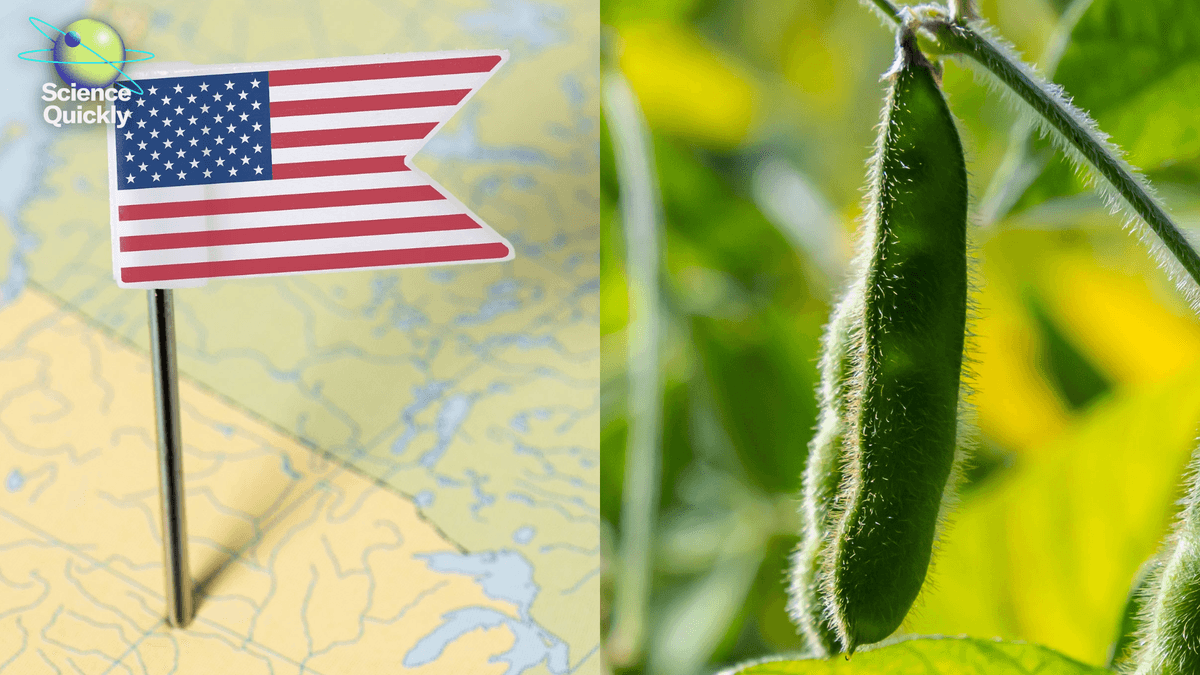
Rachel Feltman: For Scientific American’s Science Quickly, I’m Rachel Feltman.When you think about soy, what comes to mind? Maybe some salty edamame or a crispy chunk of fried tofu? But soybeans are actually kind of everywhere, from the oil most of your food is cooked in to the fuel that powers many of our vehicles. These days, almost half a billion metric tons of soybeans are grown globally in a year.Environmental historian Edward Melillo recently wrote about how this humble legume quietly became one of the world’s most important crops—and why it’s almost impossible to avoid. He’s here to give us the inside scoop on soybean’s meteoric rise.On supporting science journalismIf you're enjoying this article, consider supporting our award-winning journalism by subscribing. By purchasing a subscription you are helping to ensure the future of impactful stories about the discoveries and ideas shaping our world today.Thanks so much for coming on to chat with us today.Edward Melillo: Thank you for having me.Feltman: So I would love to start with just a little bit about what it means to be an environmental historian. It sounds like such an interesting field to be in.Melillo: Sure, sure. So it’s a fascinating field, and I come by it very honestly. My dad is an ecologist, and my mom is a historian. And so I intertwine two limbs of the family tree and get paid to do it, which is a joy. And I study the way people understand and interact with nature in the past, and I mostly do that in the context of the Pacific world, the countries and cultures in and around the Pacific Ocean. I’ve spent a lot of time there, and I very much enjoy thinking about the, sort of, interactions in the past.Feltman: So you wrote an article for the Conversationcalled “How Soybeans Took Over the American Diet—Without Anyone Noticing.” So let’s start with some context. How big a part of the American diet are soybeans?Melillo: They’re extremely big. I mean, the soybean has become ubiquitous in the American diet. Sixty percent of processed foods contain some form of soy. And the numbers are really staggering; 2026 is on track to become a record soybean harvest for the U.S. It’s 4.52 billion bushels of soybeans to be harvested this year. And I did the math, and that adds up to about 800 pounds of soybeans per American. We’re not consuming all that as, sort of, soybeans on a plate because it becomes animal feed—it’s a product, as I said, that’s in all sorts of foods—and then it’s increasingly becoming a source of feedstock for biodiesel.And so trucks and buses and commercial airplanes and passenger airplanes and, in addition, some cars are being powered by soy oil. And so soy is everywhere, at all times, and we hardly notice it, but you kinda can’t turn one way or the other without seeing something that’s got soy in it.Feltman: A lot of our listeners, when they think of soybeans, they think of tofu. Where else is soy actually showing up?Melillo: Oh, it’s, it’s absolutely everywhere. I mean, it’s in chocolate, in mayonnaise, in baby formula. And almost all the frying oil that’s used these days in the U.S. has soy oil in it. And I came to know this actually because my wife is allergic to soybeans. And there are about 1.5 million Americans who have a soy allergy, and most people don’t really think about that.We go to restaurants, and folks will say, “Oh, we’ve got gluten-free alternatives.” And she’ll say, “Well, gluten isn’t the problem here at all. I love, love gluten in my bread, but it’s soy.” And, that’s led us down the road of, kind of, looking on menus and asking at restaurants. And as we’ve eaten, we’ve learned that soy is absolutely everywhere. It’s often used as an emulsifier to keep fats and solids from separating, and that’s in all sorts of products.Feltman: Well, let’s talk a little bit about the history of the soybean. You know, where did it come from, and how was it first used in America?Melillo: So the soybean—and its scientific name is Glycine max—was domesticated somewhere between 6,000 and 9,000 years ago in China. But it wasn’t until about 1764 when a sailor named Samuel Bowen, who had been spending time in China, brought some of these back as a souvenir to Savannah, Georgia. And he planted them, and they grew with reckless abandon. There were three or four harvests that first year, when they were planted on the surveyor-general’s farm in Savannah. And after that, Bowen tried to make a soy sauce from these soybeans, something similar to what he had seen in China. He died shortly thereafter, and the soybean kind of fell into unuse after that for a while.But then, at the turn of the century, at about 1900, the U.S. agricultural experiment stations throughout the country began experimenting with soybeans as a possible animal feed. And that’s how the early history of the soybean kind of takes off, mostly being fed to animals. But then, in the 1930s, Henry Ford began a long-standing romance with the soybean. He became enamored of its possibilities as an industrial ingredient.Melillo: And his vision really was that it would be a kind of vegetable steel, where American farmers could grow this crop that Ford could then use in his car factories as a basis for making paints and plastics and all sorts of other car components.And by 1935 or so, it’s estimated that Ford was using about a bushel of soybeans in every car coming off of his factory line. So Ford not only was interested in using the soybean to make cars, but he also thought the soybean was the future of food.And he had some discontents with that theory. Some of the people working for him didn’t so much appreciate some of the, the, the soy baked goods that he was producing. But, uh, that did not deter Ford. And in 1934, at the Chicago’s Century of Progress Exposition, reporters showed up and were treated to a banquet where every single food item was soy-based. There were soy biscuits and soy cheese and soy coffee and even an apple pie made with a soybean crust.Feltman: “Protein maxxing” at the World’s Fair.Melillo: [Laughs]. Right. Right. Uh, the reporters were kind of shocked, but some of them predicted, “Well, this may be the future of food.” And so Ford, sort of, carried that vision on.And it is worth pointing out the dark side of the story because Ford, unfortunately, was a virulent antisemite. And in The Dearborn Independent, he published these antisemitic rants, and he actually received honors fr†om the Nazi government. And so Ford is a, sort of, contradictory figure in the whole story, but he certainly helped shape where, where soy began to enter U.S. markets in, in all these different ways. And things then sort of carried on into the postwar era in some different directions.Feltman: Yeah, no, I’d, I’d love to hear about how soy went from being, you know, this kind of alien food ingredient, you know, that reporters were being presented with to being so ubiquitous in processed food.Melillo: Yeah, so during the Second World War, the U.S. had been importing a lot of oil from Southeast Asia and other places that kind of went offline. And so, given these shortages, food producers started to turn to soybean oil as an alternative, and they learned that you could hydrogenate the oil by adding hydrogen to it and make it into a solid. And that solid provided the basis for margarine. And so, you know, during and after the Second World War, the rise of margarine is one of the food stories of U.S. history. Margarine begins to displace butter as one of the solids that Americans are consuming. And then, from there on, it’s just sort of a story of soy entering the U.S. diet from all sorts of different directions.Producers figured out that you could use a chemical called n-hexane to get the oil and the solids out of soybeans, and you can feed the solids to animals—cows, pigs and chickens—and then you can use the oil in food production. And that oil began to enter all sorts of products, you know, and today we have an economy that’s, that really is driven by soy, and we hardly know it. It’s kind of all around us.Feltman: And the ubiquitousness of soy is sometimes pretty controversial. Could you talk a little bit about, you know, the downsides or even just, you know, culturally perceived downsides of all this soy?Melillo: Well, one of the tricks is that soybeans are heavily genetically modified. Ninety-seven percent of soybeans are. And the reason for that is that it makes the soybean herbicide tolerant. But then, of course, when the soybean is processed, all those herbicides and other chemicals stay in the soybean. And so one of the questions is: We’re consuming all this soy. What else are we consuming in the process? And that’s controversial, and there’s a lot of scholarship on both sides of that. But that is certainly an issue.The other’s just: If you’ve got a soybean allergy, it’s really hard to tell that soy’s in the food you’re eating. ’Cause when you go out to a restaurant and stuff is fried, it’s fried in vegetable oil, but that’s one of the terms under which soy masquerades. And vegetable oil often contains soy oil. You don’t know if it’s canola oil or some other vegetable oil, but it often has soybean oil. So it’s also just hard to tell where it’s lurking in your diet.The thing about soy is its versatility. As I said, it shows up in animal feed, in fuel. It’s an emulsifier. It’s in frying oil. And so it gets involved in all sorts of things like trade wars. China’s now the world’s leading consumer of soybean meal, the solids that come from soy—and that’s because China’s trying to feed 1.4 billion people, and a lot of the soy’s going into animal feed.And one of the principal exporters to China is the U.S., so these trade wars that have been going on with Trump and China have often been soy-centered. China had slapped 25 percent tariffs on soy imports at one point, and now those tariffs are lowered, and so U.S. farmers can begin exporting soybeans to China again.But the other big issue is that Brazil is one of the other leading producers of soybeans. And soy farming is one of the leading causes of deforestation in the southwestern Amazon. And so, in states like Mato Grosso, you see huge swaths of forest being cut down to create soybean plantations to grow soy for animal feed export.And we can start to see the cascades of problems that might arise from those patterns. And so soy gets implicated in all sorts of things, from deforestation to trade wars, in ways that you wouldn’t have expected and and couldn’t have even anticipated when you were in Henry Ford’s kitchen in the 1930s.Feltman: I guess one last question I have is just that, you know, being such a versatile crop that has now gotten into so many industries, so many products, what do efforts to replace soy look like? You know, if we’re talking about areas where people are concerned about deforestation or, you know, concerned about pesticide contamination, what crops do we see stepping up to take some of the soybeans off of our plate?Melillo: There’s not a lot at the moment. I mean, soy is just going gangbusters, and it’s closed in on corn as, as the leading crop grown in the U.S. several times. In 2018, in fact, soy surpassed corn. And the world seems to be turning to soy in more ways than one. Europe is still a holdout. You can travel fairly extensively throughout Europe and not encounter this, sort of, ubiquitous soy. They use canola oil, rapeseed oil, for some of the same purposes. But throughout much of the world, it’s a soy-hungry world, and soy is doing really well. If you were to think of this as a plant success story, this is nearing the apex for soy. And so that’s one way to think about this.Feltman: Well, you know, I know this is maybe gonna come more from personal experience than from your scholarly work, but what advice do you have for people who do need to try to avoid soy and are, you know, kind of, newly confronted with, uh, how it’s everywhere?Melillo: You have to read ingredient lists carefully and be really direct in restaurants because often your servers, uh, and even the people cooking in, in those restaurants won’t know that soy is there. And so you have to ask them to read the label on the cooking oil. And it just takes a lot of effort to figure this puzzle out because, as I said, it’s sort of everywhere.Michael Pollan, who writes a lot about plants, had suggested, at one point, that you go to a gas station, and you’re putting corn into your body and corn into your car, ’cause there’s corn syrup in everything on the shelves at the gas station, and there’s corn ethanol in the fuel. But that’s now becoming true, as well, of soy, where soy is absolutely everywhere in the food we’re eating, but it’s also because of, you know, these federal, renewable fuel mandates have put soy at the top of the list as an ingredient that can go into creating biodiesel. And so we’re seeing the same thing happening that happened with corn with soy for sure, where it just is everywhere at all times, but yet it’s quite invisible.Feltman: Hmm. Well, thank you so much for coming on to chat with us today.Melillo: Thank you so much for having me. It was a real pleasure to talk with you.Feltman: That’s all for today’s episode. We’ll be back on Friday to talk about another commodity that’s taken the nation by storm with surprising speed: artificial intelligence.Science Quickly is produced by me, Rachel Feltman, along with Fonda Mwangi, Sushmita Pathak, Allison Rodgers and Jeff DelViscio. This episode was edited by Alex Sugiura. Marielle Issa and Aaron Shattuck fact-check our show. Our theme music was composed by Dominic Smith. Subscribe to Scientific American for more up-to-date and in-depth science news.For Scientific American’s Science Quickly, this is Rachel Feltman. See you next time!
How the tiny soybean took over the American diet
Full Article
Original Source
Read the full article at Scientificamerican →KhanList aggregates and links to publicly available news content. We do not host full articles from third-party sources. Always verify important information with original sources.