
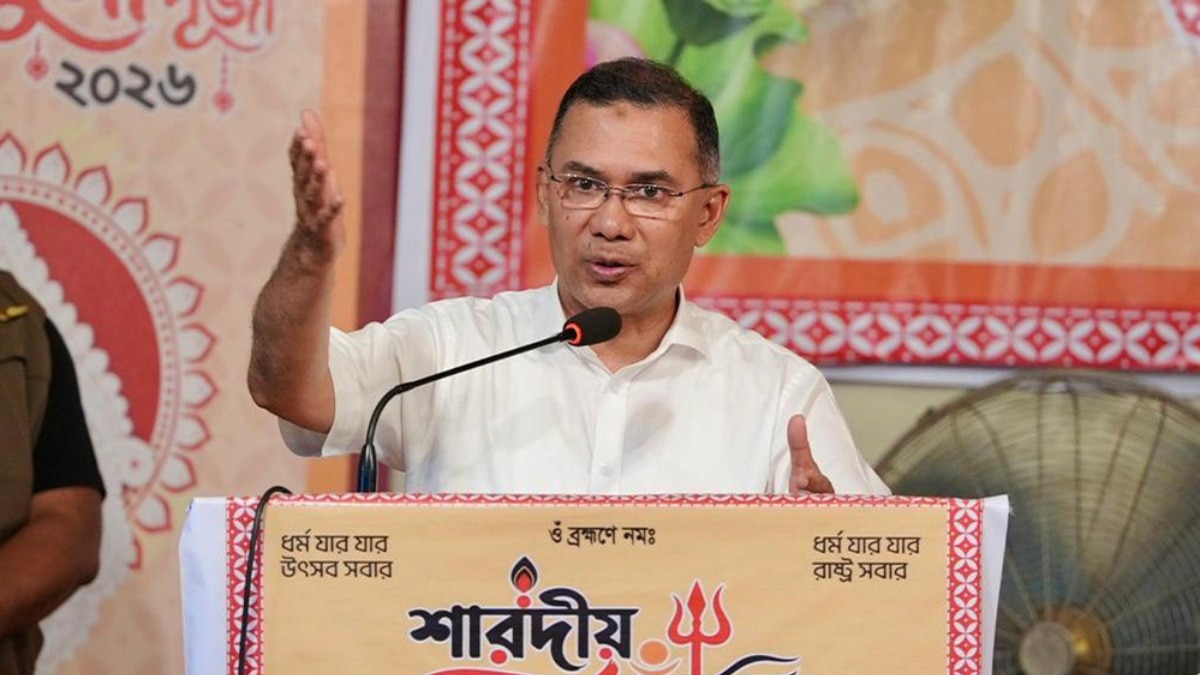
A sea of women in white saris with red borders danced through the streets as an immersion procession wound its way down Durga Bari Road in Mymensingh. To anyone watching the viral video, it could easily have been Kolkata or any other corner of West Bengal, where Durga Puja is as much a cultural spectacle as a religious observance.But this was Bangladesh.And for many Bangladeshi Hindus, that moment of unguarded joy carried a significance beyond festivity. In recent years, Durga Puja has often unfolded under the shadow of anxiety, with fears of attacks on families, temples and neighbourhoods becoming an unwelcome part of the annual ritual. This year, community leaders say, the atmosphere felt different.They credit the Bangladesh Nationalist Party (BNP) government led by Prime Minister Tarique Rahman with making security a central priority during its first Durga Puja in office. At the start of the festivities on October 16, Rahman publicly articulated that approach: “Religion is personal, but the nation belongs to everyone... Everyone has a right to security.”The message was backed by an unusually extensive security operation. The government deployed 6,000 security personnel, 550 pick-up vans and 450 motorbikes across the country to safeguard approximately 33,861 pujas. In Dhaka alone, the Metropolitan Police assigned 2,100 personnel to maintain order at 257 puja venues, including those organised by the Mahanagar Sarbojonin Puja Udjapan Committee.For a community accustomed to celebrating amid apprehension, the scale of the preparations was impossible to ignore.“In the past few years, the fear of violence has become a part of celebrating Durga Puja in Bangladesh. However, this year the arrangements made by the government were phenomenal,” says Subhashis Kumar Biswas, general secretary of the Mahanagar Sarbojonin Puja Udjapan Committee, which organises celebrations on the campus of the Dhakeswari National Temple.Rahman’s visit to the puja on October 20 carried a symbolism of its own. Having become prime minister in February, this was his first Durga Puja in office and, in many ways, an early test of his government’s commitment to minority security. The prime minister also visited several other pujas across the country. President Mirza Fakhrul Islam Alamgir, too, visited the Mahanagar puja.More Than a Security StoryThe shift was visible not only in policing but also in the government’s handling of the festival itself. For years, Hindu organisations had pressed successive governments to extend the holiday period around Durga Puja so devotees could participate fully in the celebrations without work-related constraints.“We have always demanded a longer holiday during puja,” Biswas says. “The interim government extended the holiday by a day and the new government added another. So there were three government holidays. With the weekend added, we had five days off.”According to him, Home Minister Salahuddin Ahmed has also promised that the three-day government holiday will continue from next year.Senior political leaders were drawn directly into overseeing the arrangements. Iqbal Hasan Mahmud Tuku, a minister in Rahman’s cabinet, says the prime minister deputed ministers and MPs to monitor law and order in their respective constituencies during the celebrations, while also personally visiting several puja venues.“I was in-charge of my district Sirajganj,” Tuku says. Satyanarayan Sarda, advisor to the Sirajganj unit of the Puja Udjapon Committee, the umbrella organisation that represents the Hindu community and oversees Durga Puja celebrations across Bangladesh, says Tuku’s wife and former MP Rumana Mahmood visited several pandals in the district.“The government has also increased the financial assistance to puja committees,” Sarda says. “Bad elements of the society have always tried to disrupt peaceful puja events. But the government ensured they couldn’t make a mess this time. This security was missing in our pujas.”A Test That Could Have Gone WrongThe celebrations were not entirely free of alarming incidents. On October 18, police detained a 28-year-old man, Md Yusuf Ali, at the Sri Sri Radha Gobinda Central Temple in the Ambagan area of Konabari, Gazipur, after he allegedly set fire to a copy of the Quran inside the temple. According to accounts of the incident, he entered the premises with his eight-to-ten-year-old son and ignited the book in front of the idols. Temple security personnel and police stationed there quickly extinguished the fire and took both father and son into custody before questioning the man.The episode was a stark reminder of how quickly a religiously sensitive provocation could ignite a wider crisis. Yet it was equally a demonstration of what swift intervention can achieve. Security personnel contained the situation before it spiralled into communal confrontation, allowing the festivities to continue uninterrupted.For many Hindus, that distinction is crucial. The absence of major violence does not necessarily signify the absence of threats. It can also be evidence that preventive measures worked.The Long Shadow of ComillaThat sense of relief is inseparable from memory. The trauma of the October 2021 violence continues to shape how Bangladesh’s Hindu minority experiences Durga Puja. On October 13 that year, a copy of the Quran was found at a temporary puja pavilion in Nanua Dighir Par in Comilla. Rumours spread rapidly on social media. Mobs attacked the pavilion, and the violence soon expanded into districts including Chandpur, Noakhali, Chattogram and Rangpur.Temples and idols were vandalised. Hindu homes and businesses were torched. At least seven people were killed, according to contemporary reports. The authorities deployed additional police, the Rapid Action Battalion and Border Guards Bangladesh to contain the unrest. But the aftermath generated fresh grievances. By July 2022, police had still not filed a charge sheet in the principal case, fuelling concerns over accountability and justice.As Durga Puja approached the following year, security was tightened in Comilla, with round-the-clock guards at pandals and intensified patrols. A festival meant to embody devotion and celebration had become one marked by vigilance and fear. The community’s demand, therefore, has never been only for protection. It has also been for accountability.Security, and Still the Search for JusticeThe anxieties did not end with Comilla. Reuters documented attacks on Hindu homes, businesses and temples following Sheikh Hasina’s ouster in August 2024. In September 2025, Bangladesh police reported 49 incidents associated with Durga Puja, alongside 15 cases and 19 arrests.For many community members, the issue extends far beyond the festival season. In 2025, a series of attacks on minorities culminated in the December lynching of 27-year-old garment worker Dipu Chandra Das in Mymensingh over alleged blasphemy. His body was reportedly hung from a tree and set on fire. Days later, Hindu businessman Khokon Chandra Das was stabbed and set ablaze in Shariatpur, deepening concerns over minority safety and the pace of justice.There have been several other incidents, and according to Biswas, accountability remains elusive in many of them. “We want justice,” he says. “And we hope to see a time when heavy security cover will not be necessary for us to celebrate our pujas.”That aspiration captures both the achievement and the limitation of this year’s Durga Puja. The government appears to have succeeded in delivering a festival largely free of major violence. But for Bangladesh’s Hindus, security alone is not the destination. It is the minimum condition for reaching something larger: a future in which joy does not need armed protection, and faith can be practised without fear.Subscribe to India Today Magazine- Ends
How the Tarique Rahman government ensured a peaceful Durga Puja
Full Article
Original Source
Read the full article at Indiatoday →KhanList aggregates and links to publicly available news content. We do not host full articles from third-party sources. Always verify important information with original sources.