
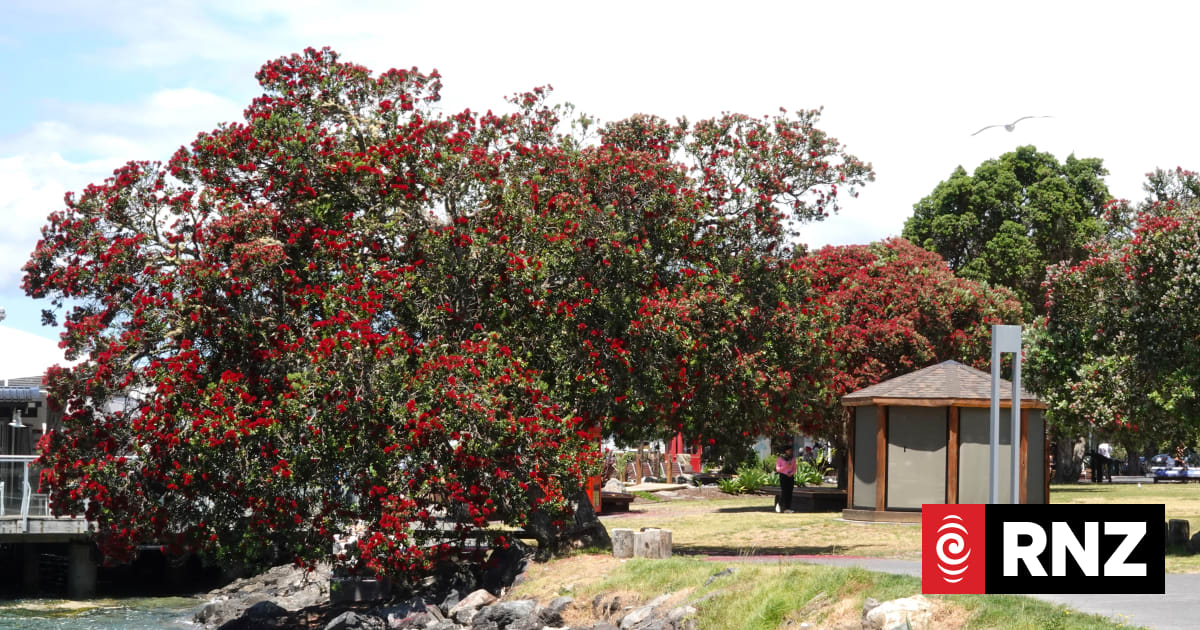
Nothing signals a Kiwi summer quite like red stamens scattered across the bonnet of a seemingly abandoned car just up the road.Pōhutukawa have started to bloom. But as iconic as they are, it's easy to take Aotearoa's Christmas trees for granted.One man who would never do that is University of Auckland Associate Professor of Biological Sciences Bruce Burns.He told RNZ's First Up there are more varieties of pōhutukawa than many New Zealanders might realise."There's at least 42 different cultivars that are produced around the country for planting in gardens and so on."Of course there's the main wild pōhutukawa but as well as that, we have a number of species of pōhutukawa that we have planted within New Zealand that come from different parts of the Pacific."Those include species from Tahiti and the Kermadec Islands."We have a Tahitian pōhutukawa which is quite common in gardens around Auckland, which is Metrosideros collina, a different species, and we also have a species from the Kermadec Islands, Metrosideros kermadecensis, and that's slightly different from our wild pōhutukawa."While pōhutukawa are now a familiar sight around much of New Zealand's coastline, their natural range is much smaller.Burns says the native pōhutukawa is originally a North Island tree."In terms of distribution, the natural range of our wild pōhutukawa only really goes down to a line from about Gisborne to Taranaki, so going south, anything in the South Island has been planted."But of course if you go down to Wellington, we have a lot of planted pōhutukawa people have brought to Wellington and they've naturalised."A view of a beach on Waiheke Island, framed by pōhutukawa flowers.Supplied/ Auckland CouncilThe trees have also established themselves along parts of the South Island coastline, having originally been brought there by people."It does also grow down the South Island around the coast and that has also been brought to that area by humans. So in terms of the genetics, they will have been derived from the North Island pōhutukawa originally."And while the pōhutukawa is famous for its vibrant red flowers, not every tree puts on the same display.Some produce golden, white or even pink blooms."There is a very beautiful golden or yellow pōhutukawa that was discovered on Motiti Island in about 1940, a sort of genetic mutant, if you like, and that's been planted in various places around the country as well."There's a yellow variety but there is also, occasionally, very occasionally, you'll get a white pōhutukawa or even a pink pōhutukawa."And if you're lucky, you might spot pink-flowering pōhutukawa around Rotorua."Unusually, there are some wild pōhutukawa growing inland around the Rotorua lakes and they're known for having a sort of very pinky-coloured flower rather than the vibrant red that we're so used to."The flowering season stretches from late November to early February, but individual trees only bloom for around two weeks.Burns says the trees stagger their flowering across that period."Interestingly, it seems if a pōhutukawa flowers early one year, it will flower early within that window in subsequent years."So they don't all flower together, although there is a peak of flowering of course just sort of mid-December coming up to Christmas, which is why we call it our wonderful Christmas tree."Pohutukawa tree taken at Cornwallis Beach, West AucklandKauhura, Wikimedia CommonsBut New Zealand's beloved Christmas tree hasn't stayed within our shores. And in some places overseas, it's become an unwelcome guest."We often in New Zealand complain about invasive plant species that have been brought from other countries, but we're not innocent ourselves in contributing to invasive species in other parts of the world, and pōhutukawa is actually one of those."Burns says pōhutukawa have been introduced to California and South Africa, where they have become problematic in some areas."San Francisco and California itself has a number of pōhutukawa that were brought over there, but they're also around Cape Town in South Africa. There's a number of pōhutukawa and in that situation they've become sort of invasive and a bit of a problem."Across the Tasman, pōhutukawa are also sold in Australian plant nurseries.And perhaps one of the most intriguing examples of a pōhutukawa abroad is a famous tree in the Spanish city of La Coruña."There is also a famous pōhutukawa in Spain in La Coruña which has been the subject of some discussions about how it actually got there."Theories include the tree being taken to Spain by early Spanish or Portuguese sailors who visited New Zealand, or by British forces during the Napoleonic Wars.
How the pōhutukawa went global
Full Article
Original Source
Read the full article at Rnz →KhanList aggregates and links to publicly available news content. We do not host full articles from third-party sources. Always verify important information with original sources.