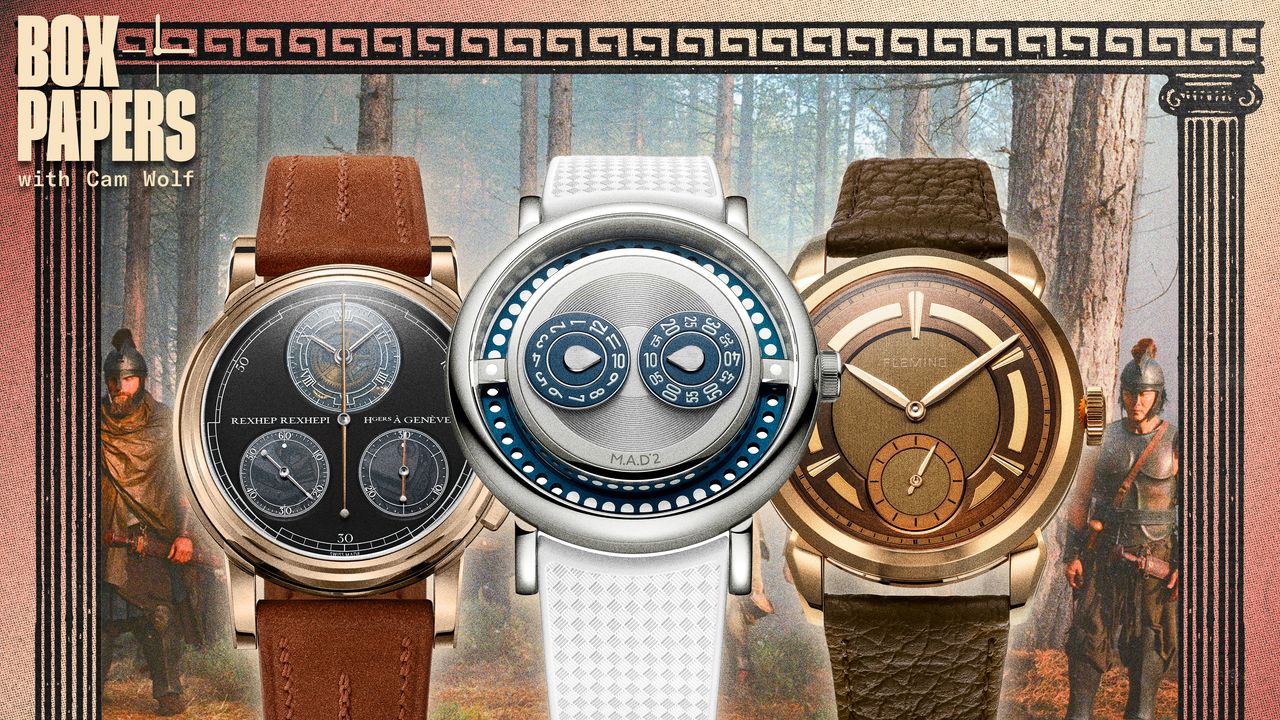
This is an edition of the newsletter Box + Papers, Cam Wolf’s weekly deep dive into the world of watches. Sign up here.AI slop is everywhere. It’s in our entertainment, our restaurant menus, even our clothing. Thankfully, the backlash to cheap workarounds and lazy digital fakery has never been stronger or more widespread. It’s partly why Christopher Nolan’s The Odyssey—which required thousands of people working for months on end to create—is receiving so much praise right now. And it’s also why this would be a particularly great time to work in an industry built on, say, analog technologies, intricate mechanical wizardry, and artisanal handicrafts.I know what you’re thinking: This guy will find a way to connect ANYTHING to watches. But it’s hard to deny the parallels between the recent explosion in the luxury watch market and the revival of theatrical moviegoing. Suddenly, it’s cool to have outrageously dorky conversations about the media we engage with—the exact types of dialogues that watch collectors have been having for decades. Consider the video that Ryan Coogler made breaking down the different film aspect ratios you could see Sinners in, or the way that tickets to The Odyssey in 70mm have become sought-after grails. Technical jargon has suddenly become the lingua franca of the hip, which is a major boon for watch brands, who love to throw around complicated terminology. Twin beat perpetual calendar! Open-worked minute repeater tourbillon!If you examine what’s happened in Hollywood this year, it’s easy to understand why more and more people are being drawn into watch collecting. Critics have lauded films like The Odyssey and Project Hail Mary for their use of practical effects, producing ambitious action sequences without the use of green screens and CGI. While those technological advancements originally felt exciting, they quickly became synonymous with empty, vapid filmmaking. That feels reminiscent of the watch industry’s Quartz Crisis. In the ‘70s, quartz movements were hailed as a thrilling new technology—so much so that even Rolex proudly released the Oysterquartz. But as the tech proliferated, enabling increasingly cheap and flimsy watches, collectors have largely returned to desiring mechanical movements. High-end brands now endeavor to create the most technically complex timepieces possible, involving hundreds of components and genius-level watchmakers to create—the equivalent of The Odyssey’s 2,000-person Trojan Horse battle scene stuffed into a watch. It’s not enough for our entertainment or belongings to simply be impressive anymore—we also want them to feel recognizably human.Another phenomenon taking over Hollywood is the success of young directors with original ideas. Backrooms and Obsession—directed by 21-year-old Kane Parsons and 26-year-old Curry Barker, respectively—have both made hundreds of millions at the box office. There’s been a similar rise in auteurs in horology as well, with independent watchmakers like FP Journe, Rexhep Rexhepi, Simon Brette, and Sylvain Berneron all developing massive cult fanbases—and million-dollar auction results following—for their groundbreaking work.No industry is more primed to capitalize on the shift towards the artisanal and human-made than the watch world. While only a select few moviegoers will be able to see The Odyssey in its intended 70mm format, and even the most ardent of vinyl collectors still have to listen to Spotify on the subway, anyone can own a watch with a real-deal mechanical movement for as little as a couple of hundred dollars.While promoting his new epic The Odyssey, director Christopher Nolan has been on a press tour de force, saying all the right stuff about the omnipresent creep of technology in our lives. He’s noticed the backlash among younger generations, including his own children: “Their judgment of AI slop has been immediate and harsh,” he told The Telegraph. Audiences are clamoring for movies like The Odyssey for the same reason they’re ditching smartphones or dumping their Apple Watches. An analog watch can be a tool to help keep us away from these technologies, and the rejection of slop is embedded in its very DNA.See all of our newsletters, including Box + Papers, here
How 'The Odyssey' Explains the Luxury Watch Market
Full Article
Original Source
Read the full article at Gq →KhanList aggregates and links to publicly available news content. We do not host full articles from third-party sources. Always verify important information with original sources.