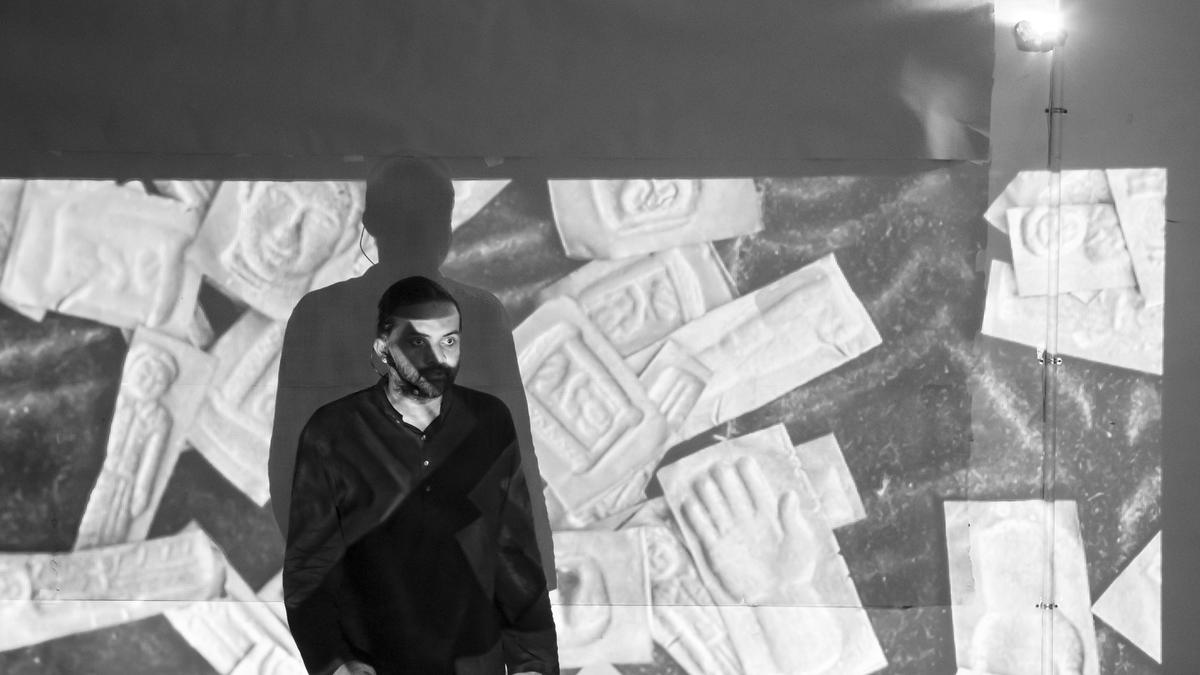
Abheesh Sasidharan sits with his back to the audience — a hooded silhouette against a giant screen, silent, as if in meditation. The intimate performance space is dark and one feels a sense of anticipation building. Abheesh then begins to talk, loudly and clearly, about Meenachilaar, a river which can well be called the lifeline of Kottayam, and his own. He soon creates a world where river, humans and history meet in curious ways.The performance, Meenachil R, begins as an ode to the river, flowing serenely through Abheesh’s childhood. But as he grows, it reveals its turbulent history to him, leading him to stories of generations of people who have lived along its various tributaries. Caste discourseFrom a bitter-sweet story of a childhood spent in the cool, watery embrace of the Meenachilaar, the narrative soon transforms into a powerful caste discourse. It culminates in Manjadikkari, a remote village near Kumarakom in Kottayam, which was believed to have been inhabited by people from subaltern communities who fled caste oppression and slavery in the early 19th century. Abheesh found a deeper anchor for his narrative in author and historian Vinil Paul’s book Manjadikkari: Olichottathinte Vimochana Daivashastram, which is centred around slave trade in the region. Abheesh Sasidharan | Photo Credit: Sudheer C “Manjadikkari was a crocodile-infested marsh. Vinil’s book tells the story of two slaves who escaped along the Meenachilar. They were running away from pain and humiliation to ultimately find and build a land they could call home,” says Abheesh. Meenachil R took its own time to evolve into its current form, says Abheesh. When he started work on it 12 years ago, it was more like an artist’s aesthetic self reflection. Born in Pala, Kottayam district, the river is in the fibre of his being, says Abheesh. He had already done over 13 fictionalised performative works on the river earlier. But something still seemed amiss. “I created a team of artists and researchers. We started a river trail from the beginning and tributaries of the river, followed writings on slavery routes for one year. We collected sounds, visuals and objects from the river. In this performance, I try to share the ‘river experience’ to the spectators with my body, sound, visuals, objects and technology,” he says. His creative collaborator and technical coordinator Sudheer C, was also part of the project. While the performance dwells on history and displacement, it also makes us aware of the river’s geographical and ecological realities. There are references to flooding, the flora and fauna surrounding it.A facilitatorAbheesh refers to himself as a facilitator rather than a performer, exploring new forms of expression in shared, intimate spaces. He engages with the audience in his own way, provoking, entertaining and questioning them all at once. At times he pauses mid-sentence, leaving the audience wondering if he has forgotten his lines. “It is, of course, intentional. I see these as little emotional breaks. Both for me and for the audience,” he says. “I want the audience to think about their socio-political standpoints and express them, I want them to wonder, to guess, to think,” he says. Abheesh Sasidharan | Photo Credit: Sudheer C Background in theatreTrained under celebrated dramatist S Ramanujam, Abheesh has led community-based projects with Theatre Hut, an intimate theatre space in Pala, since 2004. Active in community theatre, he trains actors as well. An alumnus of Freie Universität Berlin, the University of Hyderabad, NSD New Delhi, and the School of Drama, Thrissur, Abheesh has spent a large part of his theatre life as a design director. This probably explains his deftness in handling audio, lights, visuals, while also performing in front of a camera, offering the audience a hyper-real experience. He uses small DC (direct current) lights to play around with visibility, light and shade, indicating the innumerable possibilities of light. DC lights are also a sustainable model, says Abheesh. He has devised and produced several notable works such as Fraction, The Caucasian Chalk Circle, Pattangal, Floating Bodies, Marks, Bhranthu: A Mediated Performance, IoE: Inheritors of the Earth, Prethabhashanam, and Zero One: An Interactive Performance Project. Abheesh is also the founder of Techno Gypsie Production, a collective and multilingual podcast hosted by him that focuses on contemporary performance practices, theatre, and art.Currently settled in Jodhpur, Abheesh says he would take Meenachil Rtomore venues across Kerala. Abheesh recently performed at Mamangam in Kochi.
How the Meenachil river tells stories of oppression and resilience
Full Article
Original Source
Read the full article at Thehindu →KhanList aggregates and links to publicly available news content. We do not host full articles from third-party sources. Always verify important information with original sources.