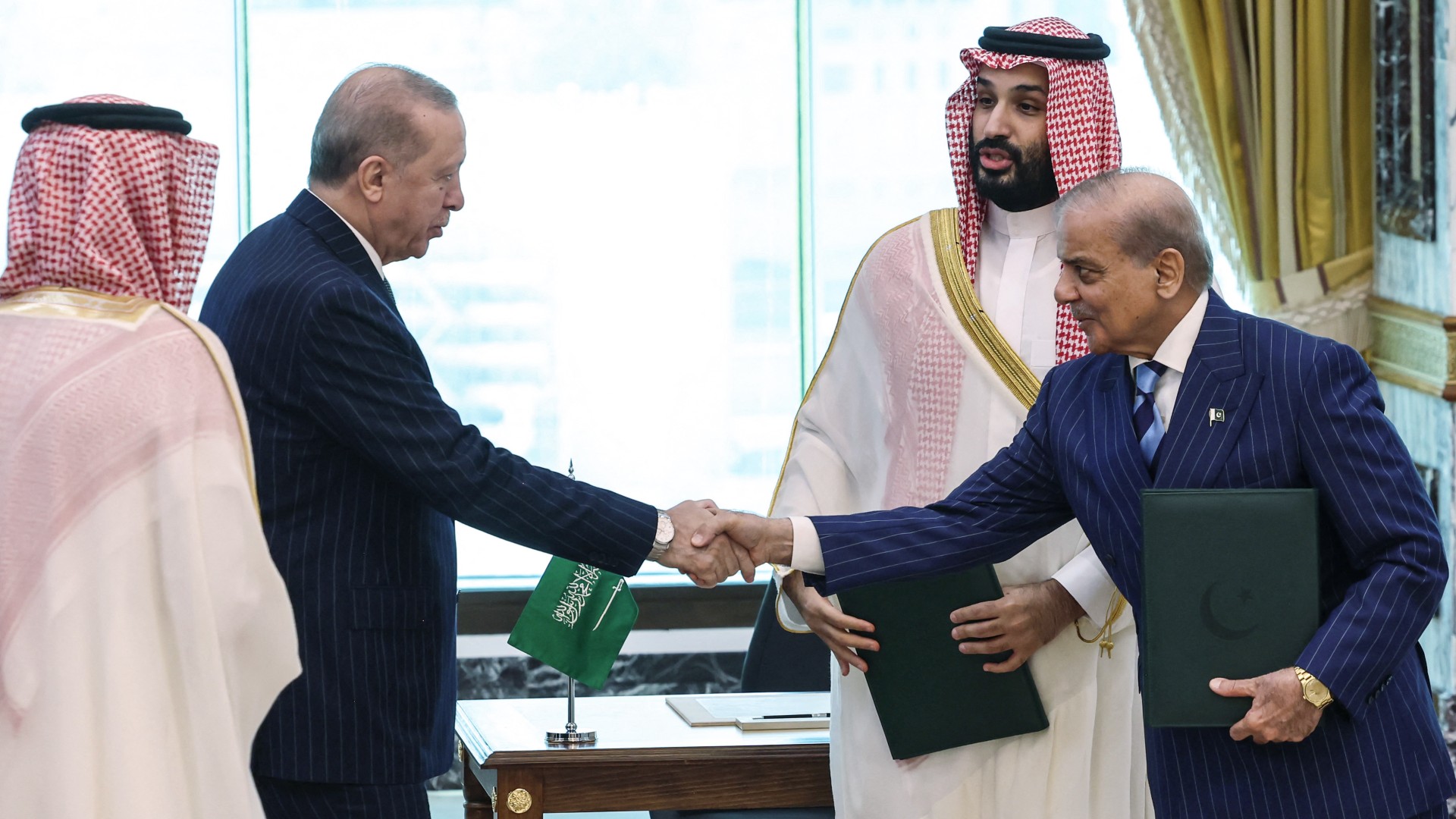
The Mecca Joint Defence Agreement between Saudi Arabia, Pakistan, and Turkey was unexpected but hardly surprising. Some have framed it as a Sunni alliance, with the role of the House of Saud as custodians of the two holy cities (Mecca and Medina), Pakistan as a nuclear-armed South Asian Islamic Republic, and Turkey’s Europe-adjacent muscular strand of political Islam. However, this agreement has little to do with religious sectarianism. The Mecca partners have far-reaching industrial, military, and diplomatic ties. The agreement, or the sum of already functioning bilateral partnerships, is not an alliance with a single command structure. The Mecca Joint Defence Agreement, signed on 7 August by Prince Mohammed bin Salman, Pakistani Prime Minister Shehbaz Sharif, and Turkish President Recep Tayyip Erdogan, attempts to consolidate three strong bilateral relationships into a single collective defence framework. Pakistan and Saudi Arabia concluded a Mutual Defence Agreement on 17 September 2025. At the time, it was speculated that this would provide Riyadh with a nuclear defence umbrella, although this point remains intentionally ambiguous. The Mecca pact adds a Turkish annex. New MEE newsletter: Jerusalem Dispatch Sign up to get the latest insights and analysis on Israel-Palestine, alongside Turkey Unpacked and other MEE newsletters “It was about time that regional agency takes shape,” says the Bahraini analyst, Abdullah Aljunaid. “Put it this way: it’s not Islamic. It’s not about containing Iran either. It is there to prove that the region can produce its own security. You have three major players within the region: Pakistan, Saudi Arabia, and Turkey. What you need to look out for now is the geographical gaps between those three domains, all the way up to Syria.” The militaries of all three states have deep ties. Islamabad and Ankara have a longstanding defence partnership. It is no secret that the Turkish industrial complex makes full use of Pakistani human resources in research and development: the Kaan fifth-generation fighter project employs about 200 Pakistani engineers. Riyadh has relied on Pakistani soldiers and pilots for decades, funded Islamabad’s nuclear programme, and has provided financial breathing space to Pakistan’s fragile economy. 'Put it this way: it’s not Islamic. It’s not about containing Iran either. It is there to prove that the region can produce its own security' - Abdullah Aljunaid, Bahraini analyst Turkey is not only a supplier of arms to Pakistan but has modular input in strategic platforms such as the JF-17 Block III multirole jet fighter, which uses an ASLPOD targeting pod and can be fitted with a MURAD AESA radar and Bozdogan short-range air-to-air missiles. Over the last five years, Riyadh and Ankara have been forging a common worldview. As noted by Aljenaid, Saudi-Turkish relations gained strategic depth in Syria, where cooperation was hailed by Washington. At present, the partnership is gaining strategic significance, as Riyadh sees Ankara as a strategic partner in fulfilling the kingdom’s 2030 Vision, which calls for the localisation of 50 percent of total military expenditure, focusing on armed vehicles, missiles, loitering munitions, and drones. In this context, Riyadh has found that Turkish companies such as Baykar and Aselsan are more willing to engage in technology transfer, joint production, and research. In sum, while this agreement is not an alliance, it is not shallow. However, turning three bilateral partnerships into a single alliance is no simple matter. Why now? According to Oral Toga, a senior researcher at the Centre for Iranian Studies in Ankara, the Mecca Agreement was negotiated over two years. Its scope predates the us-israeli war on Iran. However, the timing of the agreement certainly relates to the events unfolding around the Strait of Hormuz and the Red Sea. American security guarantees lost much of their thrust during the Hormuz crisis. As noted by former US ambassador to Qatar Patrick Theros, Washington’s attack on Iran turned the American umbrella into a liability. What Pakistan's defence pact with Saudi Arabia and Turkey means for the Middle East Read More » Washington was unable or did not prioritise air defence cover for its partners in the Gulf, creating an additional challenge to the region’s security architecture. "The Saudis have understood that the Abraham Accords have been a security guarantee for Israel, not the kingdom,” notes Dr Yeghia Tashjian, of the Issam Fares Institute at the American University of Beirut. The conclusion is that the Gulf’s defence architecture needs foundations in the region. In that respect, Qatar invested in its partnership with Turkey even before the 2025 Israeli raid on Doha. Riyadh and Abu Dhabi followed two distinct routes: the Emiratis doubled down in their partnership with Israel, with Israel installing the outward layers of its Iron Dome architecture in the Gulf. Riyadh turned to its historical security partner, Pakistan, while incrementally building on its partnership with Turkey. Destructive ambiguity The question is: to what end does this agreement go? According to the foremost expert in Turkish-Israeli relations at the Institute for National Security Studies in Tel Aviv, Dr Gallia Linderstrauss, while this pact is framed as exclusively defensive, it is meant to convey a message to Iran and Israel, perhaps also the UAE. 'Slowly and gradually, in the next one-two-three years, we will see America reducing its presence in the Gulf, and concentrating in the South China Sea' - Air Marshal (Retd) Saeed Khan The lack of clarity is whether this agreement is in fact an alliance. This begs testing, a process that can be destructive. An agreement is a statement of agency. An alliance is a joint perception of national security threats and implies unified command. We are nowhere closer to a regional alliance since 7 August. Pakistani troops and pilots have repeatedly mobilised in Yemen under the Saudi banner. It is doubtful they would take action under a Pakistani banner and challenge the Emiratis head-on. The withdrawal of more than $3.5bn of Emirati deposits from the Central Bank of Pakistan in April 2026 was a warning signal that Islamabad’s loyalty to Riyadh may come at a tangible cost. The deployment of Pakistanis is not the same as the mobilisation of Pakistan. Islamabad has priorities, and its ultimate loyalty lies with Riyadh; still, Islamabad will strive to avoid a head-on collision. When it comes to Iran, Islamabad also has priorities. As the Air Marshal (Retd) Saeed Muhammad Khan and former Pakistani ambassador to Syria underscores, Pakistan shares an extensive and rather unstable border with Iran, facing the common challenge of Baloch separatism. “We have over 1,000km border with them and the common threat of the Baloch. Slowly and gradually, in the next one-two-three years, we will see America reducing its presence in the Gulf and concentrating in the South China Sea. Things could change dramatically,” Khan said. Iran says it is not concerned by new 'Mecca Joint Defence Agreement' Read More » Islamabad has little appetite for a direct confrontation with Tehran. Similarly, it is doubtful that Ankara would take on the challenge of deploying in Yemen, risking a direct conflict with Tehran, with which it shares a Kurdish challenge. Even Riyadh would rather avoid feeding Shia-Sunni sectarianism. This regional reluctance to feed sectarianism has been “battle-tested” during successive US-Israeli campaigns against Iran. Will these three powers mobilise together against common threats? Under current circumstances, foes may be tempted to test this resolve. That can be dangerous. There are common challenges, not least in the Red Sea. Turkey’s Turksom Camp in Mogadishu is a major anchor for its power projection in the region. Pakistan is complementing this presence, signing a military cooperation agreement with Somalia that facilitates the landing of an expeditionary force. At the same time, Israel recognised Somaliland in December 2025; the United Arab Emirates is known to use the infrastructure of Bosaso port and airport for logistical purposes in its engagement in the Sudanese conflict. At times, there is a clear polarisation between status quo and revisionism, but it's never as neat as in the case of Nato. Whether a common worldview translates into joint mobilisation is a question that depends on the convergence of several contextual variables. All parties have a range of interests. Turkish-Emirati military-industrial cooperation is strong and growing. Pakistan still depends on remittance flows from 1.6 million Pakistanis residing in the UAE. One should not expect Saudi Arabia to punish India for supplying Israel with military equipment when the need arises, as military analyst Kamal Alam notes. Where do we go now The Mecca agreement presents an ambiguous message. The three defence partnerships framed by the agreement remain distinct and compartmentalised. What is simmering is a polarisation between the status quo and revisionist powers. In Ankara, Manama, Riyadh, and Beirut, the Emirati-Israeli alliance is seen as seeking to revise the security status quo, while Iran is seen as seeking to revise the status quo in the Strait of Hormuz. This polarisation is problematic, not least for Israel, which must also manage the ambiguity of the American commitment to the region. 'From an Israeli perspective, normalisation between Israel and Saudi Arabia, if not harder, is at least a more distant reality' - Gallia Lindenstrauss, Institute for National Security Studies Politics in this sense matters, and elections could make a difference. According to Dr Gallia Lindenstrauss, expanding the Abraham Accords to include Saudi Arabia is now a greater challenge. “From an Israeli perspective, normalisation between Israel and Saudi Arabia, if not harder, is at least a more distant reality. That is of concern because this is something that was a priority for Netanyahu.” Whether by reference to Israel’s de facto security zones in Lebanon and Syria, or Kurdish-controlled regions in Iraq and Iran, what unites the Mecca signatories is a commitment to the status quo. “All three signatories have backed central state authority where the UAE has backed sub-state actors: the Sudanese army against the RSF, Yemen’s recognised government against the STC, Somalia’s territorial integrity against Somaliland’s recognition," Toga of the Centre for Iranian Studies tells MEE. "Riyadh no longer faces that network alone, and after the Yemen confrontation of late 2025, that is a meaningful change. But I would not overstate it.” This observation is the point of departure, a foundational consensus among analysts in Islamabad, Ankara, and the Gulf. In that respect, the Mecca Agreement is a statement of intent to shield the territorial status quo even as the US withdraws from the region. A bigger development may be further Chinese mediation. As noted by analyst Aljunaid, China is well positioned to broker an understanding between Iran and the Mecca signatories. The US is no longer seen as having convening power.
How the Mecca Agreement aims to manage US separation from Middle East
Full Article
Original Source
Read the full article at Middleeasteye →KhanList aggregates and links to publicly available news content. We do not host full articles from third-party sources. Always verify important information with original sources.