
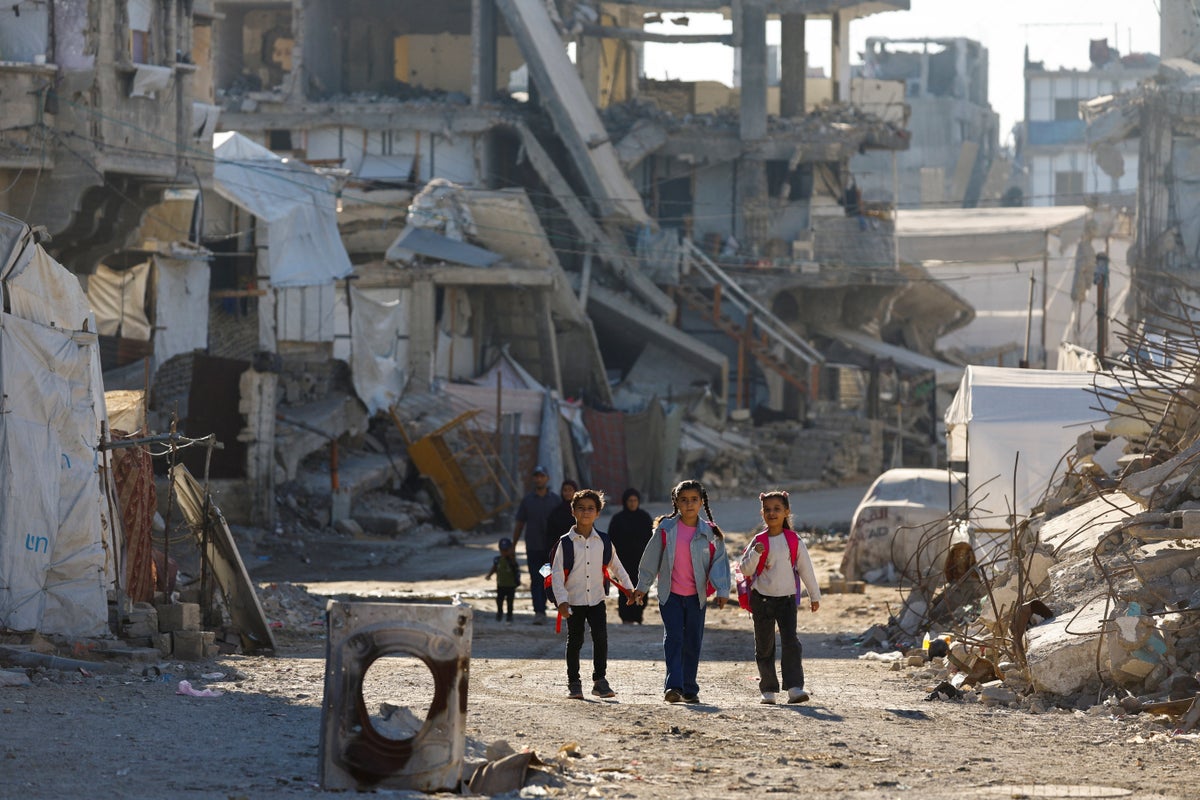
This article first appeared on our partner site, Independent ArabiaIn Gaza, we never needed a map to find our way. We knew where we were by the landmarks of everyday life: an ancient tree, a neighbourhood bakery, a bank on a street corner, the distant view of a tower block that meant we had found the place we were looking for.Before 7 October 2023, Gaza was more than a narrow strip of land on the coast. It was made up of cities and refugee camps, markets that welcomed people every morning, farmland stretching along the edges of towns, factories and small workshops, universities and hospitals.Its built environment was diverse too, with high-rise and low-rise buildings, historic and religious sites, refugee camps that had evolved over decades, industrial facilities and agricultural land.Gaza was not without its crises. High population density, the blockade, shortages of services and unemployment were all part of life before the war. But the place was familiar to its residents: every neighbourhood had its landmarks, and every street had its own memory.Palestinian children walk amid the rubble of buildings destroyed during the war (Reuters)I knew I had reached Tal al-Hawa when I came to the bank at the beginning of the street. To me, the bank was more than a building; it was a landmark marking the entrance to the neighbourhood of Tal al-Hawa. It was a prominent building with a distinctive facade, and a large doorstep in front where we would sometimes sit. Beside it was a vegetable seller, and from there began the scene I had known for years.Rows of closely packed, uniform, adjoining towers, each around seven storeys high, alongside markets, restaurants, schools and mosques, and a street I often walked.From the bank’s doorstep, I could watch the life of the place unfold: the vegetable seller calling out his wares, people leaving the bank and walking along the street, cars moving constantly, with a garden in the background and the towers forming the familiar scene I knew.At the time, none of this seemed extraordinary. It was simply the life of the place. This is how we remember our cities: through what we see as we move through them, and through what we know will be there when we arrive.The erasure of landmarks and spacesYarmouk Stadium in Gaza City pictured prior to the conflict, serving as one of the area’s oldest central sports and community hubs (AFP/Getty)The remains of Yarmouk Stadium, extensively damaged by bombardment, now serve as a makeshift refugee camp (AFP/Getty)When Israel allowed people to return to Tal al-Hawa, I went back to the place I loved. The first thing I saw, however, was not the neighbourhood I knew. In front of me was an entire row of towers whose shapes I had known for years, but which had now fallen.Six or seven towers, roughly, were no longer standing as they once had been. Part of one tower remained upright, blocking the view of what had once been behind it.I looked at the scene and said to myself: “This can’t possibly be Tal al-Hawa.” I was not looking only for my home. I was looking for the landmarks by which I had always recognised the place: the bank, the towers, the bakery, the street.But the scene I knew was no longer there in the same form. The street I remembered had been dug up and its route had changed; sand covered parts of it, the streetlights had disappeared, and the facade of the bank whose appearance I knew so well had been shattered. The building that had once been an unmistakable marker of the beginning of Tal al-Hawa no longer looked as it once did.Even the colour of the place had changed. The area I used to see from the bank’s doorstep, with its stone, facades and bustle, now appeared grey, barren and open to the void.I walked on, asking people: “Where am I? Where is the bakery?” I was asking about places I had once known without ever having to ask where they were.It was at that moment, precisely, that I understood that something greater than the buildings had changed. Three years of war had erased the landmarks that helped people in Gaza recognise where they were.Architectural researcher Yara Sharif told Independent Arabia: “After three years of war, it became clear that Gaza had lost more than its historic buildings. The destruction had also reached the cultural and social practices that took place within neighbourhoods, as well as the small details of everyday life.“The visual memory of the place had been overwhelmed by images of destruction, rubble and emptiness.”What happened in Tal al-Hawa was not something that affected me alone. In Zeitoun, one of Gaza City’s oldest neighbourhoods, residents returned to a place they had known for decades only to find large parts of it altered beyond recognition.Ferial Ahmed spoke of the roof of her home collapsing on her family, and of how the features of her street had changed after most of the landmarks she remembered were destroyed. “The neighbourhood was known for its markets, its olive groves and the relationships that bound its families together,” she says.The scale of destructionSatellite images captured by the United Nations Satellite Centre offer another perspective on the scale of this transformation. The assessment estimated that around 83 per cent of the buildings in Gaza City had been damaged, and 81 per cent of buildings across the Gaza Strip.It also recorded damage to around 200,000 buildings, including around 123,000 classified as destroyed. The remaining damage was categorised as severe, moderate or possible. In Gaza City alone, 81,159 residential units were damaged.These figures cannot tell us what Zeitoun looks like in the memory of Ferial Ahmed, who lived in the neighbourhood for around 35 years, but they help to convey the scale of what she saw when she returned to the place she had called home since childhood.In Shuja'iyya, the transformation is visible from another perspective: not only in the appearance of the buildings, but in the number of people who remained after the landmarks of a neighbourhood that had once been one of the most densely populated areas of Gaza disappeared.According to a report published by the US broadcaster National Public Radio, fewer than 50 families remain in Shuja'iyya, which had been home to more than 100,000 people before the war.Saeed al-Hattab and his wife live in a ground-floor shop on the outskirts of Shuja'iyya, near the ‘yellow line’. “The family was displaced several times and had nowhere else to go, so we decided to stay here,” he says.“There are no longer any clinics, bakeries or shops in the area, and the nearest source of drinking water is about a 30-minute walk away.“Going out into the street carries a constant sense of fear.”The United Nations Human Settlements Programme (UN-Habitat) sought to measure the functionality of Gaza’s neighbourhoods across key areas such as housing, infrastructure and services as well as their impact on movement, public facilities and residents’ everyday lives. Its assessment concluded that more than 95 per cent of Gaza’s neighbourhoods fell within low, very low or extremely low levels of functionality, with around 77 per cent of Gaza’s road network damaged.A crisis of infrastructureIn Gaza City’s al-Nasr neighbourhood, Haj Rebhi al-Feiri waited for more than four hours with his children for their turn to use a small electricity generator to switch on the water pump in their home. Each family gets only a few minutes of use.The pump is still in place, and the tank still sits above the house, but the system that once brought water into the home has changed. Access to water is no longer an ordinary function of the neighbourhood; it has become a service that requires a generator, fuel, waiting and a place in the queue.In Gaza, municipal spokesperson Hosni Muhanna estimates that the city needs around 100,000 cubic metres of water a day during the summer, while only about 30,000 cubic metres are available.Muhanna told Independent Arabia: “Eighty-five per cent of the city’s central wells have been damaged, along with more than 150,000 linear metres of water distribution networks.”The problem is not only the scale of the destruction, but also the ability of the services that remain to keep operating. After 19 water and sanitation facilities were repaired, they became technically operational, but continued to function at limited capacity because of a lack of electricity.Across the Gaza Strip, all six wastewater treatment plants remain out of service, while 70 per cent of sewage pumping stations are shut down. This means that more than 150,000 cubic metres of untreated wastewater continues to be discharged every day.This is where the problem of energy becomes apparent. Since the beginning of the war, the public electricity supply to the Gaza Strip has been cut off, leaving generators and limited energy sources to power parts of the water and sanitation systems, hospitals, communications and other services.After three years of war, the problem is no longer simply that electricity does not reach homes, but that the capacity of the services that depend on it to function has also steadily declined.Hospitals and schoolsGaza's Al-Shifa hospital flattened after end of Israel's latest siegeAt Nasser Hospital, Ahmed al-Nabarees, an internal medicine specialist, expressed his concern: “Power cuts and shortages of engine oil for the generators threaten the operation of essential equipment, particularly ventilators and inhalation devices.”The hospital may still be standing, the doctors, patients and beds may still be there, but the place no longer performs the same function it once did.According to the World Health Organisation (WHO), only 19 of the 36 hospitals in the Gaza Strip were partially functioning, while none were operating at full capacity.A study based on WHO data found that the functionality of Gaza’s hospital system had fallen to 13.9 per cent, revealing the scale of the healthcare system’s collapse.Education has resumed too, but not in the schools students attended before the war. According to Unicef, around 98 per cent of school buildings in Gaza have been damaged or destroyed, while 86 per cent of the kindergartens assessed were damaged, destroyed or rendered inaccessible.Around 495,000 children were enrolled in learning spaces supported by the UN and its partners, while around 200,000 children remained outside any form of organised education.Teacher Raja al-Nabahain told Independent Arabia: “Before the war, schools had desks, books and stationery. Now, even these basic necessities are unavailable in many places.”Shops without customers, neighbourhoods without homesIn the markets, the picture appears different at first glance. Some shops have reopened their doors, lorries are entering the Gaza Strip, and goods that had been in short supply for long periods are once again available.While goods are back on the shelves, the market itself has yet to return to pre-crisis levels. Maher al-Khudari, a shopkeeper in Gaza City, said: “The pattern of purchasing has changed. Some customers are now asking to buy what they need on credit.”According to the Palestinian Ministry of Social Development, many families are unable to afford basic goods. The UN Office for the Coordination of Humanitarian Affairs estimates inflation is at around 207 per cent above pre-October 2023 levels. Gaza’s GDP per capita stands at around $212 (£160), just 17 per cent of its 2022 level, while unemployment has reached around 78 per cent.Meanwhile, the UN Conference on Trade and Development estimates that around 92 per cent of Gaza’s economic establishments have been damaged or destroyed since the beginning of the war.When Khaled returned with his family to the residential neighbourhood in Gaza City where their home had once stood, he did not find the house they had left behind. He decided to pitch a tent over the rubble and remain close to the place where he had lived before the war.For him, returning did not mean returning to a home, but to the patch of land that remained of his life. “Staying close to where my home once stood allows me to remain on my land and hold on to my identity,” Khaled says.‘A stranger in my own city’Gaza’s historic Qaysariyya market before the war, a historic trading centre in the Old City (AFP/Getty)Rubble and collapsed arches mark the site of the historic Qaysariyya market following severe bombardment in the Old City (AFP/Getty)According to an assessment by UN-Habitat, around 1.4 million people or roughly two-thirds of the Gaza Strip’s population are living across around 1,000 displacement sites.Some 46 per cent are in Khan Younis, 29 per cent in Deir al-Balah, 16 per cent in Gaza Governorate, seven per cent in North Gaza, and just two per cent on the outskirts of Rafah.In the period following the October 2025 ceasefire agreement, around 833,000 people changed where they were living, including more than 694,000 who moved from the south towards the north, according to UN-Habitat.But moving north meant returning to a place that was no longer familiar. People returned to their areas, only to find neighbourhoods whose appearance had changed and homes that were no longer fit to live in.Osama Ali lives in a damaged building. He says it is the best he could find: “Three years of war have wiped out Gaza’s urban map. The city has changed shape and so much has been transformed. I have nowhere else to go; every area has been destroyed.”For Osama, the problem was not simply returning, but the place to which he returned. “I am living in a place I do not know, in the middle of a neighbourhood I had never entered in my life, in a damaged building whose original residents I do not know,” he adds.He falls silent for a moment, then continues: “The war has made me a stranger in my own city. I feel as though I no longer know its areas or its neighbourhoods.”A study by the UN Population Fund found that people in Gaza experienced displacement an average of seven times during the years of war.Siham Joudeh left Jabalia with her family, and they moved between different places before eventually reaching a camp west of Gaza City.Each time, Siham left one place and started again somewhere else, without knowing whether she would stay there for days or weeks, and without knowing whether the next place would be safer or simply another stop in a continuing cycle of displacement.Heritage and culture under rubbleThe Great Omari Mosque, Gaza’s largest and oldest mosque, pictured before the collapse of its ancient halls (AFP/Getty)The heavily damaged structure and exposed courtyard of the Great Omari Mosque after sustaining major direct hits (AFP/Getty)Few books and manuscripts remain in the Great Omari Mosque library, preserving names, dates, knowledge and stories that passed through Gaza and remain written in its pages.After parts of the mosque and its surroundings were damaged, efforts began to save the books and manuscripts. Each book is not simply an object that survived the war, but a small trace of what Gaza was like before its appearance was transformed.In the old city of Gaza, the alleys, markets and buildings were not separate from people’s lives. They were part of the way they lived, and part of the way they remembered their city.Unesco describes the historic centre of Gaza City as an urban fabric covering around 1.7 square kilometres, encompassing the neighbourhoods of al-Daraj, al-Zeitoun, al-Tuffah and Shuja'iyya, including markets, passageways, historic homes, mosques, churches, baths and public facilities.This was not simply a collection of old buildings standing alongside one another, but a living environment in which streets connected to markets, homes to religious and public facilities, and residents’ memories were shaped by the details of the place itself.“I have a strong connection to the old city of Gaza,” says Mohammed Mortaja. “I knew these places not simply as historic sites, but as part of my childhood and my life, from Pasha’s Palace to the Great Omari Mosque, St Porphyrius Church and the surrounding alleys.”For Mortaja, these buildings were not separate from the city in which he had lived. They were landmarks that helped him remember it and find his way through its details. He mourns not only the loss of ancient stone, but the loss of part of the place to which his memories were tied.After three years of war, Gaza’s geography has altered. Unesco says urban life in Gaza City’s historic centre has come to a halt, while a number of buildings, markets and religious and historic sites have been damaged.Among the sites whose damage has been documented by Unesco are Pasha’s Palace, Qaysariyya market, Hammam al-Samra and the St Porphyrius church complex, along with other historic homes and buildings.In the archives, the loss takes a different form. According to the International Council on Archives, Gaza City’s Central Archives and the main public library building were hit by shelling, resulting in the loss of documents, some dating back around a century.These documents were not simply papers stored inside a building. They were records of the city’s social, political and economic history. The International Council on Archives considers records to be part of the individual and collective memory of communities, and their protection to be important to rebuilding society after wars.What Gaza has lost during the war, therefore, is not only buildings that can be restored, but also documents whose contents may never be recoverable in the same way.What remains of Gaza now?Ayan Hotel (formerly Al Mashtal) was Gaza’s first luxury hotel. Overlooking the Mediterranean Sea, it first welcomed guests in 2011 and was renovated in 2023 (Ayan Hotel)The charred exterior and heavily damaged upper floors of the seaside hotel following intensive military bombardment along the coast (AFP/Getty)In taking stock of the losses suffered by Gaza’s memory, Unesco has verified damage to 164 cultural heritage sites across the Gaza Strip.The figure includes 14 religious sites, 128 buildings of historical or artistic significance, three repositories holding movable cultural property, nine monuments, two museums and eight archaeological sites.As these heritage sites are damaged, it is not merely the buildings that disappear; the means by which future generations connect with the city's history is fundamentally altered.And one final question remains: after all that has changed, all that has been destroyed, all those who have left, what remains of the place?In Gaza, a few homes remain standing, though not entirely intact; destroyed roads still carry cars; markets reopen their doors, even if only for a few hours; wells and water facilities continue to operate at limited capacity; and neighbourhoods remain inhabited, despite the fact that many of their features have changed.International assessments estimate that the war has generated around 68 million tonnes of rubble, while a joint assessment by the World Bank, the UN and the EU put Gaza’s recovery and reconstruction needs at around $71.4bn (£54bn) over 10 years.Yousef works on repairing Salah al-Din Road. He spends hours on the street people use to travel between different parts of the Gaza Strip, watching traffic and pedestrians return to sections of the road.“Repairing a single road may not seem like a major event compared with the scale of what the war has destroyed,” Yousef said. “But it reveals something important. After three years of war, what matters is what people are able to use again. This is not so much a return to the life that existed before the war as an attempt to preserve the life that remains.”The Gaza that remains is not the Gaza that was. After three years of war, a place can appear to be standing while having lost many of its essential functions. Perhaps the answer to the question that has run through this report from the beginning is that Gaza remains, but not in the form its residents once knew.Three years of war have changed the shape of the place, weakened the functions of its neighbourhoods, altered its population map and dealt a devastating blow to the places that carried its memory.Translated by Dalia Mohamed; Reviewed by Tooba Khokhar and Celine Assaf
How the landmarks of everyday Gaza have disappeared under the rubble of war
Full Article
Original Source
Read the full article at Independent →KhanList aggregates and links to publicly available news content. We do not host full articles from third-party sources. Always verify important information with original sources.