
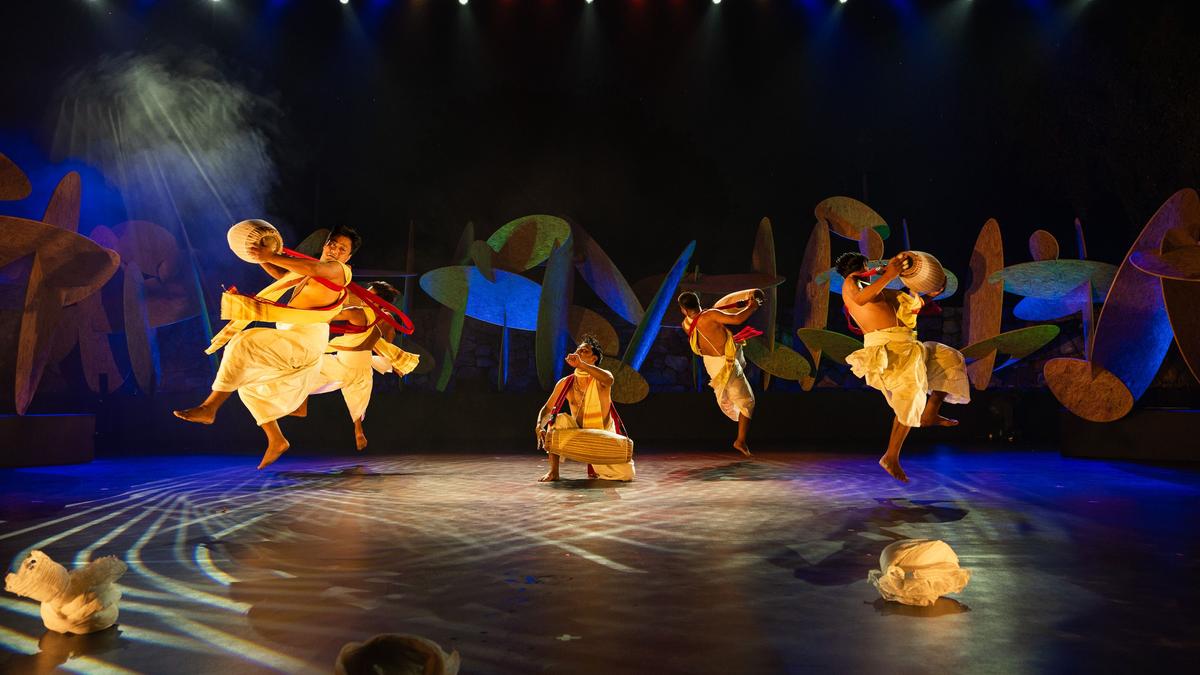
It was a warm October evening. With security restrictions and traffic diversions still in place following the recent students’ protests, the four-kilometre journey from Maharani Bagh in southeast Delhi to Sunder Nursery took nearly 45 minutes. The sprawling 16th century park, a crucial green lung of the city that grapples with seasonal smog and deteriorating air quality, was teeming with visitors. Aditi Jaitly Jadeja, head of performing arts, KNMA. | Photo Credit: Mohammed Roshan The crimson rays of the setting sun illuminated the arched doorways and sandstone-latticed jaalis of Sunder Burj, a square-shaped tomb with Quranic verses inscribed on its inner walls. One of the many Mughal-era monuments dotting the lush 90-acre landscape, it allowed you to time-travel to an era when Nature co-existed harmoniously with built heritage. As dusk deepened, the sky transformed into a darkened canvas, becoming a muse for artistes exploring the many shades of sringara rasa on the amphitheatre stage below.There could not have been a more fitting setting for the Kiran Nadar Museum of Art’s dance festival themed around love, andcurated by Bharatanatyam exponent Leela Samson. At a time when we lament the dwindling audiences for classical dance, it was heartening to see the amphitheatre packed, with spectators comfortably seated on its cement steps, with cushions placed for the occasion. Even more heartening, however, was the sight of families and youngsters stopping in their tracks to watch the performances as they walked by. In the process, the festival was creating new converts to the idiom. Kakoli Bhattacharya and her friends from Kolkata who were exploring Sunder Nursery abandoned their otherplans to watch the entire performance. Subhadra Kalyanam by R. Rajagopal’s Kanchipuram-based Kattaikkuttu Sangam. | Photo Credit: Mohammed Roshan I caught the festival only on its last two days, and the third day had more surprises in store as R. Rajagopal’s Kanchipuram-based Kattaikkuttu Sangam presented ‘Subhadra Kalyanam’. Performed in Tamil and infused with rustic flavour and indigenous humour, the production was received with loud cheers and deafening applause. As Rajagopal's Dutch wife, Hanne M. de Bruin, clad in a simple cotton sari, came up on stage after the performance to talk about the production, introduce the artistes and thank the audience for their appreciation, it became evident that art finds its own curious ways of transcending linguistic and geographical barriers. Meera Sreenarayanan’s performance tugged at the heartstrings | Photo Credit: Courtesy: KNMA Kerala-bred and Mumbai-based Bharatanatyam artiste Meera Sreenarayanan further enriched this cultural confluence when she appeared in an unconventional flowing white costume, her hair plaited with a paranda, to portray Pero, said to be the first woman poet of Punjab. Through emotionally charged kafis (sufi verses), Meera inhabited Pero’s character with remarkable conviction, taking the audience through the poet’s pain, defiance and spiritual quest.The festival underlined how expressions and movements come alive when complemented with evocative lyrics. Harinie Jeevitha brought to life Maharshtra’s saint-poet Jana Bai’s heartfelt conversations with Vittala. | Photo Credit: Courtesy: KNMA The exploration continued on the festival’s final day, when young Bharatanatyam artiste, Harinie Jeevitha, took up the life story of the Marathi saint-poet Jana Bai and how she humanised Vittala through her abhangs. Bharatanatyam artiste P.V. Adithya and Kathak exponent Dheerendra Tiwari, meanwhile, used their respective dance forms to portray the the profound spiritual bond between poet Amir Khusrau and his master, Khwaja Nizamuddin Auliya, in ‘Rang Ruhani’, with Khusrau’s melodiously haunting verses echoing through the stillness of the night. Rang Ruhani by PV Aditya and Dheerendra Tiwari was a soulful communion between the seeker and his spiritual guide.. | Photo Credit: Courtesy: KNMA The next morning, I made my way to the Kiran Nadar Museum of Art, where the past makes its presence felt through contemporary sensibilities, to meet Aditi Jaitly Jadeja, the woman behind this initiative, which takes art beyond auditoriums and into shared, inclusive spaces through themes that blur boundaries. You pass through several galleries displaying sculptures and paintings before reaching the meeting room, where all the brainstorming for the festival takes place. Clad in a breezy, comfortable salwar kameez, Aditi speaks about the purpose behind the curated annual dance and music festivals.“We have just completed our third edition, but I already feel we have created an ecosystem where artistes are coming together for this creative exchange, sans the silos. There are no mainstream or fringe forms; everything is on one platform. The idea of having an experienced artiste curate the festival brings immense value. They know how to navigate cultural pathways, disseminate ideas and guide the creative process,” says Aditi.A Bharatanatyam artiste, trained under Leela Samson, Aditi is the daughter of former politician and craft revivalist Jaya Jaitly and the wife of former cricketer Ajay Jadeja. Her early exposure to diverse fields has broadened her perspective, shaping her vision as head of the performing arts at KNMA. “It also helps to have a founder like Mrs Kiran Nadar, who understands art and the need to preserve and promote it. Her support matters immensely when we undertake such festivals. With her quiet presence and observant eye, she remains closely involved in the proceedings while giving us all the freedom to experiment,” shares Aditi. ‘Basanta Anurāga’ by Orissa Dance Academy depicted the romance of the Vasant ritu. | Photo Credit: Courtesy: KNMA With performing arts festivals redefining cultural tourism in the country, curators and organisers are finding ways to package them for wider appeal and commercial gain. “It is here that we at KNMA want to make a difference by offering a nuanced experience, even for the uninitiated. Hence, the involvement of people from the fraternity right from the ideation stage. The years spent training, performing, teaching and creating comes through in their approach,” she says.But these festivals are just one part of the performing arts section’s activities. It has also been hosting the Legacy series, which showcases the artistic lineage of a performing arts family through performances by successive generations. “This was conceived to treasure rare and rich traditions that we may lose in these changing times, when art is seen merely as a performance rather than as a way of life. We want to bring back that connection.”Believing in building an appreciation of the arts from a young age, KNMA is also reaching out to children in government schools.“The change that cultural infusion can bring about is immense. We don’t want to underestimate its impact on the lives of children who are otherwise weighed down by economic and social struggles. If they do not have the support or facilities to experience art, we take the initiative to bring it to them,” she says.Even as Aditi speaks, music fills the air — in an adjoining rehearsal space, children from underprivileged backgrounds sing in Hindi about the beauty of life. As their choir leader strums the guitar, the youngsters traverse the highs and lows of the composition. This is in keeping with the ethos of the Museum — art should not be merely observed or judged, but freely expressed and interpreted.
How the Kiran Nadar Museum of Art is breaking silos to unite art practices
Full Article
Original Source
Read the full article at Thehindu →KhanList aggregates and links to publicly available news content. We do not host full articles from third-party sources. Always verify important information with original sources.