
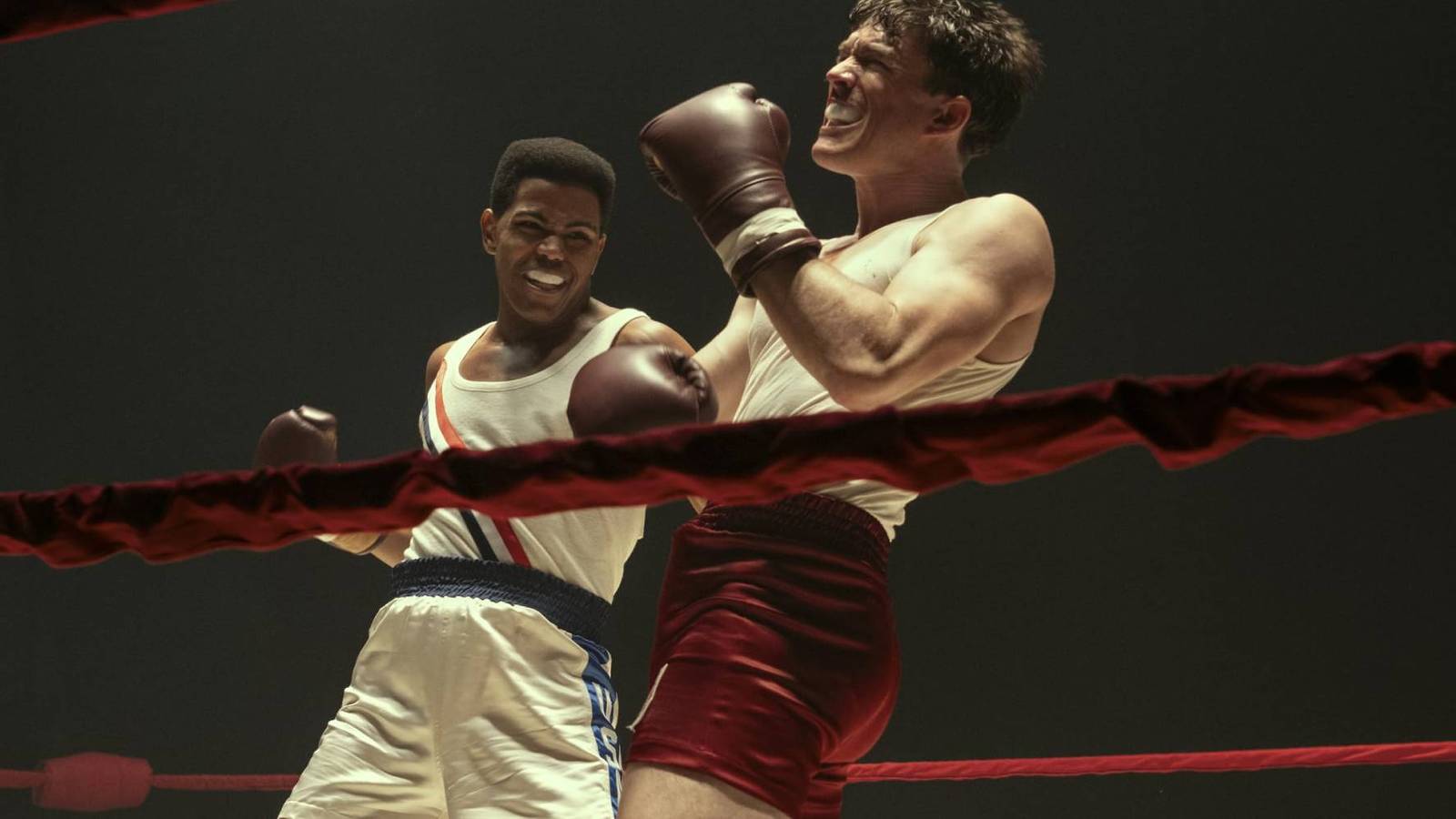
Published Nov 17, 2026, 9:00 AM EST Brandon Zachary is a Lead Writer for Screen Rant's New Movie Team. He also writes or has written for Comicbook.com, CBR, That Hashtag Show, Just Watch, and TVBrittanyF. Brandon is an Emerging Screenwriters Semi-Finalist, co-writer of a Screencraft Quarter-Finalist, a seasoned on-screen interviewer, and a MASSIVE nerd. You can reach him at bs.zachary@gmail.com Sign in to your ScreenRant account The Greatest is a tense and terrific take on the story of Muhammad Ali, charting his evolution from just another boxer into one of the legends of the sport. Created by Ben Watkins, the show has been a critical hit for Prime Video and showcases a lot of potential for the show's star, Jaalen Best. During an interview with ScreenRant, Ben Watkins reflected on the evolution of the show and how it developed during production. This includes the input of Michael B. Jordan as executive producer, the importance of casting Best, and Watkins' long-standing hopes for the show. How The Greatest Zeroed In On Muhammad Ali's Arc Brooke Palmer / Prime Video Any director who has tackled the cinematic sport of boxing adds their own flavor to the concept. Filmmakers like Martin Scorsese, Ron Howard, and Michael B. Jordan. Ben Watkins does something similar, bringing his own sense of energy and accuracy to The Greatest's recreation of Cassius Clay's skills in the ring. Reflecting on his approach to the sweet science, Watkins explained that "I'm a huge sports fan. Boxing is one of my favorite sports. I have always, all of my life, whenever dealing with sports, felt like I have to do the action justice. I would rather have a show that's set in the locker room or just hear games on the radio than to show it and not feel like it's really reflective of the sport." I don't want to do the boxing unless a fan would love it. That's the bar. A fan would have to love it. Muhammad Ali's fights are also on YouTube. If you don't do them justice, it's so easy for someone to compare what you just did to what really happened. We decided we were going to grab sequences from the real fights. We're going to recreate them, obviously dramatize them to some extent. But even when we dramatize them, the foundation has to be a retelling of the actual fight. Clayton Barber, who was our fight choreographer, had that down. When I told him that's what I was looking to do, he thought I was crazy. This is coming from a guy who's already proven he can do amazing stuff because he worked with Michael B. Jordan on the Creed franchise. He took that challenge and ran with it. It meant we would not be able to have any stand-ins, no stunt doubles. We had to find boxers who could act. We had to find actors who could legitimately box. One of the silver linings is that it actually helps speed up production because you're not switching people in and out. It meant that anybody who was in a boxing match had to start doing the choreography weeks before it would ever shoot. The finale, the title fight with Sonny Liston and Muhammad Ali, that fight started choreography training three weeks before we started principal photography for the whole season. Jalen and Amon had to learn that choreography because it was six rounds over the course of the whole season, while they were doing everything else. Then, none of that matters if our editors are not magicians, and they really embraced it. Beyond just how Muhammad Ali moves in the ring, the show also does a good job of recreating Ali's life story. The Greatest delves into his evolution from Cassius Clay into Muhammad Ali, taking eight episodes to delve into his growth and character arc. The show notably doesn't hold back in depicting Ali and his family as complex people, avoiding the typical biopic problem of portraying real-life people as genuine three-dimensional characters. What I was looking for was something intangible, someone who could capture the spirit of Ali. Just as with the fights in the show, Watkins made sure to work with Ali family estate to make sure the show accurately reflected the family by working with them, but refusing to just do things on a surface-level approach. "The process of building the trust is really important. I had to make it very clear that I was going to tell a warts-and-all story." If I was going to do it, even before I had earned the trust, I just said, 'Hey, here's my intention, and here's why it's my intention.' At that point, they hadn't fully signed off. Lonnie Ali's not saying, 'Okay, go for it, say whatever you want.' She's saying, 'I get your intention. I actually support that. If you want to tell an authentic story... This is the story. And she said, 'It's okay if you get into the more dicey parts as long as we're telling the truth.' I had to also trust that she wouldn't try to control or censor me. I think for her it was something that she maybe already was aware of, but definitely not something that she pushed against. Other people were worried that if we showed the flaws and the challenges and the anxieties and the vulnerabilities of Cassius Clay, they thought, would we be undermining his legacy? But none of the most celebrated boxers are undefeated. Seeing them struggle and seeing them deal with losses and come back are part of the story. We don't want them to be perfect. When they lose or when they struggle, they become more relatable. Otherwise, you just have a superhero that you can admire, not a real person that you can relate to. To create that realistic effect, the show needed to find the right person to play Cassius Clay as he evolved into Muhammad Ali. Instead of going for a recognizable face, though, Watkins was convinced that they needed a new actor who could embody the role instead of reminding viewers of different films or characters. When we started that process so early, long before we got the production green light, I remember talking to our casting director, Kim Coleman. I said I wanted it to be a newcomer because I don't want anybody watching the show and spending the first few episodes saying I remember that guy or I've seen that guy. There's going to be a phase where they're comparing him to the real deal no matter what. I definitely don't want them comparing them to another movie or show they're in, too. I wanted someone from the Southeast, preferably, because I knew the dialect. I wanted it to be spot on. I didn't want it to be close. I asked that they be athletic, not necessarily with a boxing background, but someone who knew what it was to train and knew what it was to compete. Those were the three beginnings of what to look for. I felt like no matter who we found, they would have to be transformed. Even if they checked all the boxes, they would have to elevate to a different level. What I was looking for was something intangible, someone who could capture the spirit of Ali. It had to be somebody with swagger, confidence, a sense of humor, a playfulness, even as they get older. They had to have a fierceness. I was hoping to find someone with a sense of what it is like to be an immovable object. I want that irresistible force. I want somebody who has this sense of destiny. Those are all intangibles, but as we were narrowing it down, Jalen always seemed to have this extra oomph. On top of having great auditions, on top of going to the physical evaluation and really rising above the competition, he just seemed to have this magnetism that was an intangible. He had this drive that turned out to have the qualities that Muhammad Ali had. Along the way, though, Watkins and his team had a secret weapon in Executive Producer Michael B. Jordan. Coming off his Best Actor win at the 98th Academy Awards, Jordan has been stretching his creative muscles. Following his work on the Creed films, Jordan came on board The Greatest even before Watkins. It turns out that, according to Watkins, it was Jordan who ended up getting the show the green light in the first place. Reflecting on Jordan's impact on the show, Watkins noted that "there are some key moments. At first, I was hesitating about whether even to do the show because I didn't know everyone involved, and because I was such a fan of Ali, I didn't want to do it if I didn't think it was going to get done right. He was already on as a producer, and he asked if we could meet." We met, and I knew him. We had crossed paths many times before, and I had actually worked with him on early episodes of Burn Notice. We were already friends, but we hadn't talked in a while. When we talked about the show for the first time, this was the first pivotal moment. He heard my approach and what my vision was, and why I was hesitant. He said he would protect my vision for the show. He loved it. He thought that there was nobody else who could tell the story, and so there's almost a responsibility there. That started our journey once I joined, and then the second time was when there was a moment where this show was on the fence about whether it was going to get greenlit or not. We knew we had a big meeting coming up with Prime Video executives, and we had a great presentation planned. We touched base with Mike, and he knew it was coming, and he was in the middle of a press tour or in production. Whatever was happening, he dropped everything and came to L.A. so he could be in that meeting in person and help seal the deal. Then we had a green light. Then the bigger stuff was the support over time as a producer. He couldn't be in the trenches with us because he had so much else going on, but he could weigh in at very key times, and if it's push a button here, nudge something here, do this email, it was just really great to have someone like that. I've had really powerful entities in projects before, but I haven't had one that really put their ego to the side and said, 'What's best for the project? I know at this point I'm one of the biggest stars in the world, but what I'm right here right now is just this producer on this show trying to help you get your vision realized.' Ben Watkin's Plans For The Greatest Go Three Seasons The season 1 finale of The Greatest focuses on the fight between Muhammad Ali and Sonny Liston, as well as Clay's decision to embrace the Ali identity over his birth name. It's a big moment in the career of the fighter, but just one chapter in the long history of Ali's fighting career. Reflecting on why he chose that moment to end the season instead of another fight in Ali's career, Watkins noted that "I approach writing in a very practical way, almost just the craft of it. Here's story beats, here's timelines, here's big moments, here's little moments. While I'm doing that, I'm sort of laying track." I am literally just waiting for my subconscious to start screaming at me, and I don't really engage until my subconscious screams at me. That's when I know I have what I call these anchors or these symbolic markers that will tell me what the show is about. When I realized that this is a coming-of-age story, one of the symbolic markers for me became the changing of the name. I started thinking about Cassius Clay changing his name to Muhammad Ali. This is a kid becoming a man, a challenger becoming a champion, someone converting in faith as well. I have four boys. I was thinking about how I wouldn't care what reason they had; if they showed up and gave me the best reason in the world but said they wanted to change their name, it would really hurt me. That's when I knew that could be symbolic for the relationship between him and his father, and so then I had the markers because I knew he was Cassius Clay when he won the gold medal. I literally wrote that scene where they introduce the winner, and they say Cassius Clay, and then I knew I had the end point where he would tell the reporter, 'My name is Muhammad Ali.' My job was to figure out how to tell the most interesting journey in between those two points. Figuring out those anchors was crucial to Watkins' approach to creating The Greatest. It was also the key to helping Watkins really zero in on what his full intention for the show could be. "There's an element to this that is mythology," Watkins noted. "It's not that we're making something up. It's that he actually led a life that was borderline mythical." When I started thinking about this story, I wasn't just thinking about one season. I was thinking about what the mythical arc of Muhammad Ali was, and in that sense, I realized there were three key pieces I wanted to show. One is him introducing himself to the world, and is Season 1. He shook up the world. Number two is him dealing with the most difficult time in his life. So you can see your hero fall, and that is going to be 'I'm Ready to Die. Season two would be 1967 to 1971 during his exile from boxing, where he loses everything, and then he comes back, and he actually loses the title fight to Joe Frazier, but he wins the soul of the nation. Then the last one would be his rebirth and redemption, and we call that 'I Am The Greatest.' That one would be the journey to fighting George Foreman in the Congo. During that season, we'll actually flash forward so you can see what he was to other people later in his life. I think those three key points are the pillars of his myth. The Greatest is currently streaming on Prime Video. The Greatest Release Date 2026 - 2026-00-00 Network Prime Video Cast Lacey Creighton Stenographer
How The Greatest Finale Sets The Stage For The Muhammad Ali Show's 3-Season Plan Explained By Creator
Full Article
Original Source
Read the full article at Screenrant →KhanList aggregates and links to publicly available news content. We do not host full articles from third-party sources. Always verify important information with original sources.