
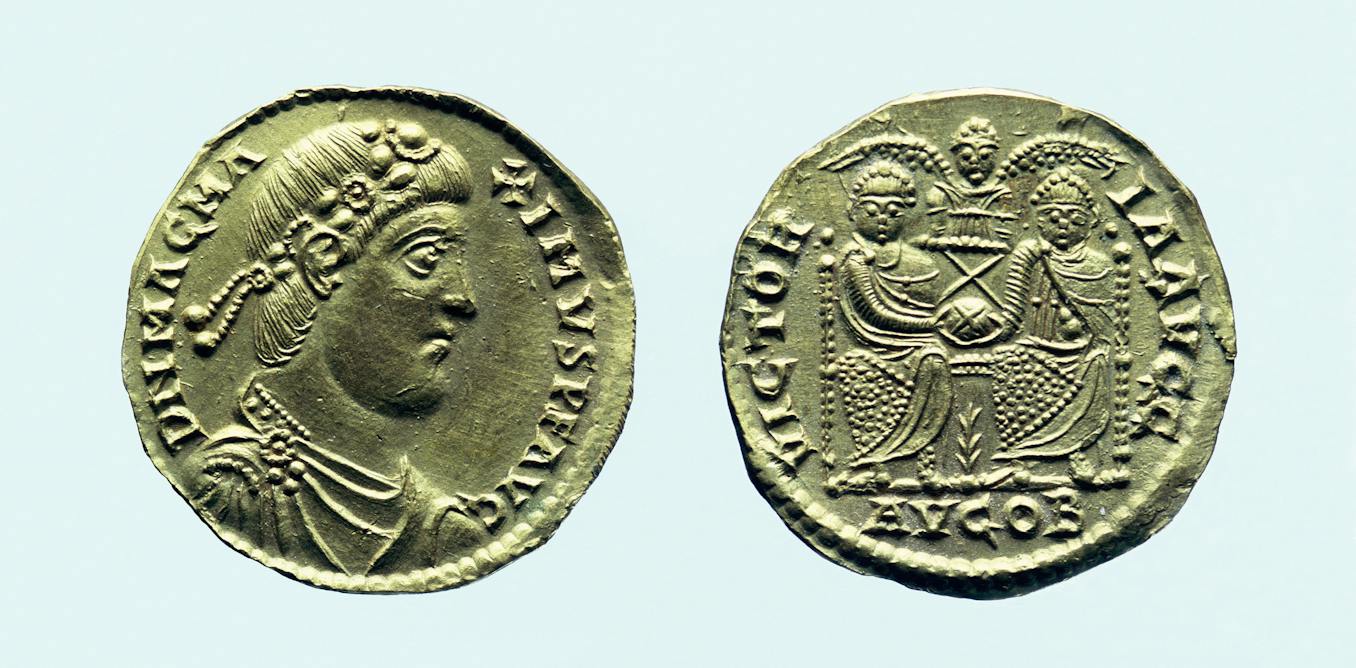
The recent discovery of a Roman timber fort in the Preseli hills of Pembrokeshire, south-west Wales, has brought a medieval Welsh legend into fresh focus. The site is mentioned in Breuddwyd Macsen Wledig (The Dream of Macsen Wledig), a story about a Roman emperor who travels to Wales. Until now, the account of a camp in that location had largely been treated as a product of medieval imagination. But the archaeological discovery raises an intriguing question: can ancient stories preserve memories of places and events that have been lost to history? The Dream of Macsen Wledig is one of the 11 medieval Welsh-language tales traditionally grouped together as the Mabinogion. These tales blend history, folklore, magic and legend, while some people see in them lost myths. Featuring kings, warriors, magicians and supernatural beings, the stories offer a glimpse into how people in medieval Wales understood their past and the world around them. The tales survive in two important Welsh-language manuscripts. First, in Llyfr Gwyn Rhydderch (the White Book of Rhydderch), compiled around the mid-14th century, and second in Llyfr Coch Hergest (the Red Book of Hergest), written towards the end of that century. A page from the medieval manuscript, Llyfr Gwyn Rhydderch. National Library of Wales/Wikimedia But the stories themselves are older. They had been transmitted and copied since before King Edward I’s conquest of Wales in 1282, and perhaps as early as the 11th century. Five of the tales feature Arthur, the legendary warrior whose tales spread throughout all of Europe. The Four Branches of the Mabinogi, are a group of stories spanning the landscapes of Wales, Ireland and England, of this world and the supernatural otherworld. The remaining two, including The Dream of Macsen Wledig, reshape particular strands of early British history through native storytelling. All the tales offer imaginative accounts of power and political authority. A Roman emperor in Welsh legend In The Dream of Macsen Wledig, a Roman emperor falls in love with a woman he sees in a dream. Determined to find her, he sends messengers to follow the route he has dreamt. Their journey takes them across Europe and eventually to what is now Caernarfon, in north-west Wales. The emperor is called Macsen Wledig (Macsen the Leader). His character is a literary composite of a number of historical characters, most notably the Galician Magnus Maximus, a Roman general who became Emperor in the late 4th century. Born in a province that is now part of Spain and Portugal, Magnus Maximus seized power in Britain and went on to rule much of the western Roman empire, including Gaul (roughly modern France and neighbouring regions). His legacy in Wales is particularly significant. In the popular Welsh song Yma o Hyd (Still Here), first released in 1983, the singer and former politician Dafydd Iwan invokes Magnus Maximus’ departure from Britain, supposedly leaving Wales behind as an entire nation. Read more: ‘Still here’: Welsh world cup song Yma o Hyd and how the language is adapting to survive The song draws on a powerful literary tradition – that the departure of Rome from Britain, just before the arrival of the English, saw the birth of Welsh identity. But the medieval story is not a straightforward account of historical events. Like the song, it blends historical memory with imagination. Its importance lies not simply in whether every detail is factually accurate, but in what the story tells us about how Welsh people understood the past. The woman in Macsen’s dream is Elen Luyddog (Elen of the Hosts). She is also a composite character, associated with two figures named Helen or Helena – Helen of Caernarfon and Helena of Constantinople, mother of Constantine the Great. Both were 4th century saints. In the story, Elen insists that Macsen travel to Wales to marry her. He agrees and she becomes empress. Her father is appointed Viceroy of Britain, and together they begin building powerful fortresses. Elen asks Macsen to establish three towns: Caerllion (Caerleon), Caerfyrddin (Carmarthen) and Caernarfon. She also asks him to build roads to link them. Sarn Elen (Elen’s Way) is still the name given to the main Roman road complex linking north and south Wales. The story offers a legendary explanation for features of the landscape that people could still see around them centuries later. A view of Frenni Fawr hill in the Preseli hills of Pembrokeshire. Samantha Rees/Alamy Ancient words, modern truths One passage in particular in the tale has taken on new significance following the archaeological discovery at Y Frenni Fawr hill in Pembrokeshire. Specifically, the moment in the tale which describes Macsen travelling from Carmarthen to the summit of the hill to hunt. There, he establishes a camp known as Cadair Facsen, or Macsen’s Chair. Until recently, this reference was generally understood as part of the story’s imaginative landscape. But the discovery of a Roman timber fort on the hill, alongside coins dating from the period of the historical Magnus Maximus, offers a fascinating connection between the medieval account and the archaeological record. Read more: I discovered a Roman fort in Wales – it may hold the key to the ancient Welsh legend of Macsen Wledig It does not mean that every detail of the story is historically true, but it does suggest that the people who told and recorded the tale may have known about real places and features of the landscape that have since been forgotten. It also raises the possibility that other details in medieval Welsh stories could preserve valuable historical information. The discovery at Y Frenni Fawr reminds us that the past is not always neatly divided between history and legend. Medieval stories preserve important pieces of older knowledge, even when they have been reshaped over generations. By reading them along with archaeology, linguistics and an eye to the landscape itself, we may discover more about the people who once lived in Wales, the stories they told and how they understood their place in the world. By doing this we understand more about the world we live in today.
How the discovery of a Roman fort rekindled interest in an emperor immortalised in Welsh mythology
Full Article
Original Source
Read the full article at Theconversation →KhanList aggregates and links to publicly available news content. We do not host full articles from third-party sources. Always verify important information with original sources.