
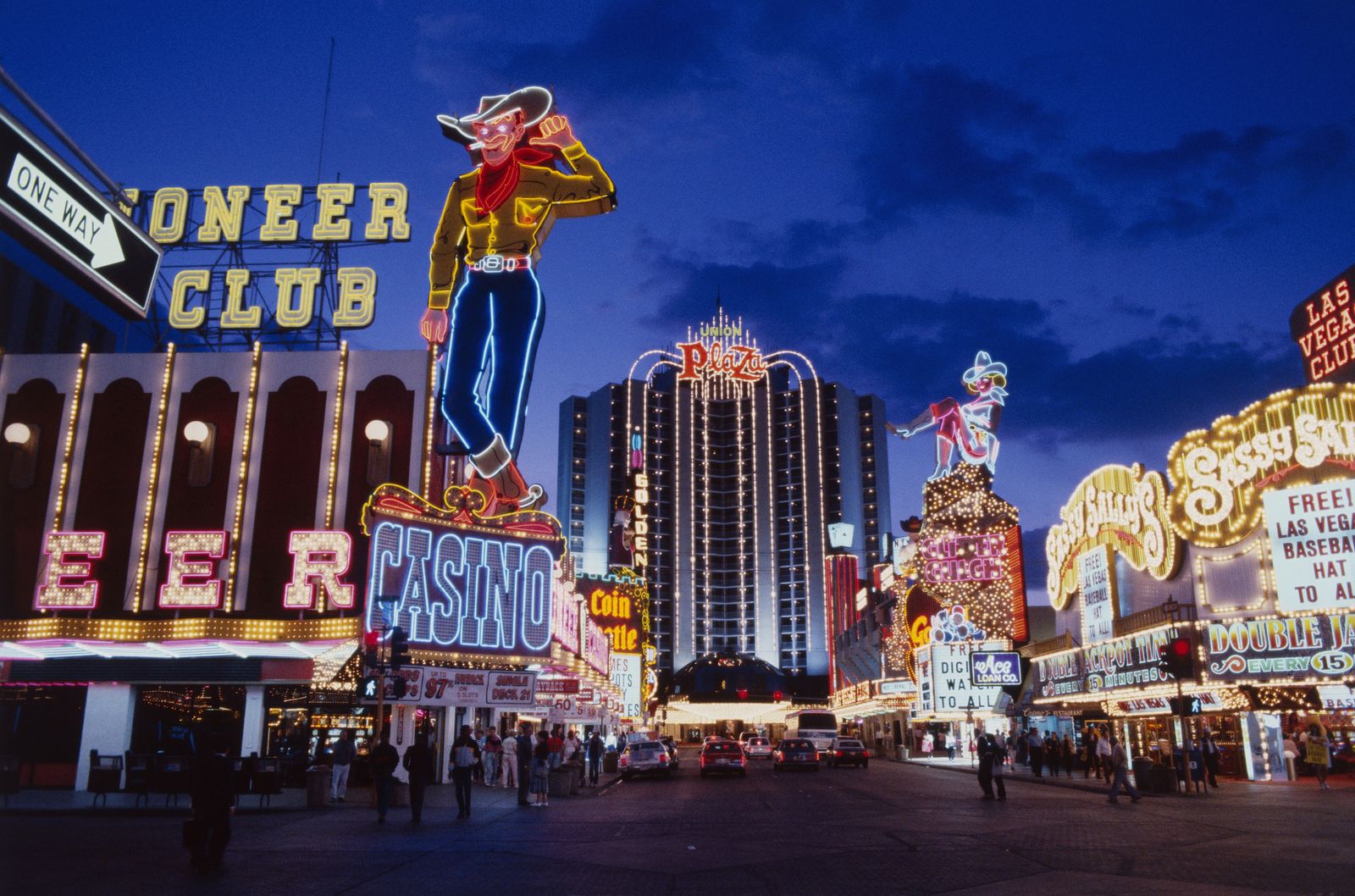
Legal gambling and the construction of the Hoover Dam conjured up an entertainment capital that constantly reinvents itself November 12, 2026 1:16 p.m. Vegas Vic prevails over the Fremont Street Experience in Las Vegas. Robert Landau/Getty Images Walking through the Fremont Street Experience in downtown Las Vegas is a smorgasbord for the senses. A 40-foot-tall neon cowboy stands beneath a rooftop display of flashing lights, while a couple of ziplines fill the air next to him; every once in a while, people zoom by like Superman. Below them, women dressed up as showgirls vie with a person in a gorilla costume for photo ops, while live music, busker battles and casino slot machines create a chaotic soundtrack for the scene. Vegas is all about pushing the boundaries of what is possible—whether that’s a glittery city bursting out from the center of a barren desert or a magician levitating in the middle of a crowd. “The story of Las Vegas is the story of magic,” says magician and illusionist Lance Rich, the author of Neon Dreams: The Story of Las Vegas Magic. “In Vegas, there is a sense and wonder that anything can happen. That you’re going to win a million dollars from a slot machine and watch a tiger disappear from a box.” Last month, at Duck Duck Shed, an annual conference put on by the Neon Museum Las Vegas, Rich shared some thoughts on how Vegas has become synonymous with magic, both in the traditional sense with magicians and illusionists like David Copperfield and Penn & Teller and in the larger-than-life way in which the city continues to morph, thrill and endlessly capture our attention. “It’s hard to remember a time before magicians became such a dominant presence in the Las Vegas landscape,” says Rich. From the city’s desert beginnings to its rise as a gambling and entertainment hub, illusion has always been a part of the Vegas story. The Neon Museum Las Vegas displays signs from old casinos and businesses in its outdoor Neon Boneyard. Amy Sparwasser/Getty Images Putting Las Vegas on the map Las Vegas was founded on May 15, 1905, when 110 acres of private railroad land were auctioned off. Originally a railway town, it was incorporated as a city six years later. Still, it wasn’t until the early 1930s that Vegas became the casino playground that we know today. Two events changed the course of Vegas history. Nevada made the decision to legalize gambling statewide, and the construction of the Hoover Dam started nearby, bringing with it a surge of workers who were looking for entertainment in their time off. Traveling vaudeville acts were already making their way to the city to delight its growing number of visitors, with lineups featuring ventriloquists and aerial escape artists. But it was a young sleight-of-hand magician named Gloria Dea who—in 1941—became the first artist to perform magic on the Las Vegas Strip, a stretch of flashy casinos and hotels that had started taking shape along U.S. Highway 91. Once Dea paved the way, other magicians and illusionists started following suit. In the late 1950s, French-style cabaret shows like Lido de Paris at the Stardust Hotel and Les Folies Bergere at the Tropicana brought large-scale stage magic to the dazzling casino stretch. Performers who later appeared on those stages—such as Siegfried & Roy and Lance Burton—would become some of the city’s biggest names in the industry. Casinos lined Fremont Street in the 1940s. Robert Alexander/Getty Images Not only was magic shaping the city’s entertainment offerings, but it was also influencing how people perceived the city. Here was this neon-lit oasis sitting smack in the heart of the Mojave Desert, filled with enormous structures, flashy signs and bizarre acts. “Las Vegas,” especially starting in 1941, when the Strip truly began, “has always been a fantasy land,” says Rich. “The kind of place where we’re going to pretend that something exists here that doesn’t really exist here.” Constant reinvention Despite never being a “Western” town, Vegas embraced the theme wholeheartedly. The Strip’s earliest casinos were Old West-inspired places like El Rancho, with its Spanish Mission-style exterior and wagon wheel chandeliers, and the Last Frontier, which used authentic horse-drawn stagecoaches to transport guests. Then, it was Caesars Palace that “took things to a whole other level,” says Rich. Opened in 1966, the Roman-inspired resort featured men dressed in centurion costumes greeting guests and women with Greco-Roman wigs and off-the-shoulder togas feeding grapes to patrons at the Bacchanal Buffet. With its marble statue replicas (including one portraying the ancient Greek god Apollo) and ornate Corinthian columns, this casino and resort was the Strip’s first fully themed, immersive experience. Vegas constantly reinvents itself. “In Las Vegas, chances are, when you become a bit familiar, you’re going to be replaced with something bigger,” says Stefan Al, an architect, urban planner and author of The Strip: Las Vegas and the Architecture of the American Dream. When developer Steve Wynn opened the Mirage on November 22, 1989, rather than replace Caesars, he simply continued building on the concept of what a property could be. Not only was the Mirage the first new resort built on the Strip in well over a decade, but it also pioneered the concept of a “mega-resort,” a vacation and entertainment destination that’s fully self-contained. A 54-foot-tall, steel-framed volcano erupted in a free display of fire, smoke and water nightly at the Mirage. Michael Montfort/Michael Ochs Archives/Getty Images Wynn’s creation ushered in a whole new world of spectacle that shifted the city’s focus from gambling to a full-blown fantasy experience (for better or for worse). Polynesian-themed, the property had its own nine-story domed glass atrium brimming with palm trees and waterfalls, as well as an enormous 20,000-gallon saltwater aquarium behind the resort’s main check-in desk filled with hundreds of exotic fish, including blue-and-yellow tangs and pufferfish. Out front, along the Strip, stood a 54-foot-tall, steel-framed volcano that erupted in a free display of fire, smoke and water nightly. Its fumes even smelled like piña colada, a synthetic scent pumped directly into the volcano’s natural gas lines. Enter Siegfried & Roy The Mirage’s starring act truly revolutionized magic in Las Vegas. Siegfried Fischbacher and Roy Horn had been ascending the ranks in Vegas since 1967, when they made their first appearance as part of the Tropicana’s Folies Bergere. By the early 1980s, the duo were headlining their first act, Beyond Belief, at the city’s New Frontier Hotel and Casino, the original Last Frontier’s successor. They started performing at the Mirage in 1990, in a 1,500-seat theater that Wynn had custom-built especially for them. There, Siegfried performed traditional magical acts, such as levitating another performer in midair and then sawing her in half, while Roy handled the show’s exotic animals, including rare white tigers, white lions and cheetahs. The duo integrated these animals into the show’s grand-stage illusions. “With the exception of maybe Debbie Reynolds walking the floors of her own hotel and casino, I don’t think a property and an act have ever been as synergistic as Siegfried & Roy were with the Mirage,” says Rich. Siegfried Fischbacher (left) and Roy Horn (right) pose for a portrait at their home in Las Vegas in March 1990. Michael Montfort/Michael Ochs Archives/Getty Images This new concept of the “mega-resort,” coupled with Siegfried & Roy’s unprecedented fame, brought magicians to Vegas in droves. This included Connie Boyd, a Canadian magician who became a headliner for Folies Bergere; Penn & Teller, now the longest continuously running headlining act in Vegas history; and international sensation David Copperfield. In 1993, assistants bound Copperfield in a regulation straitjacket, strapped his ankles to a crane hoist, and suspended him ten stories high and upside down in front of a live crowd at Caesars Palace. The ropes suspending him were then set on fire, giving the illusionist less than two minutes to escape before they burned through and he fell onto a bed of flaming, razor-sharp steel spikes below. Copperfield freed himself with only about 17 seconds to spare. It was a stunt for the ages, but the “wow factor” Las Vegas has come to be known for was just in its infancy. Between 1990 and 1999, nearly a dozen new casinos debuted along the Las Vegas Strip. The pyramid-shaped Luxor boasted a Nile River boat ride, and the Wizard of Oz-themed MGM Grand Hotel & Casino touted a seven-story Emerald City atrium and an actual yellow brick road. At the Venetian, professionally trained gondoliers propelled gondolas along blue-green canals while singing Italian melodies. Paris Las Vegas built a half-scale, 46-story replica of the Eiffel Tower on the Strip. Vegas was continuously upping the ante. You couldn’t help but wonder: What grand illusion would arise to outdo the last? Fun fact: Before Vegas, there was Hot Springs America's original Sin City was Hot Springs, Arkansas. Before the Las Vegas Strip took shape, Hot Springs was known for its casinos, brothels and gangsters. The southern city may have even provided some inspiration, at least to Bugsy Siegel, who opened the Flamingo Las Vegas in 1946. A pivotal moment But on October 3, 2003, the magic of Las Vegas all came to a screeching halt. That’s when a 380-pound white tiger named Mantecore mauled Roy Horn in the middle of a performance, leading to a paralyzing stroke that permanently ended his career. Almost instantly, Vegas entertainment shifted from death-defying feats to ensemble acts like Cirque du Soleil, digital technology and street-level magic, and low-risk celebrity residencies. Even the casino resorts began morphing into something new, moving away from the family-friendly gimmicks (think Excalibur, with its medieval castle facade, and the Big Apple Coaster at New York-New York) toward more luxury spaces like Wynn Las Vegas and the Cosmopolitan. The LED-covered Sphere displays a giant blue eye. serts/Getty Images Today, the city’s traditional magic is more subdued. With technology changing at exponential speeds, magicians have turned to more intimate venues and highly engaging, experiential offerings, whether it’s reading audience members’ thoughts in an intimate setting or performing sleight-of-hand tricks in a speakeasy-style theater. “Las Vegas is the city of reinvention,” says Aaron Berger, executive director and CEO at the Neon Museum Las Vegas. “You’ll never have the same visit twice, whether it’s for food or gambling or entertainment.” From Meow Wolf’s walk-through Omega Mart, a Day-Glo “grocery store” stocked with hidden portals and tricks of the eye, to the enormous LED-covered Sphere, which serves as a dynamic, animated canvas, Vegas continues to redefine illusion. Where to experience traditional Vegas magic for yourself Here are five spots to see some of the city’s most illustrious magicians in action. Penn & Teller at the Rio Hotel Known for the loud, carnival-barker-style of Penn Jillette and the enduring silence of Teller, this duo has been entertaining visitors to Vegas for over 30 years. They’ll often reveal how a trick is done, only to surprise audiences with something mind-blowing the next minute. Nathan Burton at FlyOver Las Vegas For a ’90s magician throwback, try Nathan Burton, says Rich. Burton performs his large-scale illusions in an intimate theater with fewer than 200 seats. It’s a fast-paced, all-ages show that also features sleight-of-hand tricks, interactive mind-reading and classic (though G-rated) Vegas showgirls. Jen Kramer at Westgate Las Vegas The city’s only headlining female magician, Jen Kramer, is known for her signature quick-change magic act, where she transforms between vibrant gowns, sequined dresses and casual outfits before audiences can even blink an eye. Piff the Magic Dragon at the Flamingo Always deadpan and dressed in a signature green-and-yellow dragon onesie, Piff performs alongside his chihuahua co-star and assistant, Mr. Piffles II, and his real-life partner, comedy showgirl Jade Simone. The show’s signature Jell-O routine includes a 25-pound block of green gelatin and lots of audience members’ watches. Shin Lim at the Venetian Shin Lim redefines close-up illusions using a synchronized system of cameras and screens, and choreographs his magic to sweeping musical scores. In one trick, he makes cards disintegrate into smoke and then transforms them into plastic sheets. You Might Also Like Planning Your Next Trip? Explore great travel deals A Note to our Readers Smithsonian magazine participates in affiliate link advertising programs. If you purchase an item through these links, we receive a commission. More about: American History Architecture Cities Las Vegas Magic Performing Arts Tourism
How the Desert Town of Las Vegas Became a Hotbed of Magic
Full Article
Original Source
Read the full article at Smithsonianmag →KhanList aggregates and links to publicly available news content. We do not host full articles from third-party sources. Always verify important information with original sources.