
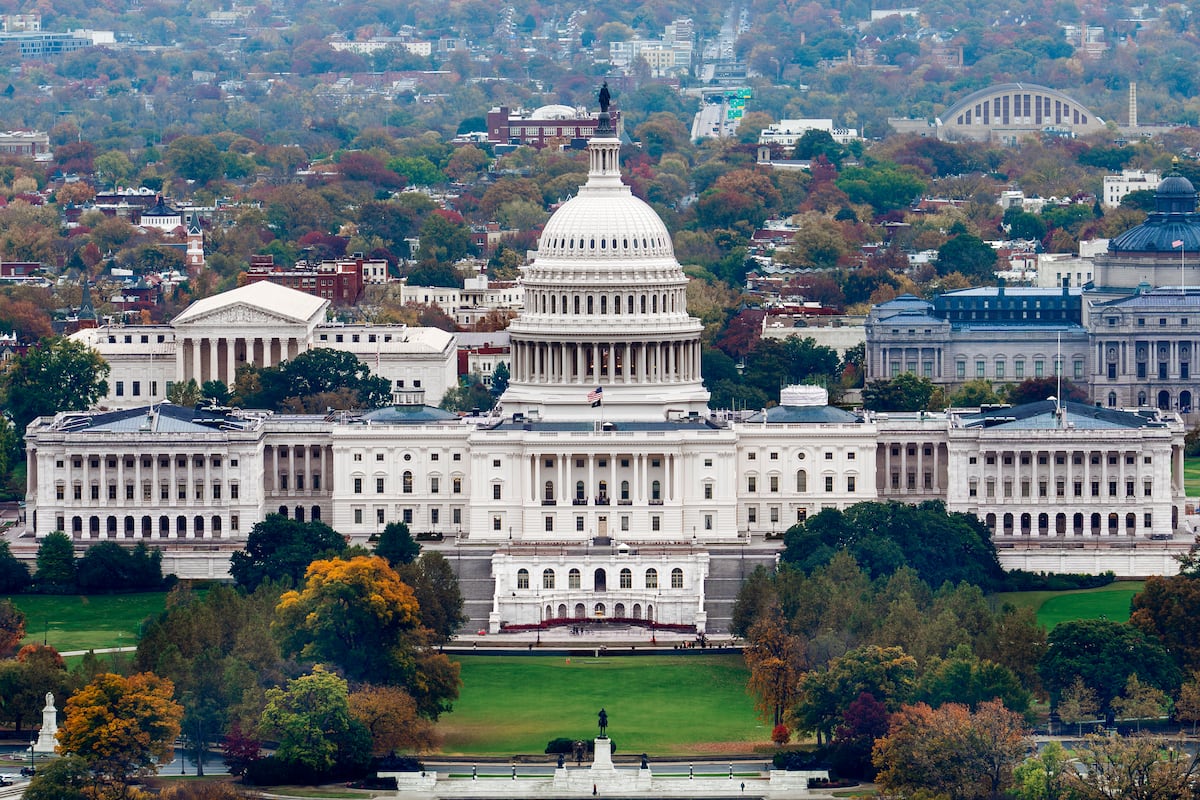
The Democrats’ historic victory at the November 3 midterm election promises to usher in a new era in Washington. It also opens the door to ending an electoral anomaly: the fact that the United States is the only presidential democracy in the world where the president is not elected directly by voters, but by an Electoral College. Here’s how it works: the Constitution assigns each of the 50 states a number of electors equal to its representation in Congress, two senators per state plus a number of members of the House of Representatives based on population, ranging from one to 52. With the exception of Maine and Nebraska, the candidate who wins a state receives all of its electoral votes, whether the margin is a single ballot or two million.Because Democrats won control of the governorship and both chambers of the state legislatures in Michigan, Pennsylvania, Wisconsin, Arizona and Nevada on November 3, advocates of this far-reaching reform now see a path to securing the support they previously lacked.Their strategy is to pass the National Popular Vote Interstate Compact, a legal framework first proposed in 2007 as an alternative to a constitutional amendment, which would be nearly impossible to achieve in a country as politically polarized as the United States. The compact has already been approved by 18 states and the District of Columbia, home to Washington. To take effect, it must be adopted by states representing a combined 270 electoral votes, the same number required to win the presidency. So far, states accounting for 222 electoral votes have joined. If Arizona, Michigan, Pennsylvania, Wisconsin and Nevada, the five states that have just turned blue, were to sign on, their combined 61 electoral votes would be enough to put the compact into force.Critics and supportersThe Electoral College has many critics as well as supporters, who see it as a crucial component of the system of checks and balances designed by the Founding Fathers. The reality is that when they laid the foundations of the American republic, they could not have foreseen the central role political parties would come to play, since they did not yet exist, nor the extent to which the system would evolve into a rigid two-party structure.The current system allows a president to be elected without winning the popular vote. Both George W. Bush and Donald Trump reached the White House despite receiving fewer votes nationwide than their opponents, Al Gore and Hillary Clinton, in the 2000 and 2016 elections.Combined with the overrepresentation of less populous states, the Electoral College tends to favor Republicans, whose support is concentrated in states that wield disproportionate influence relative to their share of the national popular vote.This is one reason why presidential elections increasingly appear to be decided in advance, with only a handful of states truly in play. In 2024, there were seven such battleground states, and Trump carried every one of them: Arizona, Georgia, Michigan, Pennsylvania, Wisconsin, Nevada and North Carolina.If enacted, the National Popular Vote Interstate Compact could face legal challenges on the grounds that it may violate the Constitution’s Compact Clause. Found in Article I, Section 10, the clause provides that no state may enter into an agreement or compact with another state, or with a foreign power, without the consent of Congress.This route to changing the Electoral College system is easier than pursuing a constitutional amendment, but it is also more fragile. Just as states can join the compact, they can also withdraw from it, for example, if Republicans regain control of state government.Nor is it a given that demographic trends will always favor Democrats. Population shifts in recent years have cost traditionally blue states residents while boosting the populations of red states.Sign up for our weekly newsletter to get more English-language news coverage from EL PAÍS USA Edition
How the Democrats’ midterm victory could reshape the rules for electing a US president
Full Article
Original Source
Read the full article at English →KhanList aggregates and links to publicly available news content. We do not host full articles from third-party sources. Always verify important information with original sources.