
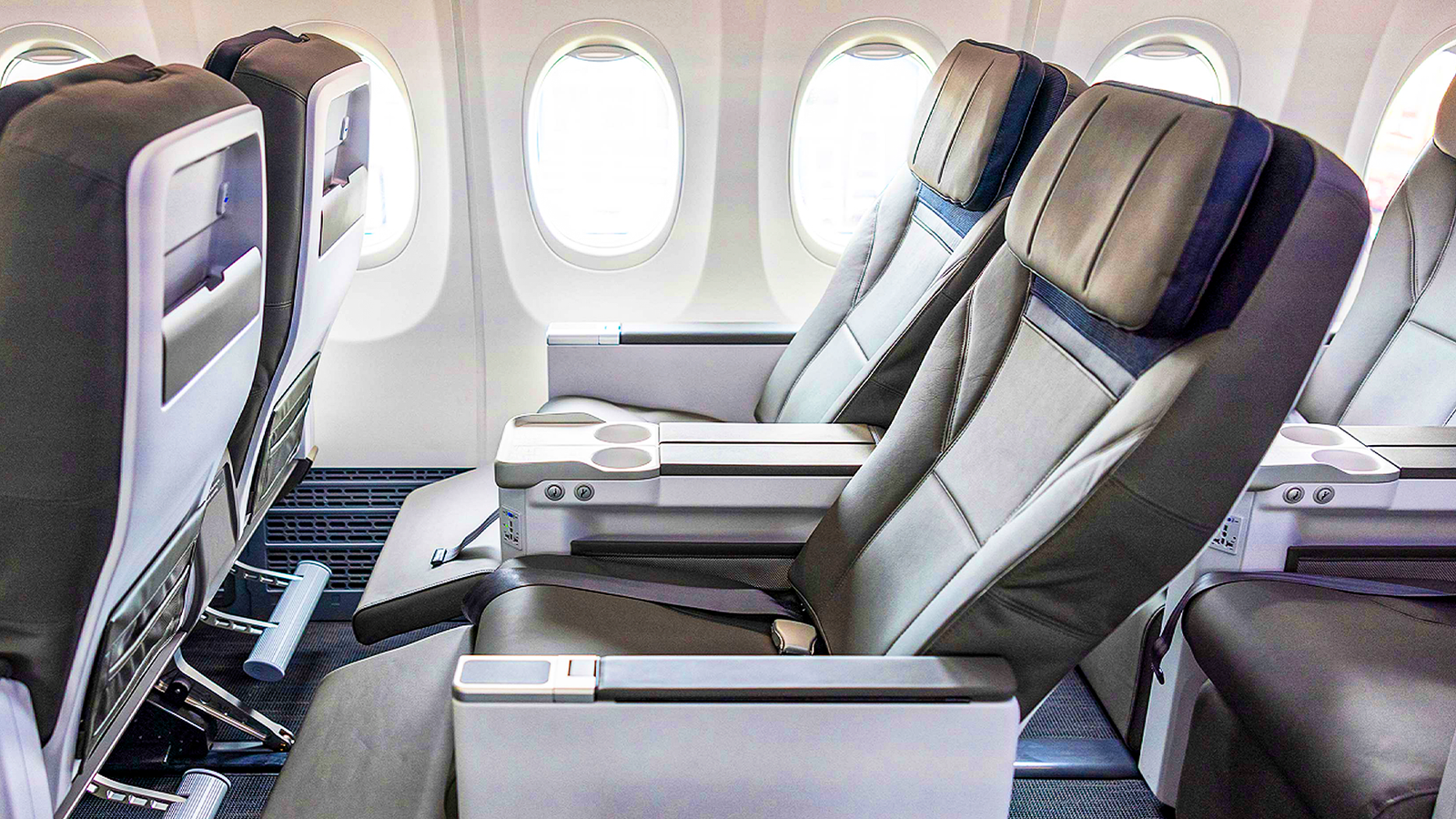
The Boeing 737 isn't the world's most common airliner anymore; that would be the Airbus A320 instead. Within the US, however, the 737 reigns supreme, as it is the most common aircraft type operated within the country. Eight passenger airlines operate almost 2,500 737s, which means that there's a lot of variance in how these planes may be configured inside. Much of this depends on the business model that the airlines are operating, although they are all configured to operate domestic flights as per aeroLOPA. What's interesting here is that the same isn't true for the Airbus A320 family or Boeing 757. Three airlines are now operating A321-200s, A321neos, or A321XLRs configured with lie-flat beds, while the two 757 operators (Delta Air Lines and United Airlines) have 757 subfleets for domestic and long-haul flights. However, while the 737 thus far has been configured in a more conventional LOPA (layout of passenger amenities) by US operators, this isn't going to remain the case for long, at least for one airline. The Three Legacy Airlines Credit: Wenjie Zheng I Shutterstock American Airlines currently only operates the 737-800 and 737 MAX 8, while Delta Air Lines only flies the 737-800 and 737-900ER. United Airlines, meanwhile, flies the 737-700, 737-800, 737-900, 737-900ER, 737 MAX 8, and 737 MAX 9, giving it the most diverse 737 fleet among the three (it also operates substantially more 737s than either). In practice, however, the 737-800 and 737 MAX 8 have the same fuselage length, while the 737-900, 737-900ER, and 737 MAX 9 also share a common fuselage length (apart from a new tailcone for the MAX variants). American, Delta, and United all install 16 first class seats on the 737-800/MAX 8. In the space between first class and the overwing exits, Delta and United both install seven rows of economy, while American installs eight. Behind the overwing exits, meanwhile, United manages to fit an extra row of economy compared to Delta by slightly trimming seat pitch and using the Collins Aerospace Advanced Spacewall lavatory, while American puts two extra economy rows. As such, Delta fits 144 economy seats, United fits 150, and American fits 156. Both United and Delta have 20 first class seats on the 737-900ER, but United installed a mid-cabin lavatory behind the first class cabin, cutting away half a row of economy, and it fits 159 economy seats in total. Its 737-900s and MAX 9s have the same layout. Delta, on the other hand, installs a coat closet behind first class, while it installs three lavatories in front of the rear emergency exit set rather than two, and there is a row of four economy seats immediately behind the overwing exits. The result is that Delta fits 160 economy seats on the 737-900ER. Airline 737 Variants Operated Capacity American Airlines 737-800/737 MAX 8 172 seats Delta Air Lines 737-800 160 seats 737-900ER 180 seats (standard LOPA) United Airlines 737-700 126 seats 737-800/737 MAX 8 166 seats 737-900/737-900ER/737 MAX 9 179 seats United Airlines is the only one of its peers operating the 737-700, which it configures with 12 first class seats and 114 economy seats, for a total of 126 seats. However, Delta configured it with two fewer seats in economy than United, as the row immediately behind the overwing exits only contained four seats rather than six. Alaska Airlines' 737 Configurations Credit: Brandon Farris | Shutterstock Alaska Airlines is generally considered to be a hybrid airline, meaning that it blends elements of full-service carriers and budget airlines. Its LOPAs for the 737, however, are among the least dense of any US operator. Its 737-700s, for example, have more pitch in first class than United's and therefore have 124 seats in total rather than 126, as it has a row of four seats by the overwing exits due to the extra space taken up by the first class cabin. Alaska Airlines' original LOPA for the 737 MAX 8 features 12 first class seats and 147 economy seats, which is less than any other 737-800 or 737 MAX 8 operator in the US. Alaska offers more pitch in first class fleetwide and also installs an extra lavatory on these planes, resulting in this seat count. It is, however, retrofitting these planes with 16 first class seats and 145 economy seats, which is being accomplished by cutting seat pitch slightly in both cabins. All of its 737-800s now feature the newer LOPA. Alaska's 737-900ERs and 737 MAX 9s feature the same LOPA, with 16 first class seats and 162 economy seats. This LOPA is particularly noteworthy because it includes only 16 first-class seats, whereas United and Delta install 20 first class seats on these aircraft, yet overall capacity is slightly lower, at 178 seats. This is mainly because the airline offers slightly more legroom on these planes than competitors. The All-Economy 737s Credit: Markus Mainka | Shutterstock You can't discuss 737 operations in the US without mentioning Southwest Airlines. The Dallas-based carrier has only ever purchased 737s (although it did briefly lease 727s in the past) and is the world's largest 737 customer, currently operating just over 800 examples on its own. The carrier does not sell first class seats, but it completed the addition of extra legroom seats across the fleet in January 2026. For the 737-800s and 737 MAX 8, Southwest kept the plane's capacity at 175 seats, but the 737-700s lost a row of seats, going from 143 to 137 seats. Southwest's 737s are actually relatively spacious compared to what true budget airlines tend to install, as the airline is generally a hybrid carrier nowadays. Avelo Airlines, which only began its current operations post-COVID, also operates the 737-700 and 737-800, but it installs 149 seats on the 737-700 (of which Avelo only flies one example) while its 737-800s are configured with 189 seats. Meanwhile, Sun Country installs either 186 or 189 seats on its 737-800s, while all three of its 737-900ERs are configured with 189 seats. Allegiant Air, which is acquiring Sun Country, is the newest 737 operator in the US. The carrier placed its order for the 737 MAX in 2022, selecting the 737 MAX 200 and 737 MAX 7. The MAX 200 is a high-density version of the MAX 8, and Allegiant Air installs 190 seats on these planes, of which it currently operates 22 examples. While Allegiant's original order also included the MAX 7, the airline has converted all of its firm orders to the MAX 200, although its 737 options can be used for either variant. What To Expect From Future 737s Credit: Lukas Souza I Shutterstock Boeing has recently certified the 737 MAX 7, which should enter service in 2027 with Southwest Airlines. Southwest is now the only airline to hold firm orders for the MAX 7, as all other carriers have converted orders to larger variants. It has yet to confirm what the LOPA for the 737 MAX 7 will be, but the aircraft is longer than the 737-700 to fit an extra two to three rows of economy. The more important aircraft for US carriers and others around the world is the 737 MAX 10. In the US, the MAX 10 has been ordered by Alaska, American, Delta, and United, with each ordering at least 100 units. This aircraft is sized similarly to the Airbus A321, and it's been confirmed that American as well as Delta will be installing 24 first class seats on these planes, rather than the previously expected 20. Whether United or Alaska will follow suit is unknown. Premium demand is on the rise in the US, yet domestic narrowbody first class cabins have not changed much over the past decade. With the 737 MAX 10, major airlines are getting a brand new type to complement their current A321/A321neo fleets, and see the introduction of this type as a good opportunity to size up their premium cabins, capturing lucrative demand for these expensive seats. Lie-Flats On The 737 MAX Credit: Alaska Airlines In the past, the 757-200 was the standard narrowbody used for premium transcontinental routes and thin transatlantic services, due to its size and range. More recently, JetBlue and American Airlines ordered A321-200s with lie-flats, while JetBlue has also ordered A321neos and A321LRs for this same role. American has ordered the A321XLR, while Delta will configure some of its A321neos with lie-flats. United will install business class flatbeds on some A321neos and all A321XLRs. United planned to operate a subfleet of 737 MAX 10s with Polaris business class and Premium Plus seats, but delays to this program meant that A321neos will now serve this role. No other US airline has intended to put lie-flats on a 737 until September 2026, when Alaska Airlines announced that it would operate a subfleet of three-class 737 MAX 10s. The full LOPA for these planes has yet to be revealed, but they will feature 12 'Aurora Suites' along with 12 'Premium Reserve' seats. Alaska has selected the Elevate Ascent narrowbody platform, a reverse herringbone seat optimized for single-aisle planes derived from the popular Ascent widebody platform. The carrier intends to operate at least 25 examples, which is a fairly large subfleet considering that Alaska has never before put lie-flats on narrowbodies. With this, Alaska will be taking on the premium Airbus narrowbodies being flown across the country with lie-flats, but with a 737 MAX 10 instead.
How The Boeing 737's Seating Configuration Differs Across US Airlines In 2026
Full Article
Original Source
Read the full article at Simpleflying →KhanList aggregates and links to publicly available news content. We do not host full articles from third-party sources. Always verify important information with original sources.