
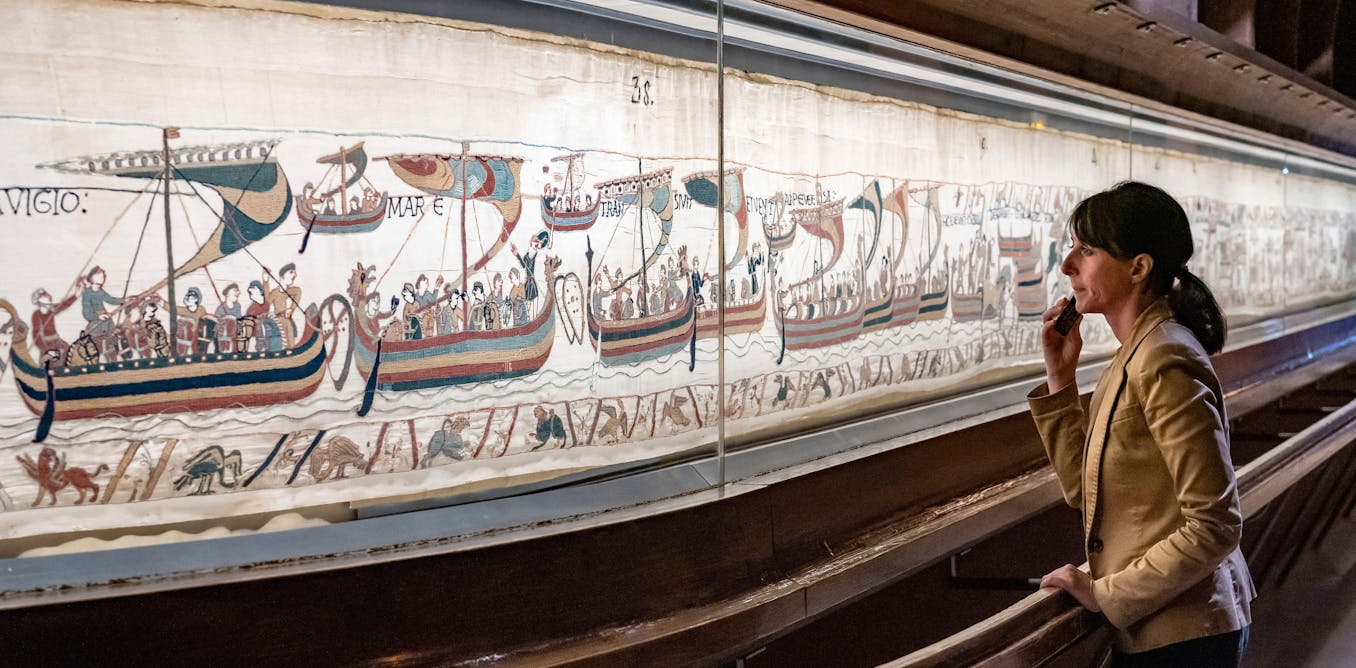
As a professional embroiderer and textile archaeologist specialising in the early medieval period (450-1100 CE), I was privileged to be asked to contribute to the British Museum’s catalogue for its much-anticipated exhibition of the Bayeux tapestry, which is on display from September 2026 till July 2027. My previous work has involved me analysing the reverse of the Bayeux tapestry from photographs, and microscopically examining sections of the front to see how it was embroidered. This work informed how I explained the embroiderers’ skills, practices and knowledge of the materials they worked with for visitors to the British Museum. Writing my contribution has made me think about the stories the Bayeux tapestry conjures, not just the narrative stitched along its surviving 68-metre length, but also the other areas that generations of researchers have explored. There have been numerous publications and research projects on the subject. While there are too many to discuss here, an online search suggests over 1,000 published works. These cover topics such as: who commissioned it and why; who made it and where; the design process; whether it was meant for a specific place and if so, where; whether the stories and motifs depicted are accurate to their real counterparts; and whether there were any hidden messages. The list goes on. Until recently, it is the detailed process of its making, and the embroiderers’ understanding of their materials and how they manipulated them to create the effects they needed, that has fascinated me. However, over the last couple of years I have become increasingly interested in how people engaged with the tapestry as a form of cognitive and sensory material culture. As part of my wider research, I have started to investigate this and publish some of my findings. Physical interaction If we look at the meanings incorporated into different objects during the early medieval period, we see that the Bayeux tapestry is a visual form of the scop, an early medieval storyteller who told tales of heroes and great deeds, helping to preserve the oral tradition of the early English peoples. When the scop spoke, they mentally shaped the listening audience, creating a shared living memory that would dissipate with the final words – until re-imagined and retold the next time. But the embroidered imagery of the Bayeux tapestry was a constant, unchanging narrative, always observable while the hanging was exhibited. Here the stories were “read” visually, as onlookers proceeded along the tapestry’s length. But if the Bayeux tapestry was displayed within a castle keep, people would have been standing in a square space viewing the different scenes directly opposite each other, enabling the viewer to make connections between them. What I found striking is that the tapestry was not a static object. When hung, it would have moved, caught by a draught or a person passing by. This movement would have made the stitched pictures come “alive”, turning the static narrative into a something like a film, inviting the viewer to participate in the action more fully than they might have expected. The colours of the fibrous wool thread used by embroiderers would contrast with the smooth cream/white linen ground fabric. Their tones would change as light moved across them and as the fabric undulated, creating shadows. Horses now galloped, sails billowed, and hair was blown by the wind, making the tapestry kinetic, enhancing the idea of a living history. If the tapestry was hung during mealtimes in a castle keep, the sound of clattering crockery and banging vessels, accompanied by talking and laughter and the smell of food would have brought the cooking and feasting scenes alive. People would have interacted with the tapestry, touching it, brushing their fingers along the stitching, over images that captured their attention, enjoying a tactile, sensory experience to accompany their thoughts. They would become animated as they talked about what they saw. Noise would have ebbed and flowed within the enclosed space while sound from outside would have been muffled by the thick texture of the hanging itself. In this way the audience would have been encapsulated in a private world. This was theatre in the round with a show that the audience was asked to participate and believe in. It was an immersive experience that would have held varying meanings for those who took part, depending on their viewpoint, life experiences and beliefs. Unlike the storytelling scops, who were able to bring together a whole audience, the Bayeux tapestry, while telling certain stories from specific perspectives, could not command the audience to unite in the same way. While the scops told their audiences what to think and feel, the intensely visual nature of the tapestry allowed each viewer to individually interpret what they saw. This would only have changed if they spoke to other onlookers, digested other thoughts and opinions and moulded their own as a result. The Bayeux tapestry was a powerful object that not only told a story. Its rich and detailed decoration created individual and personal engagements with those viewing it, while drawing together people through shared experience.
How the Bayeux tapestry came alive for the people who viewed it a thousand years ago
Full Article
Original Source
Read the full article at Theconversation →KhanList aggregates and links to publicly available news content. We do not host full articles from third-party sources. Always verify important information with original sources.