
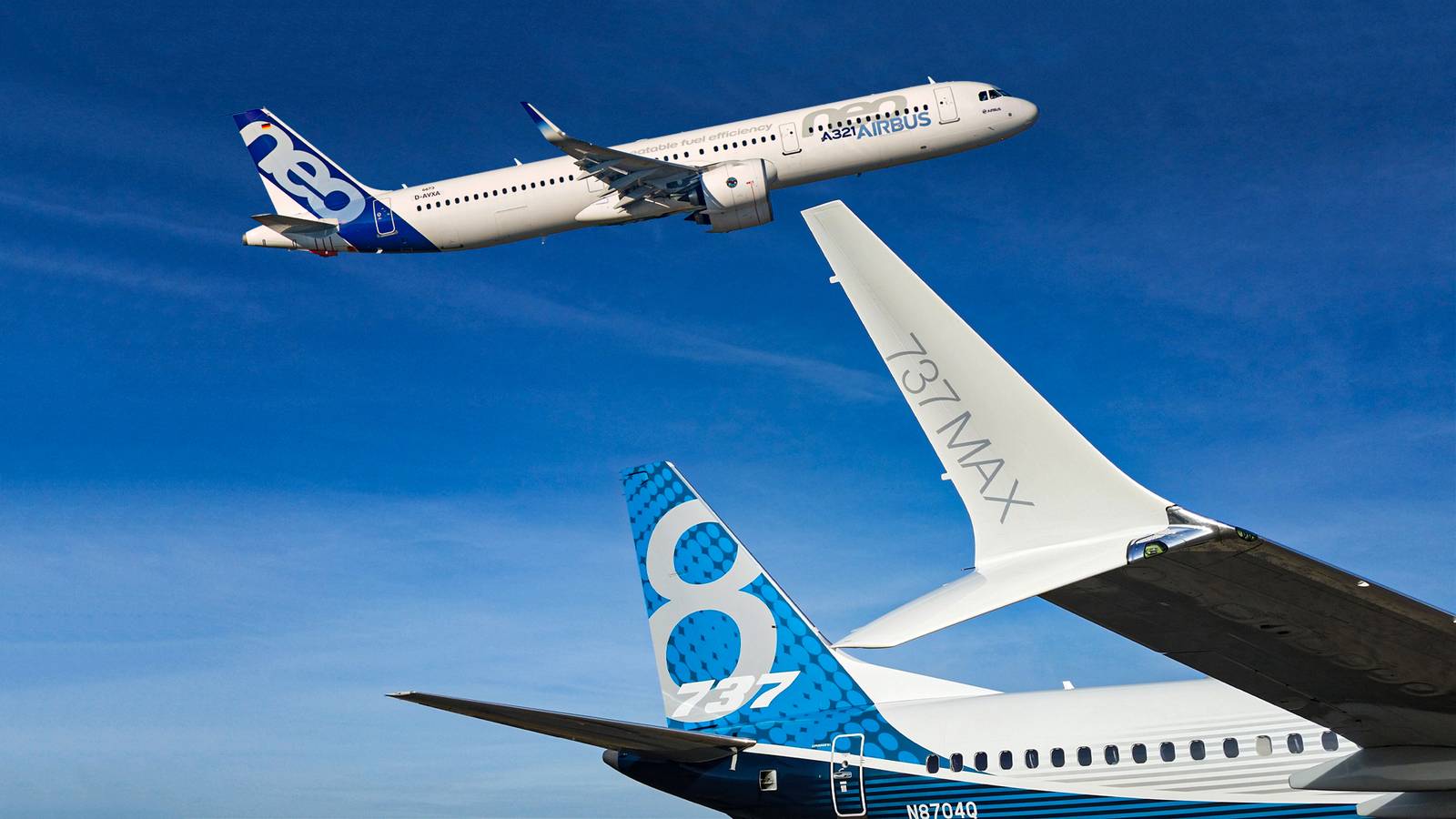
Published Nov 20, 2026, 10:00 AM EST Brandon's passion for aviation started at a young age. He became involved in the flight simulator and VATSIM communities, which sparked his interest in aviation and eventually led him to earn his private pilot license. Outside of work, he continues to build flight hours, explore new airports, and stay involved in the aviation community. Airbus’ narrowbody order book now leans heavily on its largest model. At the start of 2026, about 72% of the A320neo family backlog was for the A321neo, and that share has kept climbing. By the end of September, A321neos made up 5,656 of the 7,529 A320neo family aircraft still awaiting delivery, against 1,860 A320neos. That is roughly three of every four aircraft Airbus still owes its customers. The shift changes what the long-running A320neo versus MAX 8 comparison actually covers. On paper, the MAX 8 offers more maximum seats and slightly more brochure range, while the A320neo offers a wider cabin and a choice of engines. The biggest recent Airbus orders, however, have been for the larger aircraft, and the MAX 10, Boeing’s direct answer to it, has only just been certified. What remains between the A320neo and the MAX 8 is the set of routes where demand does not justify a jet with more than 200 seats. How The A321neo Took Over Airbus’ Narrowbody Backlog Credit: Walter Cicchetti | Shutterstock Order intake explains the backlog. In October alone, Forecast International reported that the A320neo family secured 163 gross orders (comprising 98 A321neos and 65 A320neos). Lessors drove much of that activity, including a firm order for 75 A320neo Family aircraft from Aviation Capital Group (ACG), announced on October 16. However, Airbus and ACG did not disclose the split between A320neo and A321neo aircraft. Production has followed the same pattern. In full-year 2025, Airbus delivered 793 commercial aircraft, including 607 A320neo-family aircraft, and Air Data News reported that the A321neo accounted for 64% of those handovers. The share has held into 2026. Through October, Airbus had delivered 621 aircraft, and the A321neo alone accounted for 306 deliveries, nearly half of the company’s total for the year. October’s single-aisle handovers were weighted similarly, with 39 aircraft, followed by 15 A320neos. Engine supply limits how quickly that backlog can come down. Airbus said in February it expects to deliver around 870 commercial aircraft in 2026, as it scaled back its planned production increase for the A320neo family due to shortages of Pratt & Whitney GTF engines. The company now expects A320neo family output to reach 70 to 75 aircraft per month by the end of 2027, stabilizing at 75 thereafter. Former commercial aircraft chief Christian Scherer had said engines arrived “very, very late” throughout 2025, with Airbus expecting the problem to persist into 2026. At that pace, airlines ordering an A321neo today are buying a delivery slot years in the future. The A320neo And 737 MAX 8, Side By Side Credit: Air Canada Capacity favors the Boeing, though with a qualifier. Airbus lists the A320neo at 150-180 seats in a typical two-class layout and a maximum of 194, on an overall length of 123 feet, three inches (37.57 meters). Boeing lists the MAX 8 at 162-78 seats in two classes, on a length of 129 feet, eight inches (39.52 meters). The often-quoted 210-seat maximum for the MAX 8 belongs to a sub-variant, which Boeing specifies as the MAX 8-200, with an additional mid-cabin exit. That extra pair of doors raises the evacuation limit enough to allow the denser layout. Range is close enough that the brochure figures settle little. Airbus says the A320neo flies up to 3,400 nautical miles (6,300 km), while Boeing lists the MAX 8 at 3,500 (6,480) nautical miles. Each manufacturer calculates its maximum under its own assumptions, so the 100-nautical-mile gap tells an airline less about a given route than payload, cabin layout and airport conditions do. The A320neo’s clearer advantage sits inside the aircraft. Airbus lists a maximum cabin width of 12 feet (3.70 meters), and the A320 family’s cross-section has always been wider than the 737’s. Engines and flight decks separate the two programs more sharply than dimensions do. Airbus offers the A320neo with CFM LEAP-1A or Pratt & Whitney GTF (Geared Turbofan) engines, while every 737 MAX variant uses the LEAP-1B from CFM International. A second engine supplier gives airlines leverage when negotiating an order, although GTF shortages that have slowed Airbus production show the risk of relying on one supplier. In the cockpit, the A320neo uses Airbus’ fly-by-wire controls with sidesticks, and the MAX 8 keeps the conventional control column that 737 pilots have flown for decades. Why Airlines Keep Moving Up To The A321neo Credit: Robin Guess | Shutterstock The A321neo offers more of everything the A320neo does. Airbus lists the aircraft with typical seating of two-class 180-220 seats, with a maximum of 244, and says its Cabin-Flex door configuration increases the jetliner’s maximum certified capacity to 244 seats, while still accommodating Airbus’ modern comfort standard of seats that are at least 18 inches wide. Range extends to 4,000 nautical miles on the standard A321neo, and Airbus says the A321XLR offers up to 4,700 nautical miles. AEGEAN illustrates how carriers use that flexibility. In March 2025, the Greek airline ordered 8 additional Airbus A321neo aircraft, bringing its A320neo-family commitment to 58. Its earlier A321LR aircraft feature a newly designed passenger cabin, specifically configured for flights to new markets of up to 7.5 hours. In July 2025, AEGEAN added two (2) new Airbus A321XLR (Extra Long Range) aircraft with an even longer range of up to 10.5 hours, with plans for New Delhi service from March and Mumbai from May, taking its order to 60 aircraft. Lessors have bet heavily on the same aircraft. In July 2025, Avolon placed an order for 90 Airbus aircraft, comprising 15 A330neos and 75 A321neo, bringing Avolon’s total to 79 A330neos and 264 A321neos. Avolon said the aircraft are scheduled to be delivered out to 2033. Leasing companies place aircraft with many airlines over decades, so their orders reflect where they expect demand to settle, and Avolon’s commitment points squarely at the larger model. That pattern explains why the A320neo now makes up a minority of what Airbus still has to build. The 737 MAX 10 Finally Enters The Contest Credit: Ian Dewar Photography | Shutterstock Boeing’s direct competitor to the A321neo arrived years late. The FAA certified the MAX 10 on October 20, 2026, clearing the way for deliveries of the largest variant in the 737 MAX family. Boeing described the approval as the final regulatory hurdle in bringing the largest member of the 737 MAX family to operators, following MAX 7 certification in August. Reuters reported that a problem with the anti-ice system on 737 MAX engines that arose in 2023 further delayed certification of the MAX 7 and 10. On paper, the MAX 10 and A321neo are closer competitors than the A320neo and MAX 8. Boeing lists the MAX 10 at 188–204 seats in two classes, a maximum of 230, and a range of 3,100 (5,740) nautical miles, with a length of 143 feet, 8 inches (43.8 meters). Airbus’ standard A321neo carries up to 244 seats at maximum density and lists 4,000 nautical miles of range, 900 more than the Boeing, before the XLR is counted. Those figures suggest the MAX 10 will compete most directly with the A321neo on high-density domestic and regional routes rather than longer, thinner routes. Boeing starts with a large order book for the type. It reported 1,555 MAX 10 orders from more than 30 customers at the time of certification, and says the 737-10 represents more than 30 percent of unfilled 737 MAX orders. United holds the largest airline order, with 167 aircraft, according to Cirium data reported by Business Traveller. According to Air Data News, ACG is expected to own the first aircraft delivered, and WestJet is scheduled to operate it. Boeing expects deliveries to begin in the coming months, which makes 2027 the first full year of head-to-head competition between the MAX 10 and the A321neo. What Is Left For The A320neo & The MAX 8 Credit: Michael Take | Shutterstock The A320neo still sells, even as its share of the backlog shrinks. Airbus’ remaining A320neo backlog stood at 1,860 aircraft at the end of September, and the 65 A320neos ordered in October show that airlines continue to commit to the smaller model. Those aircraft serve markets where a 150- to 180-seat jet fills more reliably than a 200-plus-seat aircraft, including routes that need higher frequency more than additional capacity on each departure. Boeing’s single-aisle business remains built around the MAX family as a whole. The company says customers have ordered 7,350 737 MAX airplanes to date. Boeing delivered nearly 2,500 as of September. In 2025, Boeing delivered 447 737s, and Air Data News reported that Boeing’s order performance was led overwhelmingly by the 737 MAX, which accounted for 591 gross orders that year, outselling Airbus on net orders. Read together, the numbers narrow the A320neo versus MAX 8 matchup rather than ending it. Both aircraft still sit at the center of the segment they were designed for, and each manufacturer continues to book orders. The difference is that the higher-capacity market, where Airbus has placed most of its backlog, now has a certified Boeing competitor for the first time. How quickly the MAX 10 can deliver, and how quickly Airbus can clear engine shortages on the A321neo, will shape that segment more than any comparison between the two smaller jets.
How The Airbus A321neo, 72% Of The A320neo Family Backlog, Shrinks The Boeing 737 MAX 8 Rivalry To Medium-Demand Routes
Full Article
Original Source
Read the full article at Simpleflying →KhanList aggregates and links to publicly available news content. We do not host full articles from third-party sources. Always verify important information with original sources.