
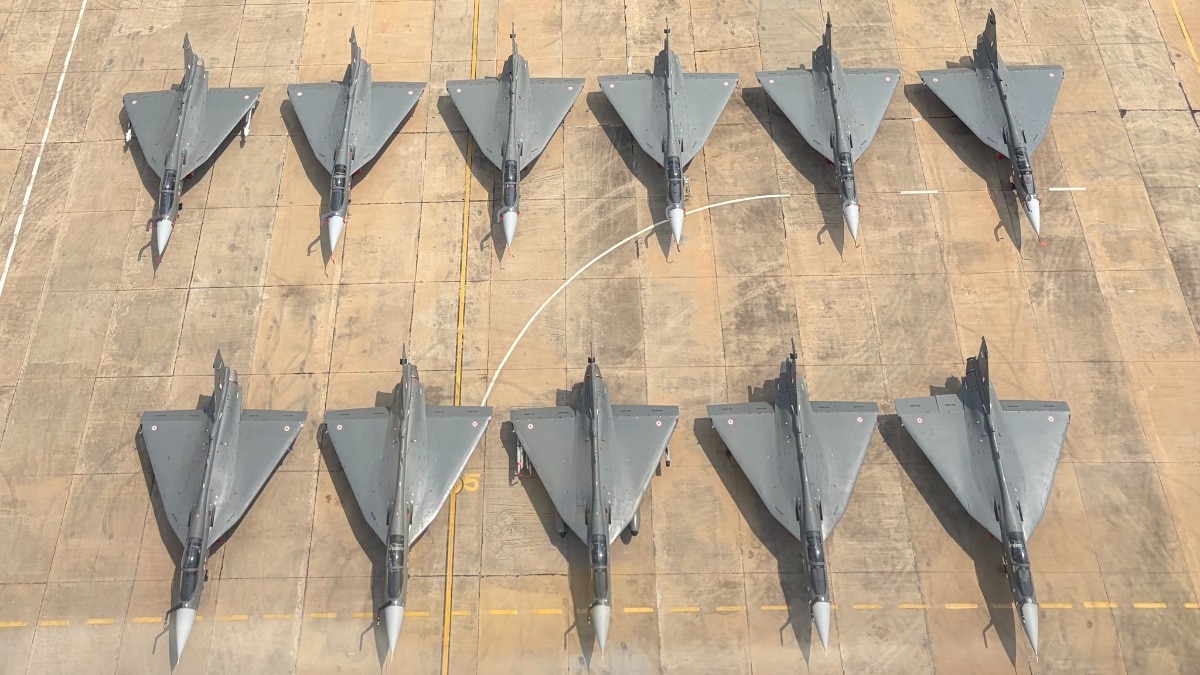
The Indian Air Force (IAF) expects its first Tejas Mk1A squadron by March 2027, after a series of delays pushed back the original delivery schedule. But what makes this upgraded fighter different from the Tejas Mk1? Here's a look at the new capabilities it brings to the table.The Indian Air Force expects to induct its first squadron of indigenous Tejas Mk1A fighters by March 2027. (Image: X)New Delhi,Nov 25, 2026 08:30 ISTWith the Indian Air Force (IAF) expecting its first squadron of Tejas Mk1A fighters by March 2027, after years of delays, attention is turning to what the upgraded indigenous aircraft will bring to the force. While the Mk1A retains several capabilities of the original Tejas Mk1, it comes with a more advanced radar, an upgraded electronic warfare suite and improved avionics.The aircraft's induction into the IAF has been a long time coming. Its manufacturer, Hindustan Aeronautics Limited (HAL) was originally expected to begin deliveries of the first 83 Mk1A fighters in March 2024. But several reasons, including delays in the supply of US-made GE Aerospace F404 engines pushed back delivery to 2027.So, what makes the new variant a more potent fighter?The Mk1A is not getting all its combat capabilities for the first time. Its predecessor, particularly in its Final Operational Clearance (FOC) configuration, could already fire beyond-visual-range (BVR) missiles and refuel in mid-air. What the Mk1A promises is a more sophisticated set of systems to detect threats, process battlefield information, counter enemy radar and engage targets. Here's what the upgraded fighter brings to the table.LCA TEJAS MK1A HAS AESA RADAR, WHICH ALLOWS IT TO SEE THREATS MORE EFFECTIVELYOne of the most significant additions to the Mk1A is its Active Electronically Scanned Array (AESA) radar, replacing the mechanically scanned multimode radar used in the original Mk1. A conventional mechanically scanned radar physically moves its antenna to direct radio waves towards different areas of the sky. An AESA radar, on the other hand, uses hundreds of small electronic modules to direct radar beams without having to physically move the antenna.In simple terms, unlike the older mechanical radar, which could only scan one part of the sky at a time, the new AESA radar allows the aircraft to scan the sky electronically and track potential threats more efficiently. It also improves the radar's ability to manage multiple targets.The Ministry of Defence's January 2021 announcement on the procurement of 83 Mk1A fighters identified AESA radar as one of the aircraft's critical operational capabilities.The upgrade matters because detecting an enemy aircraft early can give a fighter pilot more time to assess the threat and decide how to respond.ELECTRONIC WARFARE: A BETTER SHIELD AGAINST ENEMY RADARSThe Tejas Mk1 already had a self-protection suite, which helps the aircraft respond to hostile threats. The Mk1A, however, is designed to have a more advanced and integrated Electronic Warfare (EW) suite.According to the Defence Research and Development Organisation (DRDO), the Mk1A's EW suite comprises two important components — a Radar Warning Receiver (RWR) and an Advanced Self-Protection Jammer (ASPJ).The two systems perform different functions.A Radar Warning Receiver detects and identifies radar signals emitted by hostile systems. For example, if an enemy radar begins tracking the aircraft, the system can alert the pilot to the potential threat.A jammer, meanwhile, attempts to interfere with the enemy radar's ability to track the aircraft accurately. It does so by transmitting electronic signals that can confuse or disrupt the radar. This makes it harder for enemy forces on the ground to detect the aircraft's precise location.DRDO's technical documentation describes the ASPJ as a system designed to counter threats from ground-based acquisition radars, fire-control radars, anti-aircraft artillery and airborne radar systems.The jammer uses Active Phased Array technology and Digital Radio Frequency Memory (DRFM). Put simply, these technologies help it generate and manage electronic signals to counter hostile radar tracking.The upgrade is significant because modern aerial combat involves not just detecting and attacking an opponent but also protecting an aircraft from increasingly sophisticated radar and missile threats.A NEW DIGITAL FLIGHT CONTROL COMPUTERThe Mk1A also receives an upgraded Digital Flight Control Computer (DFCC), an important component of its flight-control system.Tejas uses a fly-by-wire system, in which electronic signals, rather than direct mechanical connections, transmit the pilot's commands to the aircraft's control surfaces.The flight control computer processes these commands and helps maintain the aircraft's stability and movement.On February 20, 2024, DRDO announced that the indigenously developed Digital Fly-by-Wire Flight Control Computer for the Mk1A had been integrated into a prototype and successfully flown.DRDO described the new computer as having a more advanced processing architecture and enhanced computational capability.In simple terms, the upgraded computer is designed to process flight-control information more efficiently, helping manage the aircraft's movements and handling.SMART DISPLAYS AND IMPROVED MISSION COMPUTINGAnother important improvement is the Mk1A's upgraded cockpit and avionics.According to DRDO, the aircraft features an advanced mission computer and Smart Multi-Function Displays (SMFD).The mission computer acts as the aircraft's information-processing centre. It collects and processes information from different onboard systems to help the pilot manage a mission.The Smart Multi-Function Displays bring flight and mission-related information onto digital cockpit screens. This makes it easier for pilots to access information without having to refer to several separate instruments.HAL's official description of the Mk1A also lists a Digital Map Generator (DMG), an Advanced Radio Altimeter and a Combined Interrogator and Transponder (CIT) among its upgraded equipment.The Digital Map Generator provides geographical information relevant to the aircraft's mission. The radio altimeter measures the aircraft's height above the ground, particularly useful during low-level flying. The Combined Interrogator and Transponder helps identify friendly aircraft and communicate identification information with compatible systems.These additions are intended to improve the pilot's access to information and the aircraft's overall mission-management capabilities.WHAT THE MK1A RETAINS FROM THE ORIGINAL TEJASWhile the Mk1A introduces several important upgrades, it also carries forward capabilities that were already available in the original Mk1.For instance, beyond-visual-range (BVR) missile capability was introduced in the Mk1's FOC configuration in February 2019. BVR missiles allow a fighter to engage an enemy aircraft beyond the distance at which pilots can visually identify it.Similarly, air-to-air refuelling was demonstrated on the Mk1 during trials in September 2018 and became part of its FOC configuration.The Mk1 also had a multimode airborne radar, a helmet-mounted display and a self-protection suite, as confirmed by the Ministry of Defence in its June 2023 account of the aircraft's seven years in IAF service.The Mk1A programme has acquired greater importance as the IAF grapples with a shortage of fighter squadrons.The government signed its first contract for 83 Mk1A aircraft in February 2021. A second order for 97 fighters in September 2025 took the total number contracted to 180.The aircraft are expected to strengthen the IAF's indigenous fighter fleet and help replace ageing platforms.- Ends
How Tejas will have sharpened claws with Mk1A
Full Article
Original Source
Read the full article at Indiatoday →KhanList aggregates and links to publicly available news content. We do not host full articles from third-party sources. Always verify important information with original sources.