
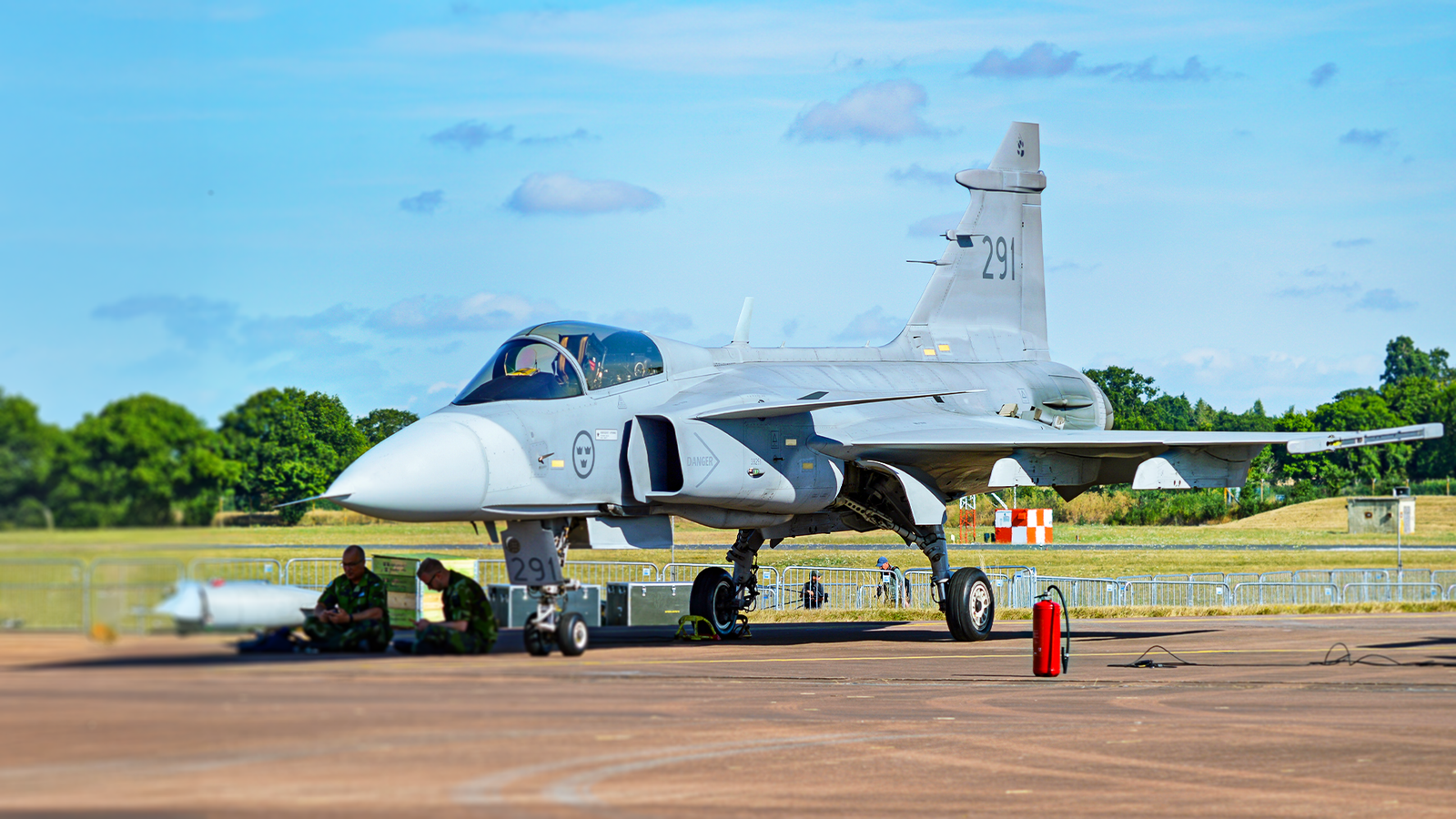
Published Sep 7, 2026, 5:00 PM EDT Luke Diaz is a freelance military writer with experience with active duty experience in the US Navy as well as defense and industrial engineering. He is a former Naval Flight Officer who performed tactical air control on the carrier-based E-2 Hawkeye. On August 21, the Swedish Air Force performed a landmark demonstration flight with the first deep strike, a counter-air munition designed to destroy modern integrated air defense systems. The test was flown by a Saab JAS 39 Gripen C, which released a live TAURUS KEPD 350 cruise missile over the Vidsel Test Range in Norrbotten. The sortie marked the first time the weapon has ever left a Gripen's rail despite decades of development, according to The Aviationist. The missile was developed as a cooperative defense program between Swedish and German manufacturers. Its full name is Target Adaptive Unitary and Dispenser Robotic Ubiquity System, or TAURUS for short. No range data were published following the test flight, but the missile is known to have a range of more than 310 miles (500 km), while flying as low as roughly 98 feet (30 meters) to deliver its 1,050 lb (480 kg) warhead built to punch through hardened structures. The Gripen E is famous for being one of the least expensive, supersonic, ruggedized 4.5-generation fighter jets in production today. Although it is primarily marketed as an interceptor, this test flight shows that its multi-role mission has expanded to make it a serious threat against advanced Air defenses, with the ability to deploy from a forest road before launching a missile that can strike deep behind an adversary's lines. A Missile Sweden Helped Build But Never Bought, Until Now Credit: Saab TAURUS Systems GmbH, the joint venture behind the KEPD 350, has counted Saab as a founding partner alongside Germany's MBDA since the missile's development began in the late 1990s, and Saab's own marketing materials have listed the Gripen as a compatible platform since German production started in 2002. Notably, the August test also landed roughly two years ahead of the program's original 2028 target for initial capability, a compression that raises the obvious question of what point exactly Stockholm is rushing to prove. The most likely answer is that the TAURUS test flight was a two-pronged demonstration meant to be a deterrence against Russian aggression and a marketing statement to prospective buyers within the North Atlantic Treaty Organization. The relevance of the demo comes especially in light of the fact that Sweden never actually procured the weapon for its own air force until this year. More than two decades later, Saab declared that the jet was compatible with the missile. The new standoff munition integration for Sweden's fighter fleet appears to be folded into a wider modernization effort, the MS20 upgrade line, that had already been under way to keep Sweden's older Gripen C/D fleet relevant into the mid-2030s. That raises the next question. What is MS20, and why did a routine avionics upgrade become the vehicle for Sweden's first fighter-based, strategic-strike weapon? A Bunker-Buster Built For GPS-Denied Skies Credit: Department of Defense The MS20 program covers 60 of Sweden's Gripen C/D airframes, upgraded in two phases: MS20 Block 3, with deliveries beginning in 2026, followed by MS20 Block 4 in 2028, alongside a new PS-05/A Mk 4 radar and the AIM-120C-8 air-to-air missile. TAURUS integration was tied to the Block 4 standard, which is also the software baseline that Saab and FMV originally pointed to for weapon clearance. At 3,086 lb (1,400 kg) and 16 feet, 9 inches (5.1 meters) long, the KEPD 350 carries a two-stage tandem MEPHISTO penetrator warhead weighing roughly 1,058 lb (480 kg), engineered with a smart fuse that can count floors or barriers inside a structure before detonating. The cruise missile propulsion comes from a turbofan giving high-subsonic cruise speeds near Mach 1. Its navigation suite combines inertial guidance, terrain-referenced navigation, image-based navigation, and GPS, which lets the missile hold its programmed route even when satellite navigation is jammed or denied. This highly survivable target guidance system is a requirement explicitly built around contested, high-end air defenses that appear to be a direct response to the kind of tactics witnessed since the Russian invasion of Ukraine in 2022. That combination of range, penetrating warhead, and jam-resistant guidance is precisely what separates a stand-off cruise missile from the laser-guided bombs and anti-ship missiles the Gripen has carried for years. Sweden is one of the newest members of NATO, yet it is one of the longest rivals to Russian aggression in the Baltics. Its Gripen E is also a strong contestant to pick up orders left vacant since numerous alliance members have declined the purchase of the advanced Lockheed Martin F-35 Joint Strike Fighter. It's clear that there are many incentives to expand the arsenal of the JAS-39E, but the question it raises is how a jet historically built for close-in territorial defense is evolving into the platform of choice. The Road-Warrior Fighter Finds A Second Mission Credit: Department of Defense The Gripen's entire design lineage answers that question. Sweden's Cold War-era Bas 90 basing doctrine, and its predecessor, Bas 60, assumed that fixed air bases would be destroyed in a first strike, so the air force built a network of roughly 800-meter reinforced road strips, dispersed hides and pre-positioned fuel and munitions across the country, with the Saab 37 Viggen and then the Gripen engineered specifically to operate from them. Saab's own account of the doctrine notes the Gripen E can take off from a strip of road just 52 feet (16 meters) wide and 1,640 feet (500 meters) long. It can also land on a runway of just 1,968 feet (600 meters), and be turned around, refueled, rearmed, and back in the air, in under 10 minutes by a small crew. That survivability, largely dormant after the Cold War, has been receiving renewed focus since Sweden rejoined the front line of Russian threat perception, according to FlightGlobal's reporting on the doctrine's revival. A dispersible, hard-to-target launch platform matters enormously once the payload on its wing can reach 310 miles (500 km). An adversary can no longer neutralize the deep-strike threat by cratering a handful of known runways, because the aircraft delivering it may already be parked on a forest road. That resilience is a genuine differentiator, but it begs a harder question about scale: does one platform's dispersibility actually close NATO's broader deep-strike gap, or does it merely add one more launcher to an alliance that still lacks the capability in depth? NATO's Deep-Strike Deficit And Where Sweden Fits Credit: Department of Defense The wider NATO air warfare picture shows a lag in modernization that has inspired recent surges in defense investment but, even with higher funding, cannot make up for lost time overnight. Among European NATO members, only Turkey currently fields ground-launched missiles with ranges above 186 miles (300 km). Every other European ally depends on air-launched cruise missiles. Another concern is the fact that the Franco-British Storm Shadow/SCALP-EG, the Taurus, and the American JASSM/JASSM-ER stockpiles have been heavily depleted by transfers to Ukraine, according to the Geopolitical Monitor. Against that backdrop, Sweden's Gripen-TAURUS pairing is not a leap to parity with the US or the United Kingdom. Instead, it is an incremental addition to a thin allied inventory, still counting its stand-off missiles in the low hundreds rather than the thousands. That pales in comparison to the massive production of ballistic missiles, drones, standoff air launch munitions, and other advanced ordnance currently being cranked out by assembly lines in Ukraine and Russia. Even the multinational European Long-Range Strike Approach launched by France, Germany, Italy, and Poland in 2024, later joined by Sweden and the UK, remains a patchwork of early-warning and low-cost work rather than a fielded system. Operational Analysis: One Carry Test, Not A Declared Capability Credit: Department of Defense In the context of a high-end, 21st-century conflict, the Gripen's own airframe imposes real limits that the Bas 90 concept tends to obscure. Even the newest Gripen E variant is a compact, single-engine fighter with a maximum take-off weight near 30,864 lb (14,000 kg) and an external payload capacity of around 5.3 tonnes across eight stations. That gap between a proven aircraft-weapon interface and a fielded strike capability is one that can be easily compensated for by 'off-board' systems. Meanwhile, production capacity for the KEPD 350 currently sits at an estimated 40 to 60 missiles per year between MBDA Germany and Saab combined. That rate pales in comparison with the roughly 720 AGM-158 JASSMs the US builds annually, with plans to reach 1,100 as reported by Air & Space Forces magazine. Still, even the US is scrambling to ramp up its production of similar ordnance in order to catch up with the capabilities witnessed during the full-scale invasion of Ukraine. Looking back to Germany's stockpile, the weapon's largest operator and Sweden's partner in TAURUS missile production, it has only an estimated 150 to 250 flight-ready rounds. That figure comes out of an estimated total inventory of 479, which was cited by Rheinmetall's chief executive in 2025 while arguing the missile alone "is not a game changer," as reported by the New Voice of Ukraine. Sweden's own missile quantities have not been publicly disclosed, but given that its procurement has only recently begun, it is likely to be far lower. By The Numbers: The Gripen's Limitations Credit: Department of Defense A Gripen carrying a single 3,086 lb (1,400 kg) TAURUS, a substantial fraction of its total external payload. That also sacrifices most of its remaining hard points to fuel tanks and self-defense missiles, meaning a Gripen strike package trades magazine depth for survivability and dispersibility rather than offering both. So, while the fighter jet is considered a relatively capable 4.5 gen platform even in an air war against stealth fighters and other fifth-generation threats, loading it down with a TAURUS hits it with a huge penalty. Additionally, Sweden's own Gripen C/D fleet is bound up with its support for Ukraine, according to Defense Express. That reduces the resources, staffing, and materials available for modernization of Sweden's own fleet. Stockholm has committed to transferring Gripen C/D fighters, with Army Recognition reporting the first deliveries expected in early 2027. The jets will be part of a broader effort to diversify Kyiv's Western fighter mix alongside F-16s and Mirage 2000-5Fs, all of which combine to delay Sweden's integration program. However, the strain on the Russian military machine means that any extended aggression will likely have limited assets available to it, and thus, the advanced striking power of the TAURUS could be enough for a decisive blow. The August test represents a major step forward in the advancement of homegrown European air defenses at a time when it is sorely needed.
How Sweden's Highway-Operating Gripen C Just Became NATO's Hardest Deep-Strike Problem To Solve
Full Article
Original Source
Read the full article at Simpleflying →KhanList aggregates and links to publicly available news content. We do not host full articles from third-party sources. Always verify important information with original sources.