
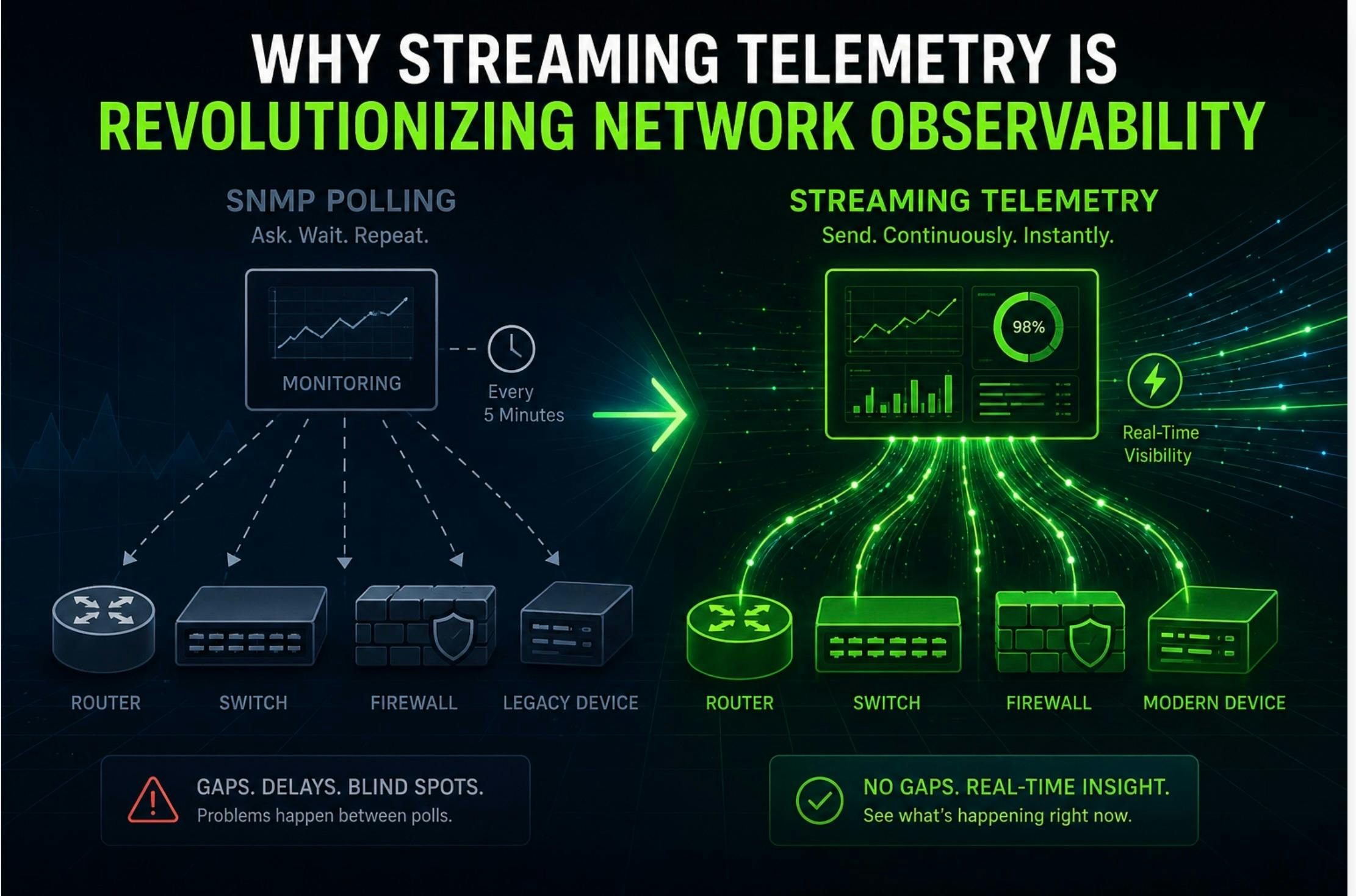
Why Streaming Telemetry Is Revolutionizing Network ObservabilityAlmost forty years ago, SNMP became the backbone of network monitoring. Most routers, switches, and firewalls deployed today still support this protocol. And many engineers think it will remain the optimal technology for monitoring networks in the years to come.I don't think so.SNMP remains a critical tool, but it doesn't fully match the networks of today.Applications generate huge volumes of traffic, cloud infrastructure changes constantly, and engineering teams expect alerts within seconds instead of minutes.That is why streaming telemetry is becoming one of the major changes in network observability. In this article, I'll explain why more engineering teams are starting to use streaming telemetry, in which cases SNMP can still work perfectly, and why the future is likely to be a combination of both.Problems with SNMPSNMP works by polling network devices at regular intervals.Every few minutes, a monitoring platform contacts each router or switch and asks it to send statistics like interface utilization, CPU utilization, memory consumption, and errors.For years, this technique worked well. However, it has a drawback: gaps.Suppose there is an issue that lasts thirty seconds. And suppose a monitoring system polls each device every five minutes. In this case, engineers may not get any alert because they won't see the issue on the dashboard. Users will face slow application performance, but the monitoring tool will say that everything is working just fine.The bigger and more dynamic the network gets, the less acceptable these problems become.The Role of Streaming TelemetryStreaming telemetry reverses the paradigm.Instead of waiting for a monitoring system to contact devices and ask for information, the devices themselves start sending it.It sounds like a small architectural change, but it changes a lot.Engineers receive alerts faster, dashboards show what is happening right now, and devices do not have to process thousands of queries per day. Instead, they continuously send operational data.All this results in a natural scalability of monitoring systems.More Than SpeedSometimes, people discuss the benefits of streaming telemetry only in terms of speed.However, in my opinion, it is the quality of the data that really matters here. Modern streaming telemetry uses structured data models instead of long lists of vendor-specific identifiers. This makes the data more understandable and more automatable.Programmable networks require more structured operational data for automation, analytics, and AI-driven operations. As a result, instead of simply seeing the utilization of an interface, engineering teams receive more context about what is happening in the network.Does This Mean SNMP Is Outdated?No, it doesn't mean that at all.The first mistake people often make is thinking about this change in terms of "either-or." But SNMP still has plenty of advantages.First of all, nearly every network device supports it.Secondly, SNMP is easy to implement.And thirdly, almost all network engineers know how it works.In the case of a small network, the operational overhead of developing a streaming telemetry platform may be too expensive. And in many organizations, SNMP provides enough visibility for their needs. That is why I'm sure streaming telemetry will not replace SNMP overnight. It simply becomes the better solution for the parts of the network where visibility is most important.The Hybrid ModelThe most practical architecture is a hybrid architecture. Modern routers, spine switches, and data center infrastructure are able to continuously send telemetry data. Older equipment will use SNMP until the end of its life cycle. All of them will connect to the same observability platform, so engineers can monitor the whole network without having to migrate to streaming telemetry instantly.This approach minimizes risks and allows receiving the benefits of modern monitoring technologies where they are needed.The Hard Part Is Not About TechnologyOddly enough, I think the most difficult thing here is not device configuration. The hard part is changing the operational paradigm.Network teams have spent decades building workflows based on polling. Dashboards, alert thresholds, troubleshooting processes, and capacity planning all expect to get fresh data every few minutes.But streaming telemetry changes these assumptions. Suddenly, engineering teams start getting much more data, much faster. It means changing the approach to monitoring, alerting, and observability instead of simply replacing the protocol.ConclusionI'm sure SNMP will remain part of enterprise network environments for years to come, because legacy hardware will be present for many years ahead.What I expect is that SNMP will cease to be the main source of truth for the most important infrastructure in an organization.When the network becomes larger, faster, and more automated, continuous telemetry gives a more complete view of what is happening.The question is not whether streaming telemetry will become mainstream. It is... "how fast engineering teams will adopt it while supporting existing infrastructure at the same time?"
How Streaming Telemetry Improves Modern Network Monitoring
Full Article
Original Source
Read the full article at Hackernoon →KhanList aggregates and links to publicly available news content. We do not host full articles from third-party sources. Always verify important information with original sources.