
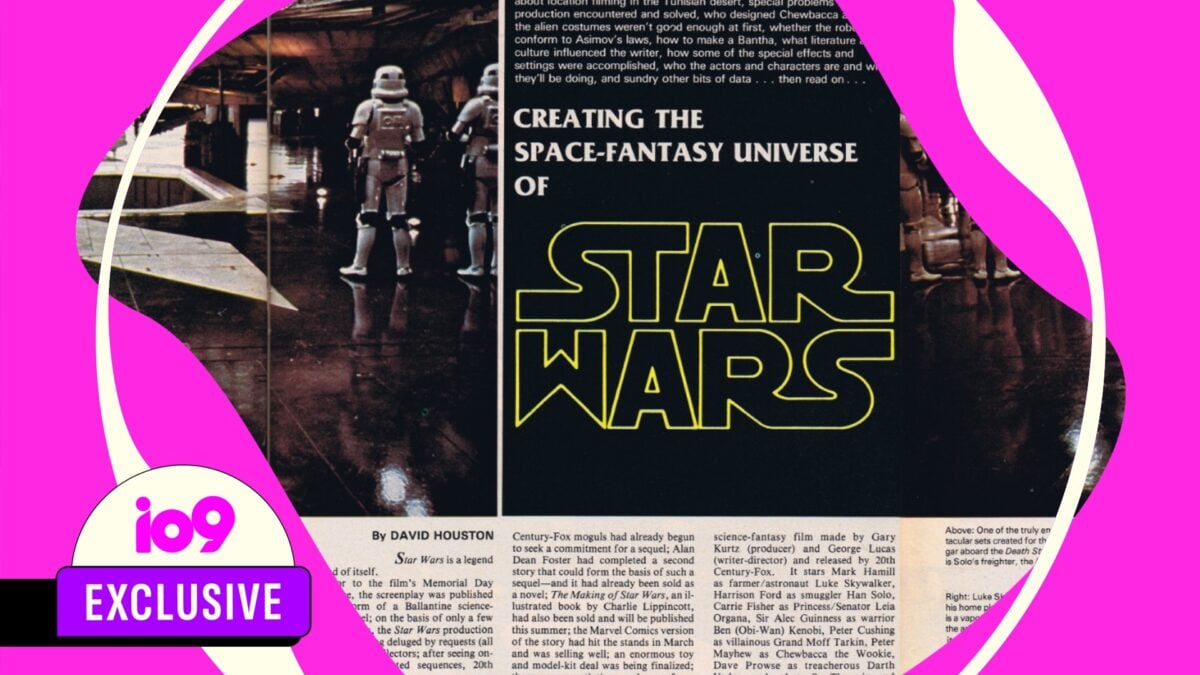
Legendary sci-fi and fantasy magazine Starlog launched in 1976 and ended its original print run in 2009. Five decades after its premiere issue, it’s starting a new era, this time as an annual print release with a readjusted focus on science, technology, and speculative fiction, with none other than io9 co-founder and acclaimed author Annalee Newitz as its editor in chief. To mark this occasion, io9 is taking a look back into the Starlog archives, specifically focusing on how a magazine that started off with an emphasis on Star Trek became one of the very first outlets to champion a new space opera in the works called Star Wars. The new issue features an article exploring Starlog’s past coverage of Star Wars and its sequels; as you might guess, Luke Skywalker and company became an important part of the magazine’s movie beat. To get some insider perspective on Starlog’s intersection with Star Wars history, io9 talked to Starlog senior editor Meredith Borders, who’s also a senior editor at horror-focused sister publication Fangoria, to learn more. © Courtesy of Starlog This interview has been edited and condensed. Cheryl Eddy, io9: Congratulations on the return of Starlog! What was the thinking behind shifting the focus toward science, technology, and speculative fiction? Meredith Borders: That was all Annalee. Starlog was started in 1976 and had this very cool, old-fashioned kind of mid-century way of looking at sci-fi. We wanted to update that and also have a sort of optimistic view towards the future. Incorporating a lot of science and speculative science felt like the best way to do that. io9: But there’s history, too—the new issue has a story on Starlog’s early interest in Star Wars, written by Josie Reisman. Borders: I just love that approach so much of looking back at the very early issues of Starlog and figuring out how they were the first publication or entity to be really vocally excited about Star Wars. It’s a wonderful article in the issue. © Courtesy of Starlog © Courtesy of Starlog © Courtesy of Starlog © Courtesy of Starlog © Courtesy of Starlog © Courtesy of Starlog io9: Rewinding to the beginning. Starlog launched in 1976, and the original focus was Star Trek. When did the people working on Starlog back then start to pick up on Star Wars? Borders: The publishers, Kerry O’Quinn and Norm Jacobs, did envision it as a Star Trek magazine, and then they shifted that almost immediately when they realized they would have to start paying licensing fees to have a magazine about one property versus the sort of fair use of talking about all the different ones. I thought about this a lot—how lucky it is that Star Wars came out when it did. It was actually a huge risk for them to start the magazine in August ‘76. Especially if it was going to be focused on Star Trek; there was no Star Trek happening at the time. It was in between Star Trek movies and shows. I don’t think it would have survived as a publication had that remained its focus or if Star Wars had not come out when it did [in May 1977]. At the beginning of every magazine [there was a section where they] would talk about upcoming titles, and they would have a line or two about something interesting. For issue two, it said, “20th Century Fox is currently completing the filming of their latest science fiction blockbuster, Star Wars.” Their information is a little off base [reading]: “Star Wars is about a galaxy-wide civil war set in the distant future when Earth and its past have been entirely forgotten. Sir Alec Guinness plays an old renegade who was a great general in the first Galactic Wars. Mark Hamill plays the film’s starring role, Luke Starkiller, a young adventurer.” And then it goes on to talk about Stuart Freeman doing the costumes and also doing some of the alien designs, and then it talks about the novelization that was coming out. So it started out with these tiny little pieces of information before anyone else was talking about it. But the energy was immediately very exciting and very enthusiastic and supportive. And I mean, maybe they really were excited, but I also think this could be a function of the fact that this is like something new to talk about in science fiction, which was having a little bit of a lapse in pop culture. © Courtesy of Starlog © Courtesy of Starlog © Courtesy of Starlog © Courtesy of Starlog © Courtesy of Starlog © Courtesy of Starlog So issue seven—by then, this is when other publications and people were getting on board, but certainly not to this level—they’ve got this 11-page spread that’s really interesting. David Houston is the author of this piece, and because the novelization had come out by this point, he uses that as an excuse to wholesale spoil the film before anyone had seen previews or anything. At that time, producers were way less afraid of spoilers. But he went part by part for the novelization and then talked about how the production had problems filming these particular scenes from the novelization and then what the solution was and then talked to different people in production about these solutions. And I think it was a really cool approach. And the way they talked about it, they kept using words like “fun” and “adventure” and “not so serious.” That’s something that obviously appealed to George Lucas and his team and, as it turns out, audiences worldwide. But that was always Starlog’s approach to science fiction. Kerry O’Quinn talks a lot about how what he loves about science fiction is how fun and optimistic it is, like in his letters from the editor throughout multiple publications. That’s really important to him. And so I think that it was just like a perfect marriage of attitude toward science fiction at a time when a lot of it could be very serious. © Courtesy of Starlog © Courtesy of Starlog © Courtesy of Starlog © Courtesy of Starlog io9: What was Starlog’s approach to Star Wars coverage in that era? Borders: I think because Starlog got in on the ground floor and was always so supportive and so enthusiastic that they continued to have a level of access that other publications didn’t necessarily have, even as it got bigger and bigger. I think in issue 48, Terry O’Quinn, the publisher, interviewed George Lucas, and it was a kind of rare magazine interview that George Lucas was doing. I think it’s issue 18, [there’s an] interview with Gary Kurtz when he’s announcing that the title of the sequel is Empire Strikes Back. I think that’s the first time it was announced anywhere, at least as far as I can find, which is kind of a huge scoop to drop in this magazine. And at the time, no one was calling episode four A New Hope. They were just calling it Star Wars. So the idea even of these movies having subtitles was a scoop, because everyone was just like, “Oh it’s Star Wars, so then it’s going to be Star Wars 2.” He also says in that same interview, “It’s not episode two; it’s actually going to be episode five, but it’s going to be so confusing because then we’ll have to go back in time and call the [first movie] episode four, and I don’t know if we can do that,” and of course that’s exactly what they ended up doing. So I do think that the way that Starlog covered it from the very beginning formed this level of access they had towards the very end. And they just continued. I mean, it’s always been a fan magazine. They weren’t afraid to have published dissenting opinions. There would certainly be some criticisms in there, but it was largely a celebration of science fiction properties. And especially as the franchise went on and George Lucas and the team were receiving criticisms from other quarters, they always felt like Starlog was a safe place to have a really positive response to whatever news they wanted to drop. © Courtesy of Starlog © Courtesy of Starlog © Courtesy of Starlog © Courtesy of Starlog © Courtesy of Starlog © Courtesy of Starlog © Courtesy of Starlog io9: When the original Star Wars trilogy wrapped up in 1983 with Return of the Jedi, what was the approach to coverage moving forward? Borders: Sci-fi television started to take off right around that time. And three years after the start of Starlog is when Fangoria started, so [there was] a lot of overlap of sci-fi horror. Then they also started incorporating, like, Superman—they started working into a little bit more fantasy. So they started opening up what their definition of what Starlog covers in part because Star Trek and Star Wars were drying up. And also because they just were realizing that a lot of their audiences were hungry for more. As their definition of what was covered became more fluid, the audience continued to grow with it to a point. Then towards the end, like any publication around that time, the internet started stealing readers. But I do think that the period of time when that bubble got bigger was a really exciting time for Starlog, and those are issues that I truly love to read. The new issue of Starlog is out now; you can order it through the Starlog website or pick it up in a wide array of stores, including Barnes & Noble, Target, Walmart, CVS, Walgreens, and in supermarkets and airports. Want more io9 news? Check out the best movies and TV shows to stream this month and all the upcoming sci-fi, fantasy, and horror books that should be on your radar.
How Starlog Helped Fan the Early Flames of ‘Star Wars’ Fever [Exclusive]
Full Article
Original Source
Read the full article at Gizmodo →KhanList aggregates and links to publicly available news content. We do not host full articles from third-party sources. Always verify important information with original sources.