
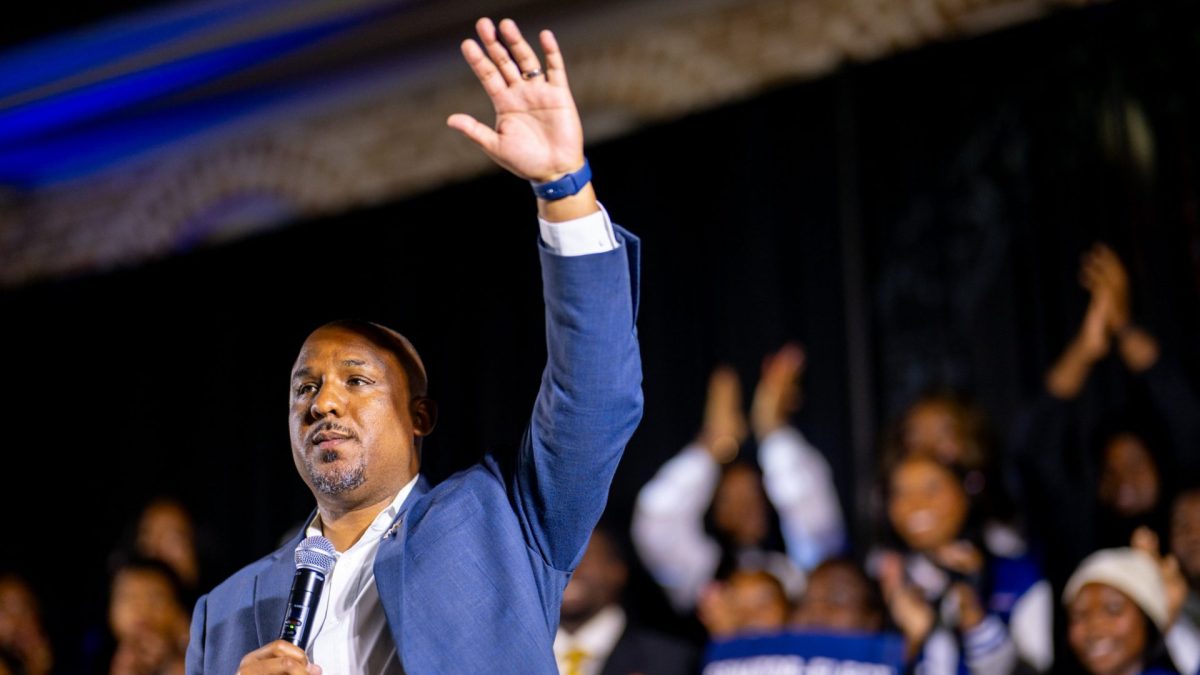
Democrat Scott Colom was humble in claiming victory late Wednesday night, seizing an eighth Senate seat from the Republicans, this one in the heart of the red south. “All I did was have the courage to imagine a night like this,” he said. “In the Mississippi, our prayers have often changed the course of history.” Colom had not just changed history, he had defied it. Mississippi has a 36 per cent Black population, more than any other state. But the last time it had a Democratic senator, he was an ardent segregationist first elected in 1947 who Atlantic magazine once described as “one of twentieth century America’s most admired white supremacists”. The last time Mississippi had a Black senator, he was the son of a slave mother and a white planter, born 20 years before the start of the American Civil War. That man, Republican Blanche Bruce, spoke in the Senate against the “flagrant wrongs” that persisted in Mississippi, where Democrats co-ordinated efforts to suppress the Black vote. More than 150 years later, the names of the parties have changed. But some of the tactics look familiar. Colom’s win represents a spectacular own goal for Republicans, who have long used controversial tactics to keep the state in their – white -hands. This time, they overreached. ‘All I did was have the courage’ Associated Press called the result for Colom, a 43 year-old former prosecutor and judge, on Wednesday night, more than a week after the election. AP put him ahead by 4669 votes, or 0.5 per cent of the 962,237 counted. Jubliant supporters gathered in Jackson, Mississippi, one of the most high-profile battlegrounds of the civil rights movement, where Black activists fought – and some died – for democracy. Supporters gathered on a storied site in Jackson, Mississippi (AP Photo/Ellen Schmidt) The victory rally was held on the lawn outside Woodworth Chapel, a meeting ground for prominent civil rights leaders in the 1960s and 1970s, including Martin Luther King, Jr. “There were many times where I had to have faith,” Colom told supporters. “There were times that I couldn’t get donors to answer the phone. They did not believe a moment like this was possible. But I kept the faith. “There were times when I did my first town hall in Jackson, Mississippi… Less than ten people showed up. But I kept the faith.” All year, Colom has insisted he could win the seat. “But every time I said it, I pointed out that people were going to give me too much credit for it,” he said. “Because it’s not something that I did, y’all. It’s something that we did. “All I did was have the courage to imagine a night like this.” There is no recount law in Mississippi. The defeated Republican, Cindy Hyde-Smith, conceded on social media on Wednesday saying: “While this is not the outcome we worked for or hoped for, I respect the decision of Mississippi voters”. In a twist of fate, the Republican beaten by Colom could have given him a different career. In 2022 Colom was nominated by President Joe Biden to be a district court judge. But Hyde-Smith used her Senate powers to personally prevent the appointment. On election night, when she thought she had won, she even boasted to supporters “I blocked Scott Colom from being a federal judge and you blocked him from being a U.S senator”. Colom defeated Republican senator Cindy Hyde-Smith (Rogelio V. Solis/Mississippi Free Press via AP) Hyde-Smith said her team had worked to ensure every legal vote was counted, and it was a “fair and transparent” election. ‘Barriers for voters of colour’ In the era of overt racial segregation in America’s south, the “colour line” was used to refer to the physical and bureaucratic barriers that stood in the way of Black people. White Democratic Party officials would use tactics like hiding voter registration books from black would-be voters, and hold white-only primaries. Modern tactics are marginally less overt. A Jim Crow era provision still imposes a lifetime voting ban for certain felony convictions, affecting nearly 70,000 people. In August the Campaign Legal Center said a Republican-led mass closure of polling places particularly disadvantaged voters of colour and low-income voters. It followed a 2013 Supreme Court decision gutting protections against discriminatory voting laws. “Many Southern localities have taken full advantage of this freedom from federal oversight to impose hard-to-spot practices that create barriers for voters of color in every election,” the CLC found. Then, in April, the Supreme Court made a decision some dubbed “the worst ruling in a century” and “judicial vandalism“. In Louisiana v Callais, the six Republican-appointed justices removed what was left of federal protections for minroity voters, giving a green light to states to gerrymander districts on racial grounds. Across the country, encouraged by Donald Trump, Republican-majority states started redrawing maps to dilute the Black Democrat vote. Mississippi’s governor declared he would call the state legislature back for a special session to apply a gerrymander further diluting the Black vote. On top of all this, shortly before the election more than 230,000 voters were designated inactive. It was the result of a mishandled attempt to “clean the rolls” the year before, initiated by a Republican official. And it disproportionately affected young voters, more likely to vote Democrat. But the efforts may have backfired. Professor D’Andra Orey of Jackson State University told the Pulitzer Center that the rolls issue, and the redistricting, inspired a surge in Black voter turnout. “Some people actually really literally thought that they were going to lose their right to vote, which then mobilised them to get out the vote,” he said. It was not the only issue, but it was a big one, he said. Derrick Johnson, president of black voting rights organisation NAACP, said: “In a state that has witnessed some of the nation’s most difficult battles for voting rights, Black voters once again demonstrated the power of civic engagement and the strength of our democracy. “The Trump Administration tried every trick in the book to block voters from the polls, but we showed up and showed out, and we voted.” ‘Blue Mississippi’ Hyde-Smith also helped Colom with unforced errors during her campaign – at one point telling consumers worried about the price of beef to “pick another protein”. But campaign insiders put Colom’s victory mainly down to his relentless campaigning, which put him in a position to pick up high-profile Democrat support and fundraising late in the day, once the seat looked winnable. This week Colom complained that, for most of the campaign cycle, analysts had assessed his seat as solid Republican, which “made it much more difficult to fundraise and [is] part of the reason the South has been neglected for so long”. But eventually, support arrived from Kamala Harris, New York Rep. Alexandria Ocasio-Cortez, Pete Buttigieg and Bill Clinton, who chose Mississippi for one of his only two public campaign stops. Barack Obama made an ad for him in the final stretch. After the result was declared, Clinton congratulated Colom on social media, saying “We may have had to count One Mississippi, Two Mississippi, but Blue Mississippi sure has a nice ring to it!” The Democrats have now won 55 Senate seats to the Republicans’ 44, with just one seat – Alaska -yet to be called.
How spectacular Republican own goals helped Mississippi make history
Full Article
Original Source
Read the full article at Inews →KhanList aggregates and links to publicly available news content. We do not host full articles from third-party sources. Always verify important information with original sources.