
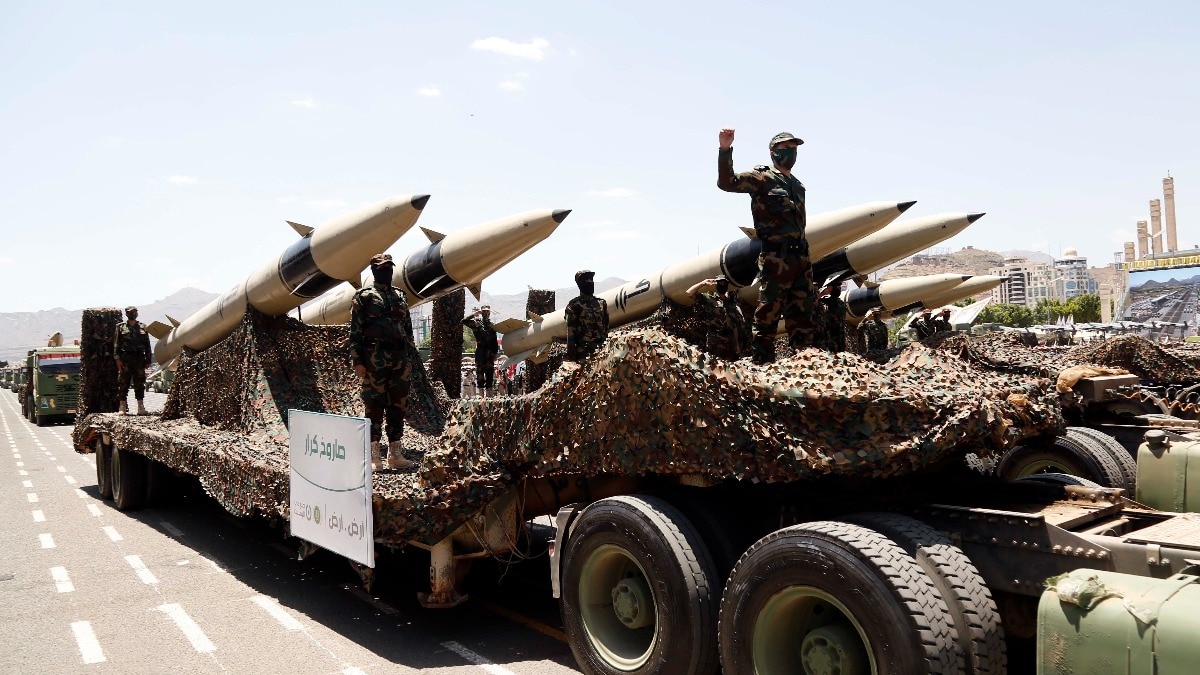
The classic image of Yemen's Houthis is that of slippers wearing Kalashnikov-wielding militants riding their Toyota pickups across vast expanses of desert. They also may or may not be high on the khat leaf. But this image belies the technological capabilities the Zaydi Shia movement has developed, and the military threat it now poses to its biggest regional rival, the oil-rich Gulf Kingdom of Saudi Arabia.Since September, the Iran-backed Houthis have taken over almost all of Yemen's Red Sea coast while shrugging off hundreds of Saudi airstrikes. Although a counteroffensive by forces loyal to the Riyadh-backed Yemeni government has clawed back some ground, including reportedly liberating the vital port city of Mokha, Houthis (who are also known as Ansar Allah) remain a force to be reckoned with.More importantly, the Houthis have also carried out missile and drone strikes targeting Saudi Arabia, hitting, among other things, vital oil extraction and refining infrastructure and King Khalid International Airport in Riyadh.The battlefield gains of Iran's proxy's cannot be explained by surprise alone. How has a movement operating in one of the world's least economically developed countries acquired and sustained a high-tech but at the same time economical arsenal of missiles and drones capable of threatening a regional power equipped with billions of dollars' worth of advanced military hardware? The answer lies in a combination of Iranian assistance, supplies of Chinese-made components, and lately, American Artificial Intelligence (AI) platforms. Smoke rises from the site of the Saudi Aramco refinery after reported Houthi attacks, south of Riyadh on Octiber 3. (Image: Reuters) THE HOUTHI ARSENALBefore we go into how the Houthis were able to build up their high-tech arsenal, let us first have a look at the high-tech weapons that are being used by the Ansar Allah. According to a February 2024 report by the US Defence Intelligence Agency (DIA), the Houthis, alongside their guns and vehicles, also possess a diverse arsenal of ballistic missiles, cruise missiles and unmanned aerial vehicles (UAVs), many of which bear similarities to Iranian designs.The group's drone arsenal includes the Sammad UAV and the Wa'id series, which the DIA linked to Iran's Shahed drones. The report estimated the Sammad's range at 1,800 km, the Wa'id 1's at 900 km and the Wa'id 2's at 2,500 km. These one-way attack drones combine relatively low costs with long ranges and explosive payloads, allowing the Houthis to threaten targets far beyond Yemen, the DIA said.Then there are the missile systems. According to the DIA report, the Houthis possess a diverse arsenal of ballistic and cruise missiles capable of striking targets on both land and sea. These include the Burkan-3, a medium-range ballistic missile with a range of about 1,200 km, and the Quds 4 cruise missile which the Houthis claim can travel up to 2,000 km.The militia also operates the Asif anti-ship ballistic missile, with a claimed range of 400 km, which can threaten naval and commercial vessels, and have displayed other types including the Toofan and Hatem. A Houthi supporter wearing a military uniform holds a mock missile as he joins the militia's supporters in a rally to show support for the movement. (Image: Reuters) IRAN PROVIDED CRITICAL COMPONENTS AND TECHNOLOGYIran's support has helped the Houthis acquire not just weapons but also the know-how to produce some of them locally.According to a 2024 US Defence Intelligence Agency (DIA) report, Tehran has supplied the Houthis with increasingly sophisticated missiles, drones and other weapons. One shipment, intercepted by Yemen's National Resistance Forces, contained 750 tonnes of conventional weapons, including advanced drone components, missile warheads and radar systems, according to a report by the Council on Foreign Relations.One common method used, according to the DIA report, was for Iran to use dhows (small sailing vessels made of wood) to smuggle in components and spares to Yemen. The Houthis would subsequently reassemble them into complete munitions, repaint them to their colours, and assign them new names.But Tehran's assistance extends beyond supplying equipment. An April 2025 analysis by the International Institute for Strategic Studies (IISS) said Iranian technical expertise, machinery and components had helped the Iran-aligned Houthi militia establish local production and assembly capabilities for weapons such as the Sammad-3 attack drone and some short-range ballistic missiles.However, the Houthis remain dependent on external supplies for critical components, including guidance and propulsion systems.The IISS noted that the group uses commercially available foreign-made parts alongside Iranian components, such as gyroscopes, to assemble drones.More advanced ballistic and cruise missiles remain heavily reliant on Iranian technology and supplies, as the Houthis lack the capability to independently manufacture some specialised components, including small turbojet engines and radar seekers. Iran's kamikaze Shahed drones are reportedly being manufactured in house by the Houthis. (Image: File) CHINA'S PARTS HELP HOUTHIS BUILD MISSILESWhile Iran gives the weapons and the know how to make them, Chinese suppliers are providing components and industrial equipment that enable the Houthis to manufacture missiles and drones in Yemen.A Wall Street Journal (WSJ) report published on October 14, citing a report by Conflict Armament Research (CAR), said two shipments intercepted by Yemeni authorities in 2025 contained components from suppliers in China intended to help the group build a version of Iran's Kheibar Shekan ballistic missile.These included custom-machined metal parts for the missile's airframe and rocket motor, stabilising fins, heat-resistant ablative material, tools and testing equipment. The missile could potentially reach targets around 1,200 miles away, the WSJ report said.A Bloomberg investigation published in September, meanwhile, found that a container shipped from China and bound for the Houthi-controlled port of Hodeidah that was intercepted in July, contained industrial machinery, chemicals and components. Among the seized material was a suspected rear missile fin that experts believed could be part of an Iranian Kheibar Shekan missile.Separately, the US Treasury has, since 2024, accused China-based firms Shenzhen Jinghon Electronics and Shenzhen Rion Technology of supplying dual-use and military-grade components for Houthi missile and drone production, stating that the two firms had shipped hundreds of components used in manufacturing missile guidance systems.HOUTHIS USED AI TO DEVELOP WEAPONSIf getting tech transfers from the Iranians and dual-use components from the Chinese were not enough, the Ansar Allah have also turned to using AI to assist them in building their weapons.In its report published in September, the AI major, Anthropic, noted that a "cell of threat actors" based in northern Yemen used Claude Code to support three weapons development programmes.These "threat actors", used the platform to develop guidance, navigation and control software for at least three weapons development programmes. These included a guided rocker, a multistage ballistic missile with a stated range of 2,000 km, and even a hypersonic glide vehicle. They also used the platform to develop simulation models that model flight and tune guidance systems.Anthropic stated that the "actors" attempted to test fire a rocket developed via Claude, but which ended up failing. The company found no evidence that they had successfully fielded an operational weapon, although the group had developed an offline simulation toolkit that could operate without Claude.But while Anthropic beat around the bush by calling the group a "cell of threat actors", reports in the Associated Press and The Washington Post identified them as Houthis. Houthi supporters carry their rifles while attending an armed tribal rally in Sanaa on October 7. (Image: AP) WHAT DOES THIS MEAN FOR SAUDI ARABIA?For decades, Saudi Arabia has spent hundreds of billions of dollars on top-of-the-line military equipment, including fighter jets such as the F-15 and advanced versions of the Patriot air defence missile system.But these weapons are prohibitively expensive, difficult to replace and, according to a New York Times report, were positioned in part to defend against potential threats from Iraq and Iran, which have historically been major security concerns for the kingdom.Take the Patriot system, for instance. Its interceptors can cost around $3 million apiece, and demand for them has increased amid conflicts in Europe and the Middle East, putting pressure on supplies.Facing this force are the Houthis, who can deploy one-way attack drones and cruise missiles, some of which they are increasingly capable of assembling or producing locally with foreign assistance.These weapons might not stand much chance against a Patriot interceptor in a direct engagement, but using a multimillion-dollar interceptor to destroy a drone costing a fraction of that amount presents a difficult economic equation for the defender. It is akin to using chemotherapy to treat a common cold.Ultimately, through Iranian technology transfers, Chinese-made components and, potentially, American AI tools, the Houthis have expanded an arsenal of missiles and drones that combine increasingly sophisticated technology with relatively low production costs. Compared with Saudi Arabia's expensive, complex military equipment, the weapons used by Houthis can be cheaper to manufacture and replace, presenting Riyadh with a persistent challenge.- Ends
How slipper-clad Houthis hit Saudi Arabia with Claude AI and China's missile parts
Full Article
Original Source
Read the full article at Indiatoday →KhanList aggregates and links to publicly available news content. We do not host full articles from third-party sources. Always verify important information with original sources.