
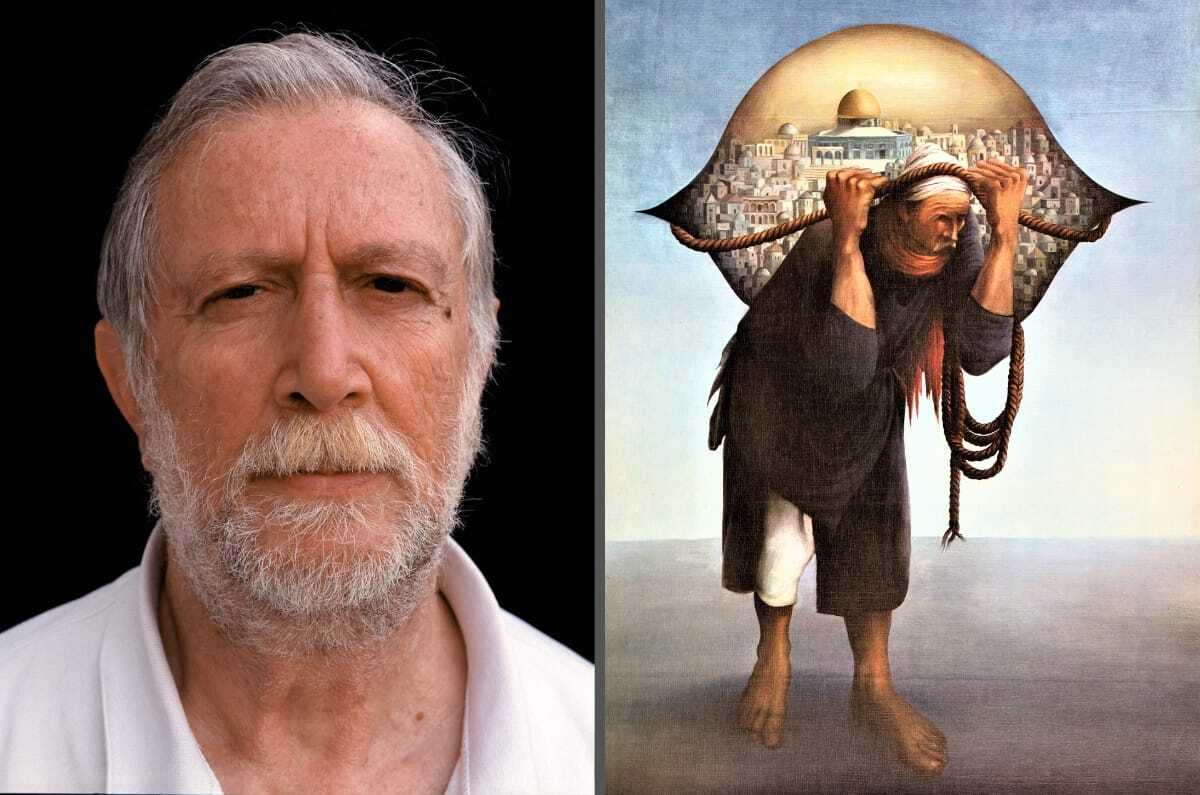
Hardly four years after the 1967 Six-Day War, I was stunned by the sudden appearance of a new group of visually striking and contextually strong paintings. The works were by a young artist from the West Bank town of Birzeit. There he stood on the side of the exhibition hall, a handsome, tall, red-haired man, talking humbly about his work. Perhaps few had heard of Sliman Mansour in those days, when he held his first solo exhibition at the East Jerusalem YMCA. But it was my first encounter with Sliman, with whom I would go on to build a long-standing friendship. We worked together alongside other artists to create a Palestinian art movement. The colorful, large oil canvases in that East Jerusalem exhibition portrayed large, built women in traditional embroidered Palestinian thobes. They stood defiantly in a frontal stance, their heavy feet solidly planted in the earth, their large working hands carrying the crops of the land. The figurative subjects gave Sliman’s works a certain edge, but his sensitive brushwork and vibrant color schemes revealed the high artistry he continued to develop, making him one of the most defining modernist Palestinian artists. Almost half a century since that first exhibition, Sliman Mansour passed away on August 24, 2026, at the age of 79. In those decades, Sliman was at the vanguard of the art movement and one of its central pillars. In the mid-1970s, he and a few other young fellow artists, most of them fresh art graduates, established the League of Palestinian Artists, the first official art body in occupied Palestine. With Sliman at the helm of the artists’ League, serving as its president on several occasions, voluntarily alongside other members, the art movement in Palestine gained unequaled momentum. Being one of a few women members in the League did not deter me from being active and outspoken, although I often felt bypassed when the male members — with Sliman, of course — spent late-night social gatherings together, smoking away and enjoying time of merriment and camaraderie. Palestinian visual artists at an exhibition at the Hakawati Theater in Jerusalem, 1986. (Photo: Palestinian Museum Digital Archive) In the absence of formal art colleges, academies, exhibition halls, and museums, we, as artists, took it upon ourselves to fill the institutional vacuum by organizing exhibitions in any available public space, usually schools or municipal halls. But the drive to use those spaces was also political: we aimed, through our art, to raise awareness of the national struggle for liberation and an end to the occupation. Through our work, we wished to also plant a love for the land, its culture, and identity. The viewers who thronged to see those early exhibitions were thirsty to witness these artistic manifestations of the national struggle. Sliman once described to me how some visitors stood so close to his paintings that they almost rubbed their noses into the varnish, as if to fully absorb the message the works held. “Hope,” by Sliman Mansour. (Photo: Palestinian Museum Digital Archive) The exhibitions themselves became increasingly popular, traveling widely from the North of Palestine to the Gaza Strip in the South. Eventually, they crossed borders and appeared at international exhibitions. Solidarity groups also formed partnerships with the League, fostering alliances to promote Palestinian art. But the art produced by the League wasn’t confined to exhibition halls. Committed to circulating our art as widely as possible, the League printed several artworks as posters for easier dissemination. One of them was Sliman’s iconic Jamal al-Mahamil, or “the Camel of Burdens,” a symbol of endurance and resistance that hangs in countless Palestinian homes to this day — in refugee camps, in villages, in the diaspora. Sliman Mansour in Deir Ghassaneh at an art exhibition organized by Tayseer Barakat, 1984. (Photo: Palestinian Museum Digital Archive) Sliman Mansour was a prolific painter, producing hundreds of artworks throughout his career, all of them dedicated to Palestine. His paintings largely honored the endurance and hard work of Palestinian peasant farmers as they went about their seasonal activities, tilling the land, picking olives, harvesting wheat — the trappings of the “sumud,” or steadfastness, that has become synonymous with the Palestinian experience. “The Harvest,” by Sliman Mansour. (Photo: Palestinian Museum Digital Archive) The landscape also had its own character in Sliman’s paintings, lovingly depicted in the scenes upon scenes of olive groves in the hill country and the orange groves on the coast. In one of his paintings, a woman hugs a tree whose two branches intertwine, one bearing oranges, the other olives, perhaps insinuating the unity of Palestine from the river to the sea. Coinciding with the First Intifada, Sliman, with Nabil Anani, Tayseer Barakat, and myself, co-founded the New Visions Collective in 1987. Its primary aim was to find new ways of making art without using Israeli products, in response to the national movement’s call to boycott all products made or purchased in Israel. We started to use new, unconventional materials for our artworks. Sliman chose to work with mud and straw, adding colorants from natural local herbs and spices. He perfected the production of cracked surfaces from this new amalgam, giving the semblance of parched earth and archeological sites, in a powerful reference to memory and history. As artists, the members of New Visions worked closely together, showcasing our new works at the Hakawati Theater in Jerusalem in 1989. The exhibition later traveled to Germany, Italy, and the United States. In 1994, Sliman and the rest of us in the New Visions Collective founded the al-Wasiti Art Center in a renovated old home in Jerusalem. For many years, it served as a hub for showcasing Palestinian art and hosting workshops, lectures, and research. I remember the countless meetings and discussions we held to make al-Wasiti a specialized art and cultural venue for the public in Jerusalem and its environs. Its inaugural exhibition, “From Exile to Jerusalem,” featured the works of many important Palestinian artists living in exile and unable to return to Palestine, including Jabra Ibrahim Jabra, Samia Halaby, Kamal Boullata, Vladimir Tamari, Samir Salameh, Naser Soumi, and countless others. Co-founders of the New Visions Art Collective, from right to left: Sliman Mansour, Taysesr Barakat, Nabil Anani, and Vera Tamari. 1988 (Photo: Palestinian Museum Digital Archive) But al-Wasiti was ultimately forced to scale back its activities when access to Jerusalem became off-limits to Palestinians living in the West Bank and Gaza after the Second Intifada, meaning that three of its founders — Nabil, Tayseer, and myself — were unable to reach it. Sliman was left by himself to try to steer the place. Sliman worked relentlessly, never missing the opportunity to promote Palestinian art. He was also one of the founders of the International Academy of Art-Palestine in Ramallah. He was an inspirational teacher, generously sharing his expertise and artistry with young Palestinians. He traveled widely, becoming an internationally renowned artist and an eloquent ambassador of Palestinian art and culture. He appeared in both the media and local and international arenas, always speaking simply, but with convincing arguments grounded in extensive research. Sliman Mansour at a workshop at the Palestinian Museum. (Photo: Palestinian Museum) With his health failing over the last year, I observed Sliman growing weaker and weaker, but never once did the spark in his expression fade. He tenaciously continued his involvement almost until the last day before his departure, holding fast to his sacred mission and love for Palestine. I’d like to believe that Sliman has now joined other beloved and sorely missed artists and cultural activists who have departed before him: Mahmoud Darwish, Naji al-Ali, Muhammad al-Bakri, Laila Chahid, Hani Joharriyeh, Laila Shawwa, Joumana Huseini, Vladimir Tamari, Samir Salameh, Fathi al-Ghaben, Kamel al-Mughanni, and countless others. They probably will welcome Sliman, cheering him on as he joins them in his eternal abode. Sliman, do I dare ask you to say hello to each of them? Undoubtedly, you will find a way to lead them into forming another Palestinian Artists’ League up in the heavens. Your departure will be sorely missed; it will undoubtedly leave a huge physical vacuum in your family, among your art colleagues, and in the Palestinian cultural scene as a whole. But your brilliant art, your luminous personality, your humility, humanity, and your ever-smiling expression will remain with the thousands of people who knew, loved, and admired you. Ma’ al-Salama, until we meet again. Rest in Peace, dear Sliman. Vera TamariVera Tamari is a Palestinian visual artist, Islamic art historian, art educator, curator, and lecturer of Islamic Art and Architecture. She is the co-founder of the New Visions Collective, alongside Sliman Mansour, Nabil Anani, and Tayseer Barakat. Tamari is actively involved in promoting art and culture in Palestine as a member of the League of Palestinian Artists and the New Visions Collective. She founded and directed the Ethnographic and Art Museum at Birzeit University Museum and the Virtual Gallery at Birzeit between 2005 and 2010. She initiated and curated numerous exhibitions, namely the “Palestinian Cities Exhibitions series”, “Framed Unframed,” and “Unlike other Springs.” As an artist, Tamari specializes in ceramic sculpture and conceptual art, and has participated in scores of personal and collective exhibitions since 1974.
How Sliman Mansour and his fellow artists built a Palestinian art movement
Full Article
Original Source
Read the full article at Mondoweiss →KhanList aggregates and links to publicly available news content. We do not host full articles from third-party sources. Always verify important information with original sources.