
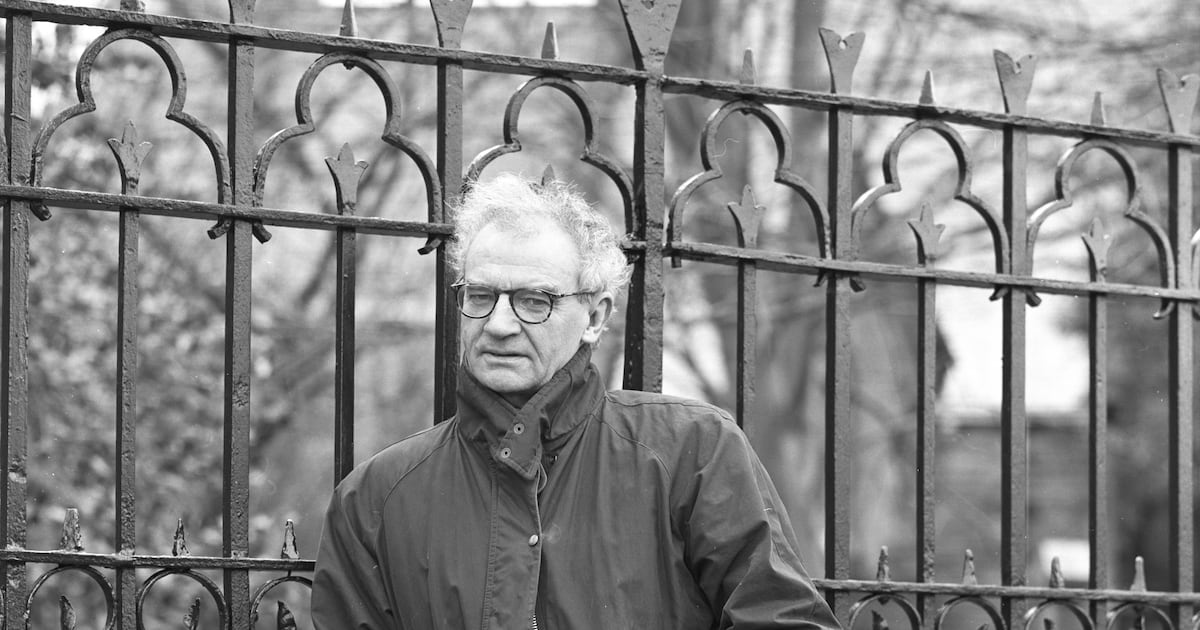
The emergence of Seamus Deane as a writer and critic in the late 1960s coincided with one of the biggest transformations in modern Irish history: the formation of Northern Ireland’s civil rights movement, the violence it faced, and the collapse of inherited political assumptions that followed. Deane was among the first intellectuals to recognise that these developments necessitated a reconsideration of the relationship between literature, history and politics in the North and beyond. The events of 1968 fundamentally altered the conditions under which Irish writers who engaged with the North in their work could interpret their public responsibilities. The language of criticism had to change accordingly.Throughout Deane’s early essays we see how he helped articulate a new role for the Irish intellectual – one rooted in literary criticism, but politically engaged, and active on an all-Ireland stage. His interrogation of the Irish intellectual tradition began by questioning whether there was one worthy of the name, in a provocative essay entitled An Irish Intelligentsia: Reflections on Its Desirability. Deane did not simply comment on Ireland’s transformation; he helped shape the language through which that transformation could be understood.Before 1968, Irish literary intellectuals had often operated primarily within a cultural sphere. This is not to say that writers and critics had been indifferent to public life, or to politics. Ireland had long produced figures who combined literary achievement with political engagement, particularly during the early decades of the 20th century. READ MOREIndeed, the 1960s saw the emergence of fearless writers who defied Ireland’s theocratic culture and the censorship that underpinned it. The decade began with the publication of Edna O’Brien’s The Country Girls (1960), soon followed by John McGahern’s first two novels – works that challenged the culture of fear and repression produced by the power wielded by Church and State. Yet, few Southern literary intellectuals had attempted to integrate the Northern question directly into their interpretation of Irish political and intellectual life. The rupture of 1968-69 had been necessary to awaken many in the South, even including official Ireland and the Irish Department of Foreign Affairs, to the reality of Northern Ireland. Shortly after the future minister for foreign affairs Peter Barry was first elected to Dáil Éireann in June 1969, he visited John Hume in Derry. Barry told Hume “that a lot of people down South who didn’t know anything about the North were making fiery speeches, but I wanted to meet people who were affected by it”. Barry later recalled with anguish what he witnessed there as “the nightmare of the nationalists”. [ Seamus Deane the poet: coming to terms with the pastOpens in new window ]The realities Barry encountered were symptomatic of a crisis that had crystallised by 1969, one that was to alter the position of the writer in all-Ireland terms. In that environment, the distinctions (always facile) between culture and politics, and between literary criticism and historical responsibility, became increasingly difficult to sustain. It was at precisely this moment that Deane’s emergence as a public intellectual began to take shape. Deane’s interrogation of Ireland’s literary and intellectual traditions extended well beyond the Troubles and contemporary debatesDeane’s own position was distinctive. A politically and emotionally committed Northerner, he operated within Southern intellectual life. He possessed an intimate knowledge of the society from which he came while also inhabiting the institutions and debates of the Republic. That dual perspective allowed him to challenge what he regarded as the intellectual distance through which much Southern commentary had approached Northern Ireland. For Deane, the conflict was never a remote political difficulty to be analysed from afar; it was a lived historical disaster, and the violence of the Troubles was the consequence of long-established inequalities.As he wrote about the outbreak of the Troubles: “It was what everyone who knew the place had always expected; yet it was shocking when it came.” The urgency of the crisis in Northern Ireland, for those whose gaze was not averted, demanded a response. Witnessing the collapse of the political order in the North, and accepting the responsibility of envisaging an all-Irish cultural alternative to it, was central to the intellectual role Deane would occupy – a role hardly seen before in Ireland.Deane’s intellectual formation helps explain the force of his early interventions. He arrived in Dublin in the late 1960s having spent formative periods abroad – completing his PhD at Cambridge and later spending periods as a lecturer in Oregon and at the University of California, Berkeley. Yet it was his upbringing in Derry that proved his most abiding influence. He belonged to the first generation in Northern Ireland to benefit from the expansion of educational opportunity after the second World War, an advancement that placed a huge responsibility upon him and his contemporaries. As he put it, “we were rightly (if frighteningly) regarded as the first hope of modifying the brutalities of unionism”.Consequently, Deane was one of a new generation of writers from the North who emerged in the 1960s with a transformed understanding of identity and the role that writing needed to play in articulating it. As he wrote in Irish Poetry and Irish Nationalism (1975), these writers were not simply ”articulating change" but “articulating what it is like to have been changed”. He was not merely describing a society in transition; he was attempting to understand what historical upheaval did to consciousness itself, something fundamental to his intellectual project. His work repeatedly returned to the question of how history is inherited, remembered and contested. Literature, in his understanding, was not an escape from politics, but one of the places where political and historical realities were most deeply examined.Seamus Deane with Seamus Heaney in The Boys of St Columb’s documentary Deane was scathing of the propaganda adopted throughout the Troubles, and the illegal practices that propaganda protected. A writer who placed the North at the centre of his work at the time risked accusations that criticism of British policy or the Northern state’s authority amounted to an endorsement of republican violence. This was particularly significant in the reception of writers such as Brian Friel, whose work confronted questions of identity, language and belonging in Ireland and Northern Ireland. [ Seamus Deane: ‘a passion for thinking’Opens in new window ]As Deane wrote of the reception for Brian Friel’s plays during the early years of the Troubles: “it was still surprising to see the ferocity and the blindness with which critics, especially in London and New York, reacted to them. During those years (1973–76), the IRA campaign against the British presence in the North was at its height and the propaganda war was, as a consequence, intensified to an almost unprecedented degree. Friel was accused by some rather hysterical English and American reviewers of defending the IRA by his attacks upon the British Army and the whole system of authority which that army was there to defend.”Deane recognised that such responses travestied the innovatory role that literature and theatre could play. To examine the conditions that produced conflict was not to justify those who participated in it. It was, rather, to confront the historical realities that made conflict possible. The formative role that literary and critical discussion could play found a powerful vehicle in the Field Day publication and theatre company. As Seamus Heaney remembered, commenting on the expansion of Field Day’s project after Brian Friel and Stephen Rea had produced Translations, “we were lucky to have Seamus [Deane’s] intellectual vigour and articulation of our aims. He in a sense wrote our mission statement.” [ Small World: Ireland, 1798-2018 by Seamus Deane – A magnificent volumeOpens in new window ]Deane’s interrogation of Ireland’s literary and intellectual traditions extended well beyond the Troubles and contemporary debates. Even in his earliest writings, we see the beginnings of his lifelong commitment to radical rereadings of a range of authors such as Edmund Burke, James Joyce, WB Yeats, Maria Edgeworth, and of the traditions they helped to construct. Deane retained an abiding commitment to establishing justice and defending the rights of what was then known as the ‘Catholic minority’This conception of the intellectual’s responsibility also distinguished Deane from one of the most influential representatives of the modern Irish public intellectual tradition, Conor Cruise O’Brien. Christopher Hitchens once wrote about how formative it was for him to discover as a young man O’Brien’s 1965 collection of essays, Writers and Politics. Hitchens argued that “nobody who tries to write about either of those subjects, or about ‘the bloody crossroads’ where they have so often met, can disown a debt to the Cruiser”. Seamus Deane and the poet Theo Dorgan at Brian Friels' funeral in Co Donegal in 2015. Photograph: Dara Mac Dónaill In a turn damaging to the course of Irish intellectual life, it was, ironically, O’Brien himself who disowned the intellectual possibilities that his early explorations had opened up in the 1960s. His tendentious commentary on the North lacked a commitment to justice and undermined his own authority. [ Getting to Good Friday: Literature and the Peace Process in Northern Ireland – an important bookOpens in new window ]Deane retained an abiding commitment to establishing justice and defending the rights of what was then known as the “Catholic minority”. He consequently had an instinctive distrust of the revisionist interpretation O’Brien offered to a receptive Southern elite, which Deane regarded as diverting attention from the ongoing injustice. Deane also rejected the idea that the intellectual could remain entirely outside history, since intellectuals were themselves participants in the societies they interpreted. He meshed scholarship with public engagement, combined an international outlook with local attachment, and literary analysis with historical consciousness. Deane did not invent the Irish public intellectual. He reinvented the relationship between literary criticism, historical consciousness and political responsibility that defined the role. This is why Deane’s legacy extends beyond his achievements as a literary critic. He helped redefine what an Irish public intellectual could be. More than half a century after his early writings first began to appear, the questions that shaped Deane’s career remain unresolved. What responsibilities do writers have during periods of political upheaval? How should literature respond to violence, memory and competing versions of history? They remain important questions for Ireland today.Early Deane: Essays on Irish Literature, Culture and Politics by Seamus Deane, edited by Maurice Fitzpatrick with a foreword by Stephen Rea, is published by Cambridge University Press
How Seamus Deane reinvented the Irish public intellectual
Full Article
Original Source
Read the full article at Irishtimes →KhanList aggregates and links to publicly available news content. We do not host full articles from third-party sources. Always verify important information with original sources.