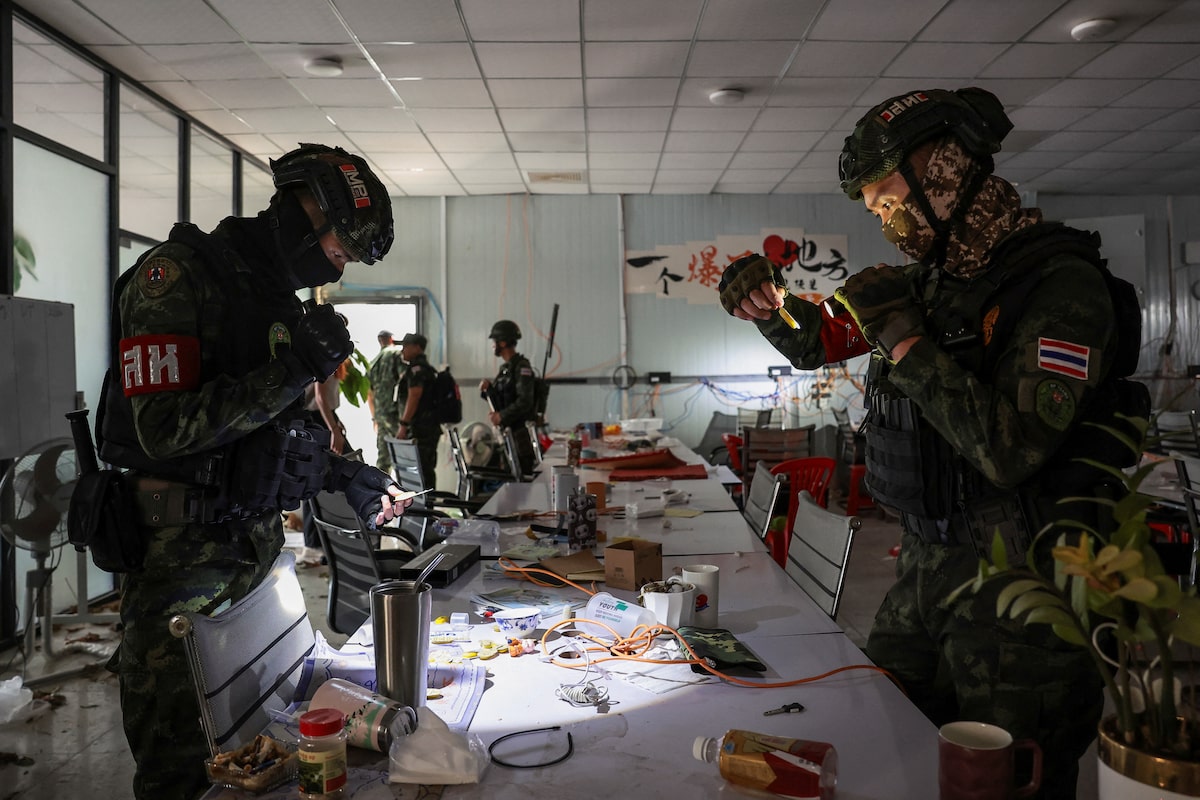
Earlier this year, the United Nations Office on Drugs and Crime warned that “large-scale scam centres” are “increasingly detected in all areas of the world.” “These operations are frequently based in regions or areas affected by armed conflict, rule of law challenges, and illicit economies – conditions that offer greater protection from detection and interdiction,” the UNODC said. This includes war-torn Ukraine, Mexican states dominated by drug cartels and corruption-riven African economies. Kristina Amerhauser, head of the Mekong Observatory at the Global Initiative Against Transnational Organized Crime, said, “We’ve seen not only an expansion of the operations of these Southeast Asian criminal groups to more places and beyond the region, but also scam centres that are being operated across the world by a wide range of criminal groups.” “Many of these scam centres look very similar, use similar tactics, rely on the same technology and seem to be very networked,” she added. Thai soldiers inspect a compound last March in O’Smach that they allege was once a scam call operation, Royal Hill. The Thais occupied the site after last year's clashes with Cambodia on the nearby border. Chalinee Thirasupa/Reuters Royal Hill may be out of commission, but there are allegedly more large-scale facilities like it across Southeast Asia, and a burgeoning global business of scammers from Latin America to Russia. Chalinee Thirasupa/Reuters As governments try to sound the warning about online scams, they also inadvertently advertise how lucrative a business it is − and criminal groups around the world are cottoning on. Canadians lost $704-million to fraudsters last year, mostly to investment, romance and job scams. The impact in other countries is even higher: In 2024, the U.S. government estimates, Americans lost US$10-billion to scammers based in Southeast Asia, while victims in Asia may have lost upwards of US$30-billion, according to the UNODC. In October, the U.S. seized approximately US$15-billion in cryptocurrency linked to an alleged scam network run by Chen Zhi, a Chinese-Cambodian billionaire who in January was extradited to China, where he faces potential execution. China was one of the earliest targets for Southeast Asian scam centres, many of which are run by Chinese organized-crime groups, and Beijing has for years been targeting alleged kingpins such as Mr. Chen.This has done little to stem the tide of online scamming, however, which can be pulled off by anyone with patience and the right predatory instinct. Victims are hooked with the promise of romance or investment, then convinced to part with their money, usually in the form of stablecoins − cryptocurrencies pegged to real currencies that are primarily used for scamming or money laundering. For scamming to be a moneymaker on the level of illicit drugs, organized crime groups operate at scale, running call centres and compounds, many of which rely on forced or trafficked labour. The United Nations estimates that more than 300,000 people have been trafficked into Southeast Asian scam compounds. Pornpen Aimhun says she was trafficked to work at Royal Hill in 2022. Many others in Thailand, where she lives, have met a similar fate in scam call centres. Chalinee Thirasupa/Reuters The largest such operations can be found in lawless areas of Myanmar, Cambodia and Laos, where corruption and civil war have often allowed criminal gangs to operate with impunity. But increased international attention and pressure on local governments and armed groups has had an effect, stymying expansion and even seeing some notorious hubs, such as K.K. Park, demolished. Ms. Amerhauser said there has been a shift away from large compounds to teams that might be running at a similar scale but in networks of small cells, rather than a single, centralized location.“They’re easier to hide, and just because one operation might look small compared to what we’re used to, doesn’t mean the criminal network or group behind it isn’t running multiple simultaneously,” she said. “It’s more and more difficult even to estimate the size of the industry.” Open this photo in gallery:Royal Hill was a large complex, including a fake bank and police station. But some criminal networks rely on smaller, more decentralized facilities.Chalinee Thirasupa/ReutersIn 2024, the BBC exposed a scam hub targeting Chinese victims that had raked in millions of dollars. It was operating out of a seaside hotel in Douglas, the capital of the Isle of Man, a British Crown Dependency. “The reach of online scam centres spans the globe and represents a dynamic and persistent global challenge,” said Cyril Gout, the acting executive director of police services at Interpol. While sanctions and arrests disrupt specific operations, the wider scamming ecosystem has proved resilient in the face of concerted international law enforcement efforts. Artificial intelligence tools that allow scammers to create a fake personality or easily spin up legitimate-looking websites and resumés are only compounding the problem. Victims’ advocates have been calling for greater education and for banks to share or accept full liability for monies lost to fraudsters. Fighting fraud: More from The Globe and MailThe Decibel podcastWhen a scammer takes your money, where do they stash it? Alexandra Posadzki, The Globe’s financial and cybercrime reporter, spoke with The Decibel about the black market of verified bank accounts and “money mules.” Subscribe for more episodes.From our personal finance teamFour ways sophisticated swindlers are duping Canadians – and how to protect yourselfSt. John’s-based Nasdaq Verafin launches AI agents to help combat financial crimeSince Swift fans lost $300,000 to a ticket scam, little has changed to fix a broken system
How scam call centres spread from Southeast Asia to become a global crisis
Full Article
Original Source
Read the full article at Theglobeandmail →KhanList aggregates and links to publicly available news content. We do not host full articles from third-party sources. Always verify important information with original sources.