
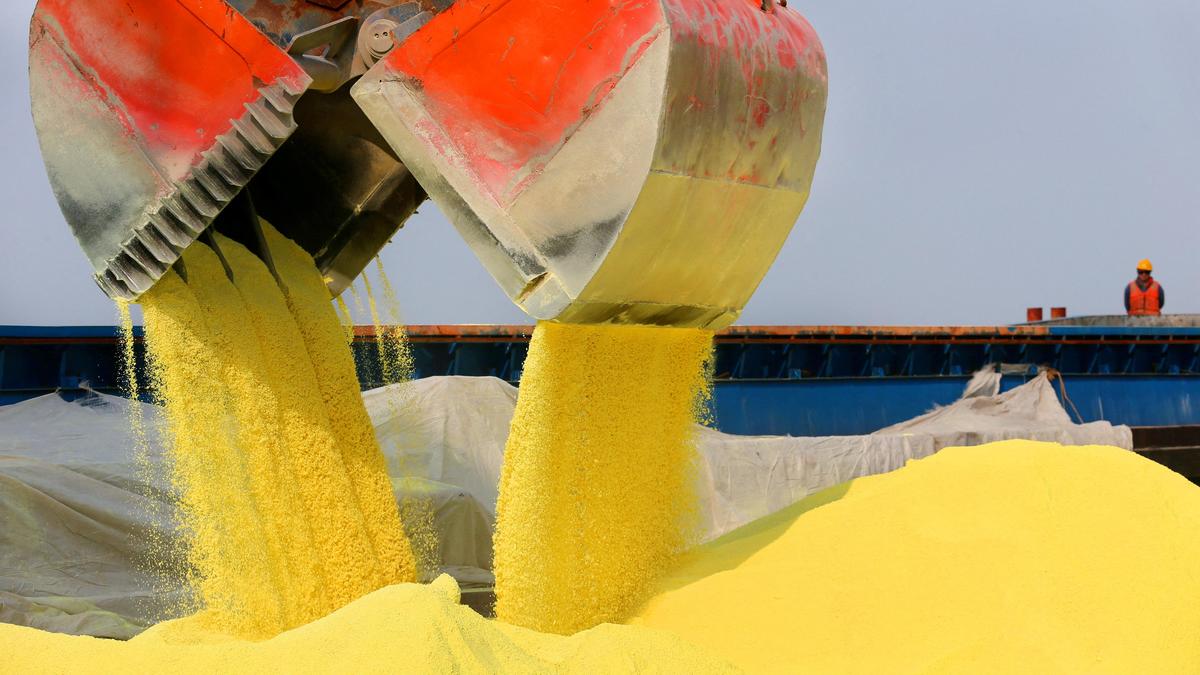
Sulphur squeeze: Imported sulphur is seen at a port in Nantong, Jiangsu province, China, in March 2018. Sulphur is a key raw material in fertiliser production and is increasingly used in nickel processing. | Photo Credit: CHINA STRINGER NETWORK The international price of sulphur, a key raw material for fertiliser production and increasingly for metals processing, has risen nearly four-fold in one year from $280 per tonne in July 2025 to $1,050 in July 2026, adding to India’s import burden.The prices started climbing since late 2025 onwards, driven by rising demand and the Russia-Ukraine war. While the prices climbed steadily, crossing $500 per tonne by December 2025, it has skyrocketed since March 2026 after the U.S. and Israel launched attacks on Iran.To understand why sulphur prices can rise so sharply, it is important to first understand how sulphur is produced. About 92% of global sulphur production comes from non-discretionary sources — mainly recovered as a by-product of petroleum refining and natural-gas processing. Only 8% comes from discretionary sources, where sulphur is extracted directly through mining from natural sulphur deposits or sulphur-rich minerals such as pyrites.China is the largest producer with an estimated production of 19 million tonnes (MT) in 2025, followed by the U.S. (8.1 MT), Russia (7.5 MT), Saudi Arabia (7.2 MT) and the UAE (6.3 MT).Despite being among the top ten producers of sulphur with 3.7 MT, India relies on imports to meet its demand. India’s imports have grown over the years, with West Asian producers contributing to about 90% of its total imports. In 2025, India imported 2.25 MT of sulphur, of which 2.02 MT came from West Asia. Russia accounted for 0.15 MT (6.5%).Majority of India’s demand is from the fertiliser industry with the Fertiliser Association of India estimating that 52% of the sulphur required for the industry came through imports in 2024-25.Conflict tightens supplyThe first major supply shock came from Russia. It is one of the world’s largest sulphur producers, accounting for about 6.5% of its total imports in 2025. Ukrainian drone strikes repeatedly disrupted Russia’s Astrakhan gas-processing plant. A September 2025 attack halted operations at the plant, and a subsequent attack in May 2026 damaged equipment used for hydrogen-sulphide processing and sulphur recovery, according to Reuters. This led to Russia restricting the export of industrial sulphur to maintain domestic supplies. The restriction, initially announced till December 2025, has since been extended till December 31, 2026. While this contributed to global escalation of the prices, the bigger disruption came in February 2026 from West Asia when the U.S. and Israel attacked Iran. West Asia not only accounted for roughly 90% of India’s sulphur imports, but also for more than 45% of global seaborne sulphur trade.Meanwhile, China also restricted sulphuric acid exports in 2026 to meet domestic needs, further tightening the global market.The sharp increase in prices has led to India’s import cost of sulphur going up 2.5 times from $ 248 million in 2024 to $638 million in 2025Demand on the riseThe impact of the conflicts and shortened supply has had such a huge impact since the demand for sulphur was already on the rise.As per the CRU Group, the global market had moved into a structural deficit by 2024. It estimated the demand to be 72.8 MT in 2025, against a supply of 70.8 MT — a deficit of about 1.9 MT. Stock releases from Kazakhstan and Saudi Arabia helped bridge the gap, but those inventories were also being drawn down.A major reason for the increasing demand is because of metals processing, linked to production of batteries. Sulphuric acid is used in high-pressure acid leach (HPAL) plants to extract nickel from laterite ores, which is then used in products including electric vehicle batteries.Indonesia has become a key player in this industry with both its nickel-related sulphuric acid demand and imports roughly quintupling between 2021 and 2025. While its demand went from 3.5 MT to 16 MT in this period, its imports increased from 0.23 MT to 1.09 MT. With the global uncertainties showing no signs of abating and with demand continuing to rise, India’s additional burden due to increased import costs may continue for the near future. The data for the Charts were sourced from the Department of Fertilizers, United States Geological Survey, UN Comtrade, and CRU group, which studies global commodity markets, specialising in the mining, metals, and fertiliser industries.devyanshi.b@thehindu.co.in Published - October 01, 2026 07:00 am IST
How Russia-Ukraine war and West Asia conflict sent sulphur prices soaring
Full Article
Original Source
Read the full article at Thehindu →KhanList aggregates and links to publicly available news content. We do not host full articles from third-party sources. Always verify important information with original sources.