
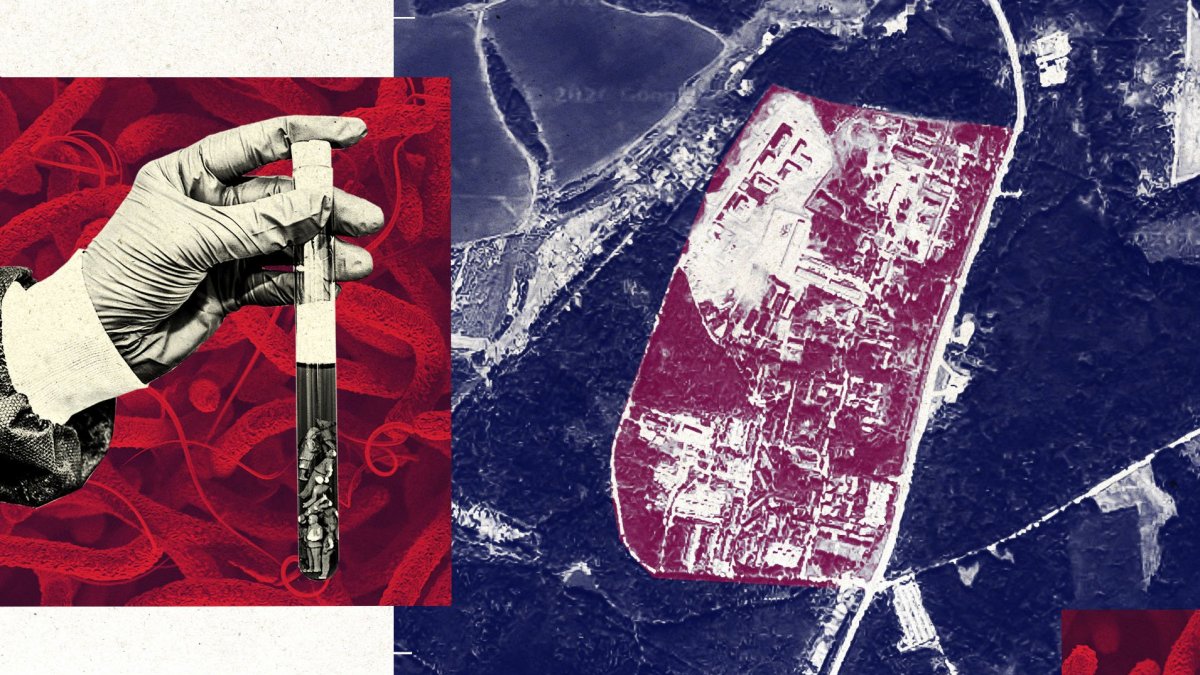
The exact nature of the work undertaken at Sergiev Posad-6 is not something the Kremlin likes to discuss. Nestled in a forest outside Moscow, the military bioresearch laboratory is one of three such sites in Russia to which international monitors have never been granted access. During the Cold War, the complex enjoyed a chilling reputation as a major centre for the Soviet Union’s development of biological weapons, working with the viruses that cause smallpox and Ebola. After the fall of the Berlin Wall, Sergiev Posad-6 went quiet – but, it seems, never entirely silent. Moscow insists any research it conducts into biological agents is for defence purposes, and there is no evidence that Russia has deployed such a weapon. But Western intelligence agencies don’t pull punches when it comes to what they think is going on there. Russia recently spent millions on constructing additional buildings at Sergiev Posad-6: a move that bears all the hallmarks of advanced labs designed to handle killer pathogens. But as Russia wages a “grey-zone” war against Britain and its allies, one leading expert has told The i Paper that Moscow could one day turn to bioweapons to devastate food chains or cause debilitating illness in armed forces as a way to weaken its opponents’ defences. ‘Aggressor number one’ Biological warfare is the deliberate use of disease-causing agents – such as bacteria and viruses – to harm or kill people, animals or crops. Unlike chemical weapons, bioweapons are live organisms that can multiply and spread. Concerns of the threat posed by bioagents are growing rapidly, with Sir Ken McCallum, MI5’s director general, warning this week about the misuse of AI to develop “existing or even new bioweapons”. He also described Russia as “aggressor number one” in terms of hybrid warfare tactics against the UK.The US State Department has long assessed that Russia “maintains an offensive biological warfare programme”. A source told The i Paper that Sergiev Posad-6 is one site associated with this. American intelligence services warned this year that Russia, China and North Korea were likely to maintain the capability to “produce and employ” biological pathogens and toxins, and that unnamed states were pursuing “advanced technologies” that could create new “anti-material and anti-personnel” agents. Christopher East, former chief of staff for biological security at the Cabinet Office, said the UK needs to wake up to the risk that Russia and other hostile states are evolving hybrid warfare tactics to potentially unleash “unattributable” bioweapons. The long-standing belief that no government would unleash a lethal virus or bacteria that could ultimately harm their own population has given way to concern about these more targeted and destabilising attacks. Among the scenarios concerning intelligence agencies is the possibility of a hostile state seeking further layers of deniability by providing a proxy with a bioweapon. ‘Potentially a lot easier than we think’ Options open to Britain’s adversaries include the use of AI to help increase the impact of existing pathogens – from an animal virus like swine flu or foot and mouth disease, to a human disease such as cholera – doing so in a manner that makes the strain look like a natural mutation. “What isn’t being recognised is the growing utility of bioweapons in the grey zone,” said East, now a biosecurity expert at the Council for Strategic Risks. “If you wanted to hit the soft underbelly of the UK, such as the food supply chain, with an unattributable weapon designed to sow discontent and inflict economic scarring, it’s potentially a lot easier than we think.” “This is where AI is at its best,” he said. “We could face a ‘naturally occurring’ disease which in reality has been synthetically created by someone in their lab in Siberia and introduced covertly into our supply chains.” MI5 chief Sir Ken McCallum described Russia as ‘aggressor number one’ (Photo: Jonathan Brady/PA via AP) Cholera ‘could be used to disable British troops’ Another hybrid tactic is the possibility of targeting military installations with a virulent bug to take key personnel out of action, potentially as a precursor to an attack by China on Taiwan or by Russia on Nato’s eastern flank. Engineering an outbreak of treatment-resistant cholera in a location such as Okinawa, the Japanese island home to a large US Marines base – or among British and other Nato troops stationed to deter a Russian incursion into the Baltic states, is one such scenario. East said: “If you could mimic something like a naturally-occurring cholera outbreak, you could totally undermine force resilience… Your first echelon forces would all be in the sick bay.” Other doomsday scenarios include terrorists interrogating AI chatbots for instructions on weaponising pathogens, or state-sponsored labs using AI to redesign viruses into completely new, lethal bioagents. But the idea of an entirely computer-generated weapon of mass destruction remains far off – and ultimately may prove beyond the reach of even the most powerful AI model. Professor Tom Ellis, a bioengineering expert at Imperial College London, said: “Using AI and extensive DNA engineering to turn a safe and common organism into something deadly is the possible new threat. But this is a far less efficient, slower, more expensive and much less likely to work way to get to a bioweapon, with much less chance that it will work to cause harm.” Experts say the most pressing concern is AI’s ability to help scientists edit or alter existing pathogens – a technique known as “gain of function” – to enhance their capabilities. While such research can be for legitimate purposes, such as developing vaccines, it can also be used to create superbugs resistant to existing treatments. AI chatbots for potential bioweapon plotting Anthropic revealed last month that its Claude AI model was used on at least five occasions this year in potential plots to develop biological weapons. In one case, the company said, a researcher at an unnamed military research facility sought help in writing a funding application for gain-of-function research into chikungunya virus, a mosquito-borne illness that can lead to long-term severe pain. Anthropic said the scientist wanted to engineer mutations to make the virus more harmful. Google revealed that its AI, Gemini, had been asked to provide a “step-by-step technical guide for synthesizing weaponized biological agents suitable for aerosol dispersal in a densely populated urban area”, including lists of precursor chemicals and laboratory equipment. John Galatas, a doctor and specialist in chemical, biological and nuclear warfare medicine, told The i Paper: “The organisms of greatest concern are not necessarily entirely new pathogens, but existing biological agents whose harmful properties could potentially be enhanced or whose use could be facilitated by AI-assisted research.” Several experts noted that even where AI could help identify potential pathogens, considerable technical expertise and resources would be required to test and ultimately manufacture a bioagent. “AI could assist research into biological properties, but it cannot reliably predict or guarantee a pathogen’s behavior in humans or in the environment,” Galatas, a former senior intelligence officer in the Greek military, said. Russia capitalises on Cold War legacy Calls are growing to formalise controls on the supply of precursor materials to ensure they only reaches authorised laboratories. Such materials include DNA or RNA strands that could be used to manufacture viruses or bacteria. However, restrictions would be difficult to apply to states known or suspected to be running their own bioweapons programmes. East, who oversaw the development of Britain’s national biosecurity strategy in 2023, pointed to the widely-held belief in intelligence circles that Russia never fully abandoned its Cold War efforts – a sprawling programme involving thousands of scientists known as “Biopreparat” – to develop biowarfare techniques, despite being a signatory of the international treaty banning the weapons. “The Soviets built highly sophisticated resources under Biopreparat and they weren’t completely dismantled. Consequently, they’ve been doing this stuff for many years and they’re now incorporating AI. They are pressing ahead,” he said. There are suspicions that alongside enhancing facilities such as Sergiev Posad-6, Russia has built new military research centres. They include a complex on Lisiy, an island north-west of Moscow that was previously open to the public for swimming and fishing but is now a closed site overseen by a previous Sergiev Posad-6 senior officer. In August, Ukrainian intelligence claimed the site was being used for “experimenting with dangerous viruses and other pathogens for the benefit of the [Russian] armed forces”. Lab workers at the Siberian plague research institute where a lab technician died (Photo: Irkutsk Anti-Plague Research Institute of Siberia and Far East via AP) ‘We are not engaged in spreading death’ Russia has long denied that its bioagent research is for offensive purposes. In 2005, Vladimir Maksimov, now in charge of the Lisiy Island facility, said of the work at Sergiev Posad-6: “Contrary to what is sometimes attributed to us, we are not engaged in ‘spreading death’. Our task is exactly the opposite – to be able to combat it.” Russia’s embassy in London did not respond to a request for comment on the status of Russia’s bioweapons research. However, in a statement after McCallum’s speech, it said MI5’s hybrid warfare claims were “baseless”, adding: “Attributing every cyber incident, drone mishap and criminal case in Europe to Moscow is convenient, particularly when no evidence is offered.” There is, however, abundant evidence that exotic poisons remain a weapon of choice for Russia. From the Novichok nerve agent unleashed in Salisbury, to Western intelligence assessments that a frog neurotoxin was used to kill Russian opposition leader Alexei Navalny in 2024, the Kremlin has poured years of effort into isolating novel means of eliminating its perceived enemies. The death this month of a 28-year-old technician at a Siberian anti-plague laboratory raised questions about safety standards at Russian facilities. Initial reports suggested that Darya Shipolova fell ill after the accidental breakage of equipment containing a plague sample. After quarantining dozens of people, officials now insist she died of an “undetermined pneumonia” unconnected with her work. It is clear that – whether as a consequence of deliberate or accidental release, or of the actions of a sophisticated state agency or atavistic terror group – concerns about the development of bioweapons are rapidly increasing. As East put it: “There is a new framing [for bioweapons] and it is far more nefarious, far more obfuscated and far more dark.”
How Russia could unleash a bioweapon on the UK – from cholera to crop pathogens
Full Article
Original Source
Read the full article at Inews →KhanList aggregates and links to publicly available news content. We do not host full articles from third-party sources. Always verify important information with original sources.