
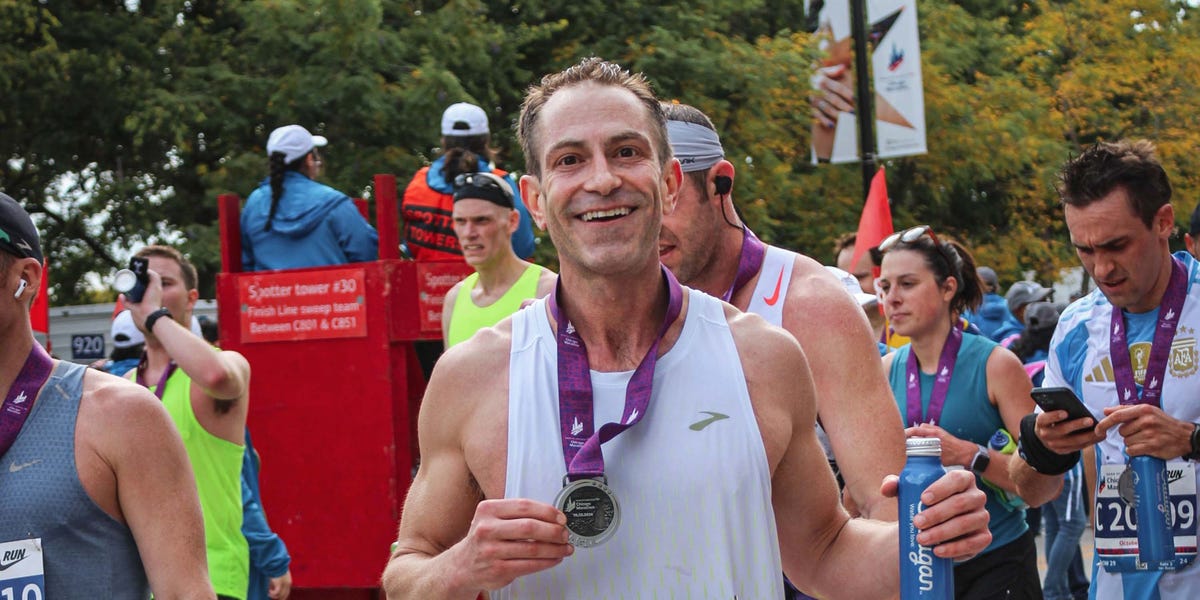
High school cross-country was my backup sport. I’d wanted to play basketball, but I didn’t make the team, so I settled for long-distance running. I ended up falling in love with everything about the sport: being outside, the smell of freshly cut grass, the camaraderie of my team. Focusing on self-improvement and setting new PRs was satisfying.Over those four years of high school, I steadily developed as an athlete. As a freshman, I was the seventh- or eighth-best runner on the team. By sophomore year, I’d worked my way up to being the fourth-best all-time runner in our school. And by senior year, I was captain of the team and one of the better runners in Illinois. (Of course, this was more than 20 years ago; times have gotten crazy fast, and my school, Hinsdale Central High School, won the state championship several years after I left.)Unfortunately, I never made it to the state meet for cross-country. I put a lot of work into training for it, but a few weeks before the event, I got injured and had to withdraw. It was heartbreaking and, honestly, it still kind of haunts me a little today.I then went to college at DePauw University in Greencastle, Indiana. I chose a Division III school so I could get the best of both worlds in terms of academics and athletics. I ran there for two years before getting injured again. What was supposed to be a 15-miler turned into 19 miles, and I took it way too fast. My old IT-band issues and bursitis flared up, and I could barely walk the next day.I don’t think my injuries were technically career-ending, but I decided to quit the team. I was frustrated after putting so much work into my training. Plus, my classes were getting progressively harder, and I wanted to have more time to network and socialize.I was still hitting the gym and running a few miles here and there, but I definitely partied and picked up some bad habits that carried over into my 20s. During that time period, I probably drank alcohol every day. I don’t think I skipped a day unless I was up so late the night before that my drinking bled into the following morning, so I wouldn’t drink again later that day.I probably consumed anywhere between six and 10 beers every weeknight after work. On weekends, I’d go into the city with my friends and have 15 to 20 drinks. But I was functional, so no one, including me, was all that concerned. I was still showing up to work on time. I was operating a successful vending machine business on the side. I was managing to exercise a bit, so I looked relatively healthy from the outside. And most of the people in my social circle were drinking just as much as I was, so it felt normal.Once I hit my 30s, I started to question my relationship with alcohol and how it might be affecting my physical and mental health, my work, and my relationships with friends and family. I tried talking to friends about it, but my concerns were usually brushed under the rug. Like I said, most of my peers were drinking quite a bit too, and it’s not like I’d hit rock bottom. I was always able to recover after a night out and at least give off the appearance of being okay. But I knew I had a problem.I made a few attempts to quit or at least cut back, but I couldn’t find my footing. I read books about alcohol and addiction. I found myself calling helplines, but I always hung up when someone answered. It wasn’t until running became a meaningful part of my life again that I found the desire and determination to make a lasting change.Courtesy John StewartThe Influence Running Had on My DrinkingIt was 2017, when I was 34, and a close friend’s wife was sponsoring a local 5K. My friend said to me, “We need runners, and you used to run. You have to register.” I wanted to be supportive, so I signed up. I figured I’d show up, be with friends, and just take it easy. I even went out drinking the night before the event. Honestly, I think I was nervous. It had been years since I’d run a race.After the gun went off, I hung back with my friends in a sort of jog-walk for a few minutes. But then something overcame me, and I took off in a run. I was running as fast as I could, and it felt amazing.The euphoria I felt wasn’t just about moving my body. I was also taking in the sense of community and the good vibes around me. The early-morning sun was shining. Whole families were there doing this healthy activity together. Guys were passing me, but I watched them with admiration. They were super fit and having fun, which was inspiring.This is what I want my life to be like, I thought to myself. The partying and late nights were getting old. I was tired of drinking too much and feeling like garbage the next day. I wanted to be up and running in the morning sunshine. I wanted to feel that positive energy as much as I could.I immediately entered the lottery for the 2018 Chicago Marathon, despite having never raced that distance before. I needed a big goal to keep me accountable. I knew I could probably get through another 5K or a 10K if I were still drinking, but I couldn’t cheat the marathon distance.When I opened the email notifying me that I’d gotten into the marathon, I teared up a little. It felt like a major turning point in my life.I threw myself into training. I read Advanced Marathoning by Pete Pfitzinger and Scott Douglas and started following elite long-distance runners like Sage Canaday and Ken Rideout on YouTube. (Ken’s content is especially helpful because he’s battled addiction and speaks openly about it.)Running almost every day gave me something to focus on as I reined in my drinking. I was able to take my recovery one day at a time by considering what I needed to make that day’s run happen. I needed to fuel and hydrate, get enough sleep, stretch and mobilize, and still manage all of my work, family, and household responsibilities. There simply wasn’t any room for drinking.I didn’t quit all at once, but I did drastically cut back from 90 to 100 drinks a week to about 10. And then I went from 10 to around five. And then I stopped. During the weaning process, I had really uncomfortable withdrawal symptoms. My night sweats were awful, and I had some mild hallucinations.My fiancé Anne Marie, who’s a nurse, was so supportive and encouraged me to stick it out. She’d leave me little notes like, “Great job!” and make me smoothies. She was the one who bought me my first GPS running watch.Even before my withdrawal symptoms fully subsided, I started noticing positive changes in and outside of my runs. I felt stronger and my paces got faster. My anxiety improved. Eventually the night sweats stopped, and I started sleeping better. I was more productive at work and able to show up more fully for my fiancé and family.My Marathon DebutThe day of the marathon was a little dark and rainy, which is ideal running weather for me. I showed up to the starting line with no expectations. I just wanted to give it my best shot and finish, and I hoped I’d put in enough training to carry me through.There’s really nothing else like race-day energy. Everyone’s nervous and excited and hopeful that all those months of hard work pay off. Plus, the Chicago Marathon is so well run, and they treat the runners like rock stars. I felt great the whole time. At no point did I question my decision to register and train. I was having so much fun—way more fun than I ever had drinking.I finished in 3:15:50, which I was happy with. I saw my parents at the finish line, and my mom was like, “You came in around 3,000th place out of 45,000 runners!” That stat really blew me away. What could I do if I kept going? What if I increased my mileage, fine-tuned my training, and really tried to get faster? I was ready to sign up again right away and get back to work.One of the first big changes I made to my training was incorporating strength training, which I think has helped prevent injuries. Proper fueling was another game changer. I used to think eating the bare minimum would help me feel lighter, so I’d skip breakfast and wash down a few gels with a cup of coffee. Now, I understand that my body needs calories and nutrients to perform at its best and recover from workouts, so I eat a lot more than I ever did.I also became more mindful of my stress levels. I used to watch Rocky clips before my long runs or listen to high-energy playlists to pump me up. Now I find myself putting on meditation music and focusing on keeping my heart rate low.Also, if I don’t sleep well—this happens with some regularity since my son was born six months ago—I don’t force myself to do a hard workout the next day. I’m not that runner who wants to wear fatigue like a badge of honor.I ran the Chicago Marathon again in 2019, finishing more than seven minutes faster in 3:08:10. I DNF’d in 2021 because of severe cramping, but in 2022, I shaved a minute off with a time of 3:07:12. I ran in 2024 hoping to PR and qualify for Boston. My time was 3:07:27, which was not a PR, but I did technically qualify ... then I got bumped by the cutoff. While there’s still plenty of room for improvement, it’s gratifying to see my consistency pay off in steady progress.Right now, I’m training for my sixth Chicago Marathon. I’m running four to six days a week, with a focus on threshold work. I typically cross-train once a week with cycling, Arc training, or light basketball. I think it’s good to give my body a break from all that pounding but still get my heart rate up.I try to get to the gym for strength training—mostly lower body and core—at least three times over the course of 10 days. I’d like to be doing more volume, but with a newborn baby it can be tough to get it all in. Right now I’m clocking about 30 miles a week. If I can eventually double that, I think I’ll see a big shift.Still, I don’t think my goal of breaking three hours is totally off the table for Chicago 2026. Based on my workouts, I’m probably in the 3:04 to 3:09 range, but we’ll see what happens on race day. I’d also love to qualify for Boston again and actually make it in. But I don’t want to put too much pressure on myself. This is supposed to be fun, and really, I just want to keep running as much as I can for as long as possible.Courtesy MarathonFoto3 Tips for Quitting (or Cutting Back on) Drinking and Committing to Running 1. Track Your Drinking Once it occurred to me that my drinking might be an issue, I started tracking my intake. I logged it along with my runs and workouts so I could see my patterns and understand exactly how much I was consuming.I think a lot of people don’t realize how much they’re drinking because they’re not paying attention. It’s easy to say, “I’m going to cut back,” and then days, weeks, and months go by. For me, keeping a record made it easier to change my behavior.Every once in a while, I’ll have a drink. I don’t keep a log anymore, but I’m hyperaware of any intake. I tell myself, “Okay, I’ve really got to watch it.” I don’t know if a problematic relationship with alcohol is something you can ever really overcome. So, if I’m going to have a beer at a special event, I just have to be careful that it doesn’t turn into more than that.2. Think of Yourself as an Athlete Even if it’s been a while since you trained with purpose, don’t be afraid to start thinking of yourself as an athlete again. A casual exerciser works out when they happen to have time, but an athlete sets goals, registers for races, follows a training plan, and makes arrangements in advance so that nothing gets in the way of a workout.Once you make that mental shift, you start prioritizing yourself. You start making choices that benefit your health and support your training. It gets easier to say no to happy hour or a few beers on the couch after a long day, because you’re an athlete who has a workout the next morning.3. Forgive Yourself I’ve made a lot of mistakes. And even when I fully committed to a healthier lifestyle, I still had setbacks. You have to forgive yourself in order to move on. It’s okay if your journey isn’t perfect. Whenever I’d have a bad day, I’d tell myself, “At least you are aware of what’s happening. And you’re way ahead of everyone else who isn’t trying.” So keep trying.I know it’s sometimes hard to ask for help, but having just one person to talk to can make a huge difference. For me, it was my fiancé. Being able to talk to her about everything I was going through made the hard stuff seem possible to handle.
‘How Running Helped Me Cut Back on Drinking—and Then Chase a Sub-3:10 Marathon’
Full Article
Original Source
Read the full article at Runnersworld →KhanList aggregates and links to publicly available news content. We do not host full articles from third-party sources. Always verify important information with original sources.