
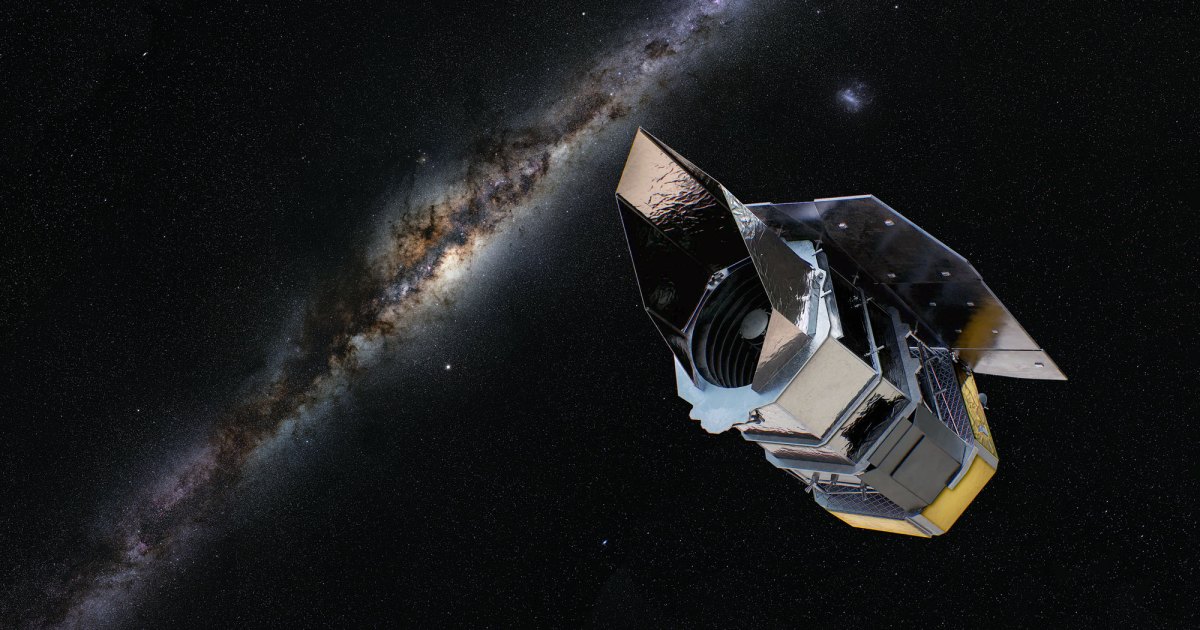
The Nancy Grace Roman Space Telescope is NASA’s newest flagship mission. Designed with an enormous field of view and the ability to quickly move between fields, it is set to revolutionize our understanding of the cosmos, near and far. Credit: Astronomy: Roen Kelly, after NASA. Background image: ESO/S. Brunier The Nancy Grace Roman Space Telescope — the first space observatory named for a woman — is poised to become one of astronomy’s biggest workhorses. With a field of view 100 times that of the Hubble Space Telescope and the ability to map the sky a thousand times faster at the same resolution, Roman will produce the equivalent of a thousand years’ worth of Hubble data every 10 months. Those data will touch nearly every branch of astronomy: dark matter and dark energy, exoplanet demographics, galaxy evolution, transient events, and more. And every observation will be immediately available to the entire scientific community. In the more than two decades since its inception, Roman has undergone changes and weathered threats of cancellation. Yet not only will the telescope be lofted to space this year eight months ahead of schedule, but it will also come in under budget. And the final result will change the way we view our universe. “Hubble and Webb are like looking through a keyhole at an individual object,” says Kristen McQuinn, who heads the Nancy Grace Roman Space Telescope mission office at the Space Telescope Science Institute (STScI) in Baltimore. “With Roman, it’s like opening the door, and now you see everything.” Engineers at NASA’s Kennedy Space Center rotate the completed Roman Space Telescope in preparation for final prelaunch inspection and testing in late June 2026. Credit: NASA/Sydney Rohde (Rocz) From the beginning Roman started life as NASA’s Wide Field Infrared Survey Telescope (WFIRST), a project recommended for funding in the 2010 Astronomy and Astrophysics Decadal Survey, an influential report produced every 10 years by the U.S. National Academy of Sciences. WFIRST prioritized three scientific goals, says B. Scott Gaudi of The Ohio State University, an expert in exoplanet detection who has been working on the mission since its inception. Those goals were to characterize dark matter and dark energy, survey the sky in infrared light, and build a galactic catalog of exoplanets. “All require almost the same hardware,” he says: a 1.5- to 2-meter infrared space telescope capable of seeing a lot of the sky at once. But it was difficult for astronomers from disparate disciplines to agree on how to share the mission, or even whether it should be shared, says Gaudi. Its small size also failed to garner excitement at a time when the 6.5-meter James Webb Space Telescope (JWST) was under development. And with JWST far behind schedule and over budget, NASA was facing political pressure to finish that long-awaited mission before building another flagship. A turning point came in 2012, when the U.S. National Reconnaissance Office, which builds and operates the nation’s intelligence satellites, gifted NASA two space-qualified 2.4-meter telescopes — the same size as Hubble’s primary mirror. “NASA could do whatever they wanted with these telescopes except point them at the ground,” Gaudi says. One went to WFIRST and “gave the mission entirely new life. It gave it more capabilities” — particularly an aperture large enough to directly image exoplanets to test technology for NASA’s next-generation planet hunter, the Habitable Worlds Observatory. The mission received another boost in 2020, when it was renamed the Nancy Grace Roman Space Telescope. Roman was hired by NASA in February 1959 — just six months after the agency’s creation, and at a time when few women were encouraged or allowed to be astronomers. She served as NASA’s first chief of astronomy and is perhaps best remembered for championing the creation of the Hubble Space Telescope. “Nancy Grace Roman was just a hero,” says Gaudi. Her name breathed new and necessary life into the project at a time when many astronomers were concerned about naming a space telescope after James Webb. It also allowed the project to shed the baggage WFIRST had accumulated through years of near-cancellations and disagreement over its goals. Nancy Grace Roman takes notes while working at NASA’s Goddard Space Flight Center, circa 1970. Roman served as the agency’s first chief of astronomy and advocated so strongly for the development of space-based observatories that she is now known as the mother of Hubble. Credit: NASA The Roman Space Telescope is now ready to blaze its own trail. The mission is slated to launch Aug. 30. After lifting off from NASA’s Kennedy Space Center in Florida aboard a SpaceX Falcon Heavy rocket, Roman will be stationed at the L2 Earth-Sun Lagrange point 930,000 miles (1.5 million kilometers) beyond Earth, on the other side of our planet from the Sun. This is where JWST and the European Space Agency’s Euclid mission reside — an ideal place to put an infrared telescope, which must stay cool and thermally stable. Roman will spend its first 90 days in the commissioning phase, including its trip to L2, says McQuinn. Then, provided all is well, “we roll right into science operations.” Roman’s primary science instrument is the Wide Field Instrument (WFI), a 300-megapixel camera that can take images and spectra in visible and near-infrared light, from 0.48 to 2.3 microns. (Visible light runs from about 0.4 to 0.7 microns, after which comes the infrared regime.) Its 18 detectors have a total field of view of 0.281 square degree, larger than the apparent size of the Full Moon. Each image will have the same resolution as Hubble, and Roman can slew to and settle on adjacent fields in about a minute. “We can survey regions of the sky over 1,000 times faster than Hubble with the same performance,” says Julie McEnery, senior project scientist for the Roman Space Telescope at NASA’s Goddard Space Flight Center in Greenbelt, Maryland. Roman will use those impressive specs to reveal more than 10% of the sky in never-before-seen detail. The Nancy Grace Roman Space Telescope is an optical and infrared telescope with a primary mirror 2.4 meters across, the same size as Hubble’s. The telescope is more than 42 feet (12.7 m) long and 14 feet (4.4 m) wide — roughly the size of a semi-truck trailer or, according to NASA, an average Tyrannosaurus rex. Its six solar panels will generate power, while an aperture cover and sunshield will keep the telescope and its infrared instruments shaded and cool. Its two instruments, the Wide Field Instrument and Coronagraph Instrument, are installed on opposite sides of the spacecraft. They sit just forward of the bus, or main body, which contains electronics and other support systems. Credit: Astronomy: Roen Kelly, after NASA’s Goddard Space Flight Center Uncovering exoplanets At the heart of the mission are three Core Community Surveys, developed with input from the astronomical community. They will offer the deepest-ever look into the heart of our Milky Way Galaxy, as well as extend our view outward, mapping hundreds of millions of galaxies and charting the cosmos in real time. One of these is the Galactic Bulge Time-Domain Survey, which will observe six fields in the Milky Way’s center with a total area equivalent to eight and a half Full Moons, or 1.7 square degrees, for a total of 438 days. Roman will take data for 72 days at a time, snapping images every 12 minutes. A primary goal is capturing microlensing events — the temporary brightening of a star as a nearer object passes between it and Earth, acting as a lens that bends and magnifies the light from the distant star. The interloper could be a star, neutron star, black hole, brown dwarf, or even a rogue planet without a sun. If an intervening star has planets, those also have an effect, causing tiny fluctuations in the way the background star brightens and dims. “You would have to look at [one star] for about a hundred thousand years before it happened to be microlensed,” says Gaudi. But in the galactic center, Roman will be looking at hundreds of millions of stars, and at any given time, one to 1,000 of them are being microlensed. These events are random, one-time occurrences, lasting on the order of days to hundreds of days. A perturbation from a planet lasts hours to days. That’s why Roman will spend months at a time snapping huge images of the galactic center so frequently. It is also why the near-infrared is vital, Gaudi adds, to cut through the dense dust in this region of the galaxy, which blocks visible light but allows longer wavelengths through, allowing us to see the stars hidden to visible-light telescopes like Hubble. Roman will produce the equivalent of a thousand years’ worth of Hubble data every 10 months. Roman may find thousands of new planets via microlensing, says Gaudi. And while these won’t be worlds we can go back and study later because the chance alignment of stars that made the detection possible has passed, there will be planets we’ve never seen — those that are “really impossible to detect any other way,” Gaudi says. Other methods have limitations when it comes to finding planets with orbits longer than about a year, as well as difficulties spotting lower-mass worlds. But Roman could find worlds at the same distance from their host star as Jupiter is from our Sun, and with masses much, much smaller — say, that of Jupiter’s moon Ganymede, just twice the mass of Earth’s Moon. “There’s no other way you can do that,” Gaudi says. Microlensing is incredibly powerful for building a fuller catalog of exoplanet demographics. Gaudi says that telescopes like Kepler and TESS have given us a good idea of what planets are like in our local part of the galaxy, the disk. But the bulge is a completely different environment, with “a very different population of stars where we think planet formation could have operated very differently than it does here,” he says. Combining microlensing and other methods, “Roman is expected to find more than 100,000 exoplanets. That’s a game changer right off the bat,” McQuinn says. It will reveal the true breadth of planets that form in the Milky Way — a picture that today remains incomplete. “This is kind of the ultimate dataset with which you can use to try to test your theories for how planets evolve and grow and then move around in their planetary systems to help us really understand how planet formation works … all across the galaxy,” Gaudi says. And from there, astronomers can gain a better foothold on habitability — and where to look for life. Microlensing occurs when a nearer object passes in front of a more distant star, bending and distorting its light. This both magnifies the light and creates multiple, shifting images of the background star in the sky. The way the star’s light changes with time reveals details about the intervening object, such as its mass and physical size. If the nearer object is a star with a planet, the planet will also create a smaller, shorter lensing effect, allowing astronomers to also measure its mass and distance from the parent star. This technique can uncover very different planets than other more widely used methods, including small planets at roughly any separation from their star. Credit: Astronomy: Roen Kelly, after Alice Hopkinson, LCO Understanding the universe Beyond our home is an entire universe of galaxies. But although our current best model — called Lambda-cold dark matter, or ΛCDM — is very successful in describing it, there are places it falls short. Over the past decade, combining measurements of the nearby universe with those from very early epochs has begun to hint that cosmic history is more complex than previously thought. “Our understanding of the expansion of the universe itself is not quite right,” says McEnery. One area where it falls short is related to dark energy, the mysterious force that scientists invoke to explain why the universe’s expansion is not slowing down, but speeding up. “We have emerging evidence that the cosmological constant [which mathematically describes dark energy] is not, in fact, constant,” she says. This is where the High-Latitude Time-Domain Survey steps in. It will address this question by focusing on an 18-square-degree area of sky (equivalent to 90 Full Moons) to collect some 180 days’ worth of data over five years, taken in 30-hour observations every five days. Roman will pick up tens of thousands of type Ia supernovae at distances that correspond to about 8 billion to 11 billion years ago, says Rebekah Hounsell of the University of Maryland, Baltimore County, co-principal investigator for Roman’s Supernova Cosmology Project Infrastructure Team. Type Ia supernovae occur when a white dwarf in a binary system explodes. White dwarfs are the dense remnants of Sun-like stars — so dense that they physically cannot be further compressed. If they steal material from a companion star and exceed a critical mass threshold of around 1.4 times that of the Sun, the white dwarf detonates. Because this always occurs at the same mass, the detonation always has similar brightness. They are an extremely powerful tool for measuring distance — in the 1990s, it was observations of type Ia supernovae in distant galaxies that showed that the expansion of the universe is accelerating. “Hubble and Webb are like looking through a keyhole at an individual object. With Roman, it’s like opening the door, and now you see everything.” — Kristen McQuinn Roman should increase our catalog of these events tenfold. Amassing so many across a broad swath of the cosmos with the same instrument will yield a robust sample that maps the expansion of our universe across time more precisely than ever before, Hounsell says. It will ensure astronomers are comparing apples to apples, rather than reconciling data from telescopes with varying capabilities. In all, the High-Latitude Time-Domain Survey is expected to spot some 100,000 one-off events, what astronomers call transients. These will include not only supernovae, but also events like gamma-ray bursts, kilonovae from merging neutron stars, tidal disruption events as black holes tear apart stars, and more, McEnery says, including surprises astronomers aren’t expecting. Additionally, the High-Latitude Wide-Area Survey will image billions of galaxies over more than 5,000 square degrees (12% of the sky), with a greater focus on an area of some 2,500 square degrees. It will observe a total of 520 days, building a 3D map of the universe to look at structure and its evolution on a cosmological scale. Each cube shown here, which represents a region of space 100 million light-years across, depicts a snapshot from a 3D simulation of the distribution of galaxies over time. Below each cube is the age of the universe at the time the snapshot was taken. As the universe ages, it expands, carrying galaxies farther apart and the density of galaxies in a given volume of space drops. But astronomers aren’t yet sure exactly how this played out, or whether our simulations are correct. Roman will survey galaxies to map structure at times between about 8 billion and 11 billion years ago, or when the universe was nearly 3 billion to 6 billion years old. Credit: NASA’s Goddard Space Flight Center/F. Reddy and Z. Zhai, Y. Wang (IPAC) and A. Benson (Carnegie Observatories) From these maps, astronomers will be able to deduce the distribution of matter — including dark matter — by examining its effects on the apparent shapes of galaxies. Any intervening matter, seen or unseen, will bend the light from more distant galaxies, distorting their images. And because looking at more distant galaxies allows us to look farther back in time, the positions and concentrations of these galaxies trace the evolution of structure in the universe. This includes the cosmic web, the lattice of gas and galaxies strung throughout the universe, which not only outlines where matter resides, but also shows how the space that contains it is expanding. Crucially, the wavelengths Roman will probe pick up galaxies roughly in the middle of the universe’s history — a timeframe when astronomers believe dark energy’s influence transformed into a major driver of expansion. This puts Roman in “a very exciting position,” says McEnery, to potentially show that the venerable ΛCDM model is incorrect. This would reveal something truly fundamental about our universe — and could only deepen our understanding of it. “It’s very hard not to get excited by that,” she says. Roman is not the first or only effort to resolve this tension. But, says McEnery, Roman “can measure dark energy over much larger distances and much larger lookback times than any other facility,” including the Vera C. Rubin Observatory and the Euclid mission, which both focus on the nearby universe. By combining Roman’s data with Rubin and Euclid, “the sum is greater than the parts. … You can characterize and understand galaxy structure and evolution far better than just doing one of [these missions] by themselves. I wouldn’t even say it’s an incremental difference. It’s a huge leap up.” And there are far-reaching benefits beyond even this substantive goal. “If you’re detecting 2 billion galaxies to study the universe,” McEnery says of the High-Latitude Wide-Area Survey, “you also have a fantastic dataset to study galaxies themselves” over time, as well as the supermassive black holes they harbor. Simulated images compare views of the same region of space using the ground-based Vera C. Rubin Observatory’s 8.4-meter telescope (left) and the Nancy Grace Roman Space Telescope (right). While Rubin has a larger field of view and is designed to survey the entire Southern Hemisphere sky in visible light every few days, Roman’s space-based, infrared view will be not just deeper but sharper as well, allowing astronomers to differentiate between multiple objects that may appear as a single source from the ground. Credit: J. Chiang (SLAC), C. Hirata (OSU), and NASA’s Goddard Space Flight Center But wait, there’s more While the three core surveys are Roman’s main focus, about one-quarter of observing time is open to more traditional proposals from individuals or teams of researchers, McQuinn says. Of that, some 700 hours have already been allocated to a survey suggested by the community to map one-third of the Milky Way’s galactic plane, which will create the highest-resolution map of the galaxy yet. It will detect some 20 billion sources — “[more] than the cumulative sum of all cataloged astronomy objects in the history of humanity … from this one survey,” McQuinn says. All Roman data will be available to the public after only a few hours for initial processing by STScI, with no proprietary period. All this work will fall to the WFI. But Roman also carries a coronagraph, which uses masks to block the light from a star, revealing fainter objects — such as disks or planets — around it. Roman’s first-of-its-kind coronagraph adds deformable mirrors, widely used in ground-based telescopes to compensate for atmospheric turbulence, creating sharper images. “We are adapting that technology for space, now not correcting the atmosphere, but correcting the polishing imperfections in the system, the small misalignments that can happen intrinsically or due to thermal variations,” says Vanessa Bailey, instrument scientist for the Roman Coronagraph Instrument at NASA’s Jet Propulsion Laboratory. Roman’s coronagraph contains two hand-sized deformable mirrors, as well as next-generation masks designed to suppress unwanted light better than those in Hubble or Webb. In addition to deformable mirrors, Roman’s next-generation coronagraph will implement custom masks to suppress starlight more effectively than current instruments. Credit: NASA/JPL-Caltech The coronagraph is primarily a technology demonstration for systems that could one day give a mission like the Habitable Worlds Observatory its first look at an Earth-like planet, Bailey says. “First and foremost, our goal is showing that we can suppress the starlight better than any previous generation.” She estimates Roman will outperform Hubble by at least a factor of 100, suppressing starlight by a factor of 100 million. But it is also a highly capable science instrument, she adds. Over three months during Roman’s first 18 months of operation, the coronagraph will look at hot, young super-Jupiters in the infrared, including at shorter wavelengths than JWST. In the best-case scenario, it might even capture reflected visible light from the cloud tops of older, colder Jupiter-sized planets in Jupiter-like orbits, Bailey says. The ability to analyze visible light will be critical when looking at potentially habitable planets down the road. “We think that looking at reflected visible light as opposed to emitted infrared light will give us the best handle on biomarkers with some future observatory,” she says. “We’re testing out those capabilities at visible wavelengths with Roman.” Technician Billy Keim prepares to install the protective cover over the 18 detectors of Roman’s Wide Field Instrument at NASA’s Goddard Space Flight Center in Greenbelt, Maryland. Credit: NASA/Chris Gunn Data for everyone Unlike Hubble and JWST, which grant proposing researchers six months to a year of private access to their observations, all Roman data will be available to the public after only a few hours for initial processing by STScI, with no proprietary period. Roman is also making another shift away from Hubble and JWST, whose data astronomers download to analyze using their own equipment. “That’s not going to work for Roman,” McQuinn says. The volume of data is just too large. Built and operated by STScI, and hosted on Amazon Web Services, the cloud-based Roman Research Nexus will house the mission’s data and tools to analyze it. This democratizes Roman data, removing barriers such as funding or equipment. “Anybody in the world is going to be able to look at this [data],” says Hounsell. “You don’t need a fancy computer.” McEnery hopes this will encourage more researchers to work with Roman data, including those with use cases not explicitly laid out by the mission. Roman’s surveys will capture many different types of events — from microlensing in the bulge to small bodies in our own solar system streaking across the field. “People who have very different scientific interests [should be] able to simultaneously make use of Roman data,” she says. Roman’s Wide Field Instrument comprises 18 detectors that can view a total of 0.4° by 0.8° (0.281 square degree, excluding gaps between the chips) of the sky at once, with a resolution of 0.11″/pixel. This is comparable in resolution to Hubble, but the field of view is 200 times larger than Hubble’s infrared detector and 100 times larger than its visible-light footprint (shown here), as well as 100 times larger than JWST’s infrared view. This composite image of the Andromeda Galaxy (M31), made of hundreds of Hubble pointings, is nearly entirely encompassed within one Roman field of view. Credit: NASA’s Goddard Space Flight Center Undiscovered country Roman arrived in Florida June 21 to undergo final mission preparations. If all goes as planned, its first images could come by the end of the year. It will then join the workforce along with Hubble, JWST, Rubin, and Euclid. And astronomers are ready. “I love the fact that we’re going to have Roman, Hubble, and James Webb all together,” says Hounsell. “Roman is going to be conducting this amazing new infrared survey. And James Webb is kind of like this cosmic scalpel that goes to individual objects and does very, very precise observations. And then you have Hubble, — that’s been our legacy, our archive,” from which so many discoveries arose. Gaudi is eager for Roman to find planets we’ve never seen before — including those we hadn’t even envisioned could exist. “Mother Nature is way more imaginative than we are,” he says. Roman’s success will be a collective achievement — as will its discoveries. “ ‘Telescopes for the people’ is the phrase I like to use,” Gaudi says. “I’m doing [science] because I’m fascinated with what the universe has to tell us, and I think a lot of people in the public are as well. You should see people like me as a conduit for delivering that wonder and those discoveries to them, not as the final end person this is getting delivered to.” “Roman is for everybody,” says Hounsell. “It’s going to find all sorts of weird and wonderful things, things that we didn’t even think about. And it’s going to really open our eyes to what the universe is hiding. … I’m really excited for all these potential unknown unknowns.” Alison Klesman is senior editor of Astronomy.
How Roman will unlock the universe
Full Article
Original Source
Read the full article at Astronomy →KhanList aggregates and links to publicly available news content. We do not host full articles from third-party sources. Always verify important information with original sources.