
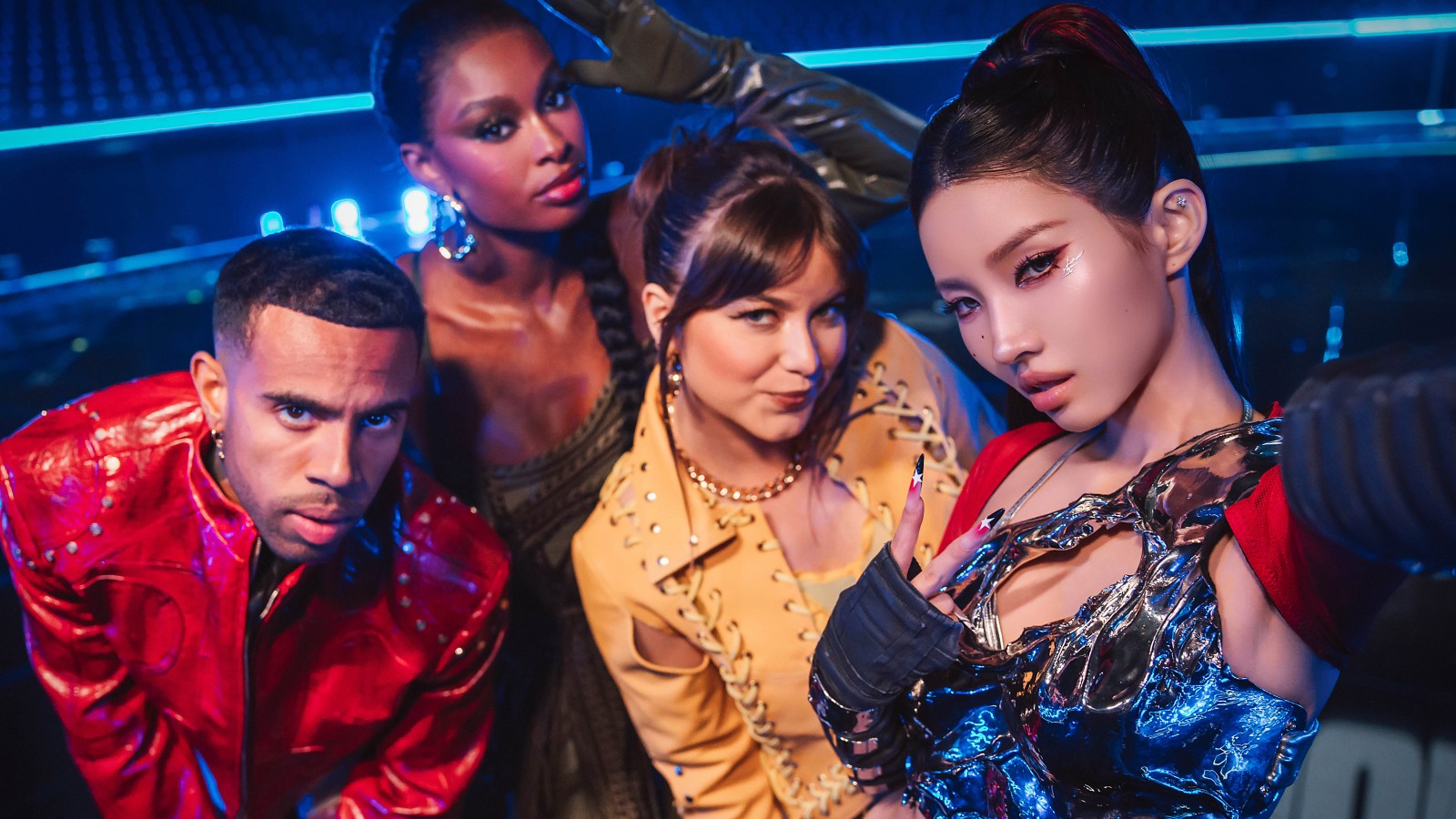
As the lights dim in Downtown Brooklyn’s Barclays Center, more than 14,500 fans raise their hands in the dark. The hue of synchronized wristbands creates a sea of bright pops before the green lasers kick in. As the bass drops, a voice breaks through that stirs an eruption in the crowd: Akali, K/DA’s charismatic rapper, kicks things off with a commanding verse. She’s joined by Kai’Sa, the group’s lead dancer and vocalist, taking the stage for a transition into a power ballad. One-by-one, the members of K/DA — Akali, Kai’Sa, Evelynn, and Ahri — all come together to round out a medley of their greatest hits before launching into the first live performance of their new track, “Firestarter.” With billions of streams globally and a platinum-certified hit to their name, K/DA have long since transcended their video game origins. Now, they’re back to kick off the League of Legends 2026 World Championship. Of course, you might know them all by different names. K/DA, as well as headliner True Damage are made of fictional champions from the game League of Legends, brought to life this year by a roster of international artists whose names now resonate between both the game’s world and our own. Founded in 2018, K/DA is one of League’s legacy acts, consisting of returning original members, i-dle’s Miyeon (Ahri) and Soyeon (Akali), and newcomers Sophie Powers (Evelynn) and Mimi Webb (Kai’Sa). Soyeon is also part of True Damage, who, alongside Coco Jones (Senna), Sofia Reyes (Qiyana), and Vic Mensa (Ekko), closed out the Nov. 14 opening ceremony with this year’s Worlds Finals anthem, “Know My Name.” Know My Name ft. True Damage (Official Music Video) | League of Legends Worlds 2026 Anthem “‘Know My Name’ is very motivating,” R&B singer Coco Jones tells Rolling Stone. “It truly sets the tone. I couldn’t imagine a competition going and just being like, ‘…And start!’ The trumpets, the drums — it brings energy. It reminds you of your intention, of what you’re doing and why, and it motivates you. Music is like fuel.” Editor’s picks That fuel has driven League of Legends studio, Riot Games, as a pioneer in its industry for over a decade, weaving together music, gaming, and cross-media disciplines into a strategy that could reshape what fandom looks like moving forward. Collaborative crossworlds This year’s performances at the Barclays aren’t a one-off spectacle for Riot; showstopping Opening Ceremonies for their annual championship match have been a recurring part of their plan as far back as 2014. It began with Imagine Dragon’s “Warriors,” the first-ever League anthem, and has since included collaborations with artists like Lil Nas X (in 2022), NewJeans (2023), and Linkin Park (2024). The Worlds anthem is now an integral part of the League experience, a moment where the game’s global fandom of over 100million monthly active users collectively celebrate their community. But it’s less of a publicity stunt and more of an essential creative force between Riot’s internal teams. Since 2022, that force has been spearheaded by Maria Egan, Global Head of Music & Events at Riot, who runs the team that provides music services across the company’s multiple games, esports, film, and TV. “ I love the job of marrying storytelling and music, and how to do that within the world of League is so diverse, it allows you to play in so many different spaces,” says Egan. Stefan Wisnoski/Riot Games Egan joined the company just in time to develop one of their biggest musical collaborations ever with Lil Nas X, a campaign that crossed over beyond music into video sketches that blew up on social media. Reflecting on that first year, the executive draws a stark comparison to the culture and framework of Riot and her previous work. “In the traditional business, you’re used to relating to talent and creativity outside the building, and you’re sitting inside the building, trying to get people to do cool things,” she says. “Being able to be a part of a creative studio where all that worldbuilding and music and narrative and art and game design and everything coming together within the studio — I’m super privileged.” Related Content At her side is Alex Shahmiri, Principal Brand Manager for League of Legends and a 12-year veteran at Riot, who’s helped define what the brand’s musical fingerprint has been — and what it’s evolving into. In the early days, bringing in bands to build off the work of composers like Sebastien Najand was a strong starting point, but the idea was never to leave it at that. “When I joined, the team at the time was called Creative Development, and the whole intent of it was to be more of an R&D studio within the company to understand that we take this IP and take it outside the game,” Shahmiri says. “When it came to music, in particular, a lot of it was, ‘How do we make this work, and where are the things that are exciting? ’[We] used music as a storytelling medium, and by doing so, it opened up these doors for us. We saw how players were reacting to [our] songs and music videos, and I was like, ‘Why limit it to Runeterra’ — the in-world universe — ‘What if we bring it into the real world and actually create these virtual artists and start testing it?’” The development led to creating more in-universe music acts, taking playable characters from the League of Legends world and transforming them into full-fledged artists. It began with DJ Sona and the metal band Pentakill, featuring characters Karthus, Kayle, Mordekaiser, Olaf, Yorick (as well as Sona herself). In 2018, K/DA made their debut with K-pop idols Soyeon and Miyeon first playing their roles as Akali and Ahri, respectively, and singers Madison Beer (as Evelynn) and Jaira Burns (Kai’Sa) rounding out the crew. Hip-hop collective, True Damage, first appeared in 2019 featuring a lineup of Soyeon (as Akali), the duo of Duckwrth and Thutmose (both portraying Ekko), Keke Palmer (Senna), and Becky G (Qiyana). Introduced in 2023, Heartsteel is the newest group, a boy band originally consisting of artists Baekhyun (as Ezreal), Tobi Lou (K’Sante), Cal Scruby (Kayn), and ØZI (Sett). This year, returns as vocalist, with newcomers Anderson .Paak as K’Sante, Connor Price as Sett, and Nic D as Kayn. Passing the torch In the years since, the groups have taken hiatuses and undergone redevelopment, leading to a vision where League of Legends’ musical characters serve as mantles that can be passed down between artists. For their dual comeback appearances, both K/DA and True Damage have fresh-faced members stepping in to answer the call. Mexican singer-songwriter, Sofia Reyes, is one such newcomer. For her, portraying the character of Qiyana in True Damage has been an opportunity to reimagine herself and add a new layer to the existing visage of the champion. “This has been so fun, because normally I play me. In this case, when I went to the studio to record the vocals, I felt like performing the song started with a challenge. Qiyana is this strong, powerful woman,” she says. “I feel like I am, too, but I’m a little more shy, more introverted. Qiyana is an extrovert. She’s like, ‘I’m not asking for anybody’s permission.’ Playing with my vocals like that has been really beautiful. I’ve learned so much from this amazing character.” Erid Anamalay/Riot Games Coco Jones, already well known for her R&B music and acting roles, also has big shoes to fill as Senna, a champion previously embodied by Keke Palmer. As seen at the Worlds stage, Jones is more than game, delivering an aggressively powerful performance on “Know My Name,” oozing with confidence. “It’s really cool to be a part of this legacy, and I also love that Keke [Palmer] has played this role as well. That’s my girl,” Jones says. “It’s very rewarding, creatively. I’m feeling very inspired by the show, by the backstory, by the theatrics and performance of it. It’s an actor-artist’s dream.” All of the performers say that they’re honored to be a part of League history, but for Canadian singer Sophie Powers, the opportunity to portray Evelynn feels like a culmination of multiple threads. A League player herself, she’s now embodying a champion she actually mains in-game. “It feels very surreal. I’ve been such a huge fan of Arcane and K/DA for so many years that this coming to fruition feels like all of my years in the fandom actually accumulated into something real and tangible,” she says. “But it also feels unreal.” For Riot staff like Egan and Shahmiri, the evolution of the brand’s musical enterprise is a boon not just for the company, but for the longevity of the in-game world and its community. Creating characters that fans can play as, watch in a television show, or listen to in concert builds a parasocial relationship that transcends any one experience. For the artists and voice actors, they now have an entire universe of characters to portray that can be slipped into and reinterpreted for years, like a Broadway show. “For many of us, music is a memory marker in our lives, so unraveling any part of the nostalgia is very disturbing for people,” Egan says. It speaks to the passion, but I think that the game’s moving forward, there’s always new audiences coming in. There are going to be people here who weren’t here for the first K/DA and have no attachment. This will be their first. It’s not always about trying to recreate a moment in the past.” K/DA – FIRESTARTER ft. MIYEON and SOYEON of i-dle, Sophie Powers, Mimi Webb (Official Music Video) For returning artists like Soyeon and Miyeon, the longevity of League’s music and K/DA have had a profound effect on their own careers. Both began their partnership with Riot back in 2018, just as their pop group i-dle was taking off. Being a part of both groups as they’ve risen in tandem has been its own unique experience. “We were really honored to join this project. League of Legends is not just popular within the Korean community, but also globally,” Soyeon says. “At the same time, back in 2018, the term ‘virtual artist,’ or even metaverse, was not fully defined.” “I was so excited when I heard the news of K/DA’s comeback,” Miyeon adds. “When I first got the demo version of ‘Firestarter,’ I also had an impression that K/DA had grown up as time went on. Working in a group called i-dle in Korea and globally, I somewhat felt that we were also growing up as a group, not just as individuals. Back in 2018, K/DA was a group that highlighted individual characteristics rather than the group itself. As time went on, I felt K/DA’s identity as a group should be highlighted [more]. Now, it feels more like one team.” But beyond making globally popular music, working within the League ecosystem means these artists are a part of a still-new and changing dynamic. Their involvement adds to and accentuates the Runeterra universe, but it also services an existing fanbase of gamers that’s millions strong. After all, once the smoke settles on the opening ceremony performance, there’s still an entire world championship competition left to play. “I think it’s so cool that there’s the music industry and the gaming world mixing; these worlds colliding,” says British singer and songwriter, Mimi Webb. “We’re opening the show and then it’s seeing the actual gamers go up there and compete.” For Webb, the experience brings together the spectacle of a major concert with the excitement of competitive gaming. “We’re doing a music show, we’re playing an arena. Lights, everything’s going off. It’s a real show, but it’s also supporting these competitors for the game.” It’s important to note that Riot isn’t the only gaming studio working to crack the code of cross-media domination. Many other titles, from single-player games and ongoing services like League have made headway with artist collaborations and skins. The difference is in the execution, and how deeply Riot’s creatives insist on making musicality an organic and essential part of their ecosystem. Many pop culture and IP crossovers mostly amount to cosmetics, or limited time rushes to draw attention while capitalizing on FOMO — which can sour feelings for fans longing for a meaningful expansion of their favorite games. Egan is keenly aware of the trepidation, and maintaining authenticity is always top of mind. “The natural instinct with any corporation is to be distrustful of their motives,” she says, “‘[They’re] just doing this to sell skins.’ No, there’s a studio full of really passionate, creative players, community members, and IP fans that want to bring something to life that’s in their fantasy of the IP.” Fans show their support at the League of Legends World Championship 2026 Grand Finals at Barclays Center in Brooklyn, New York, on Saturday, November 14, 2026. Colin Young-Wolff/Riot Games “The thing we do differently is — often, World Cup anthems or Olympic songs, they’re just songs — we never ship just songs. We ship a music video. The video is the experience that we’re trying to deliver to the player, and the music is really a supporting element. The video has a story, there’s a narrative,” Egan adds. The commitment to storytelling through its music videos and songs extends to Riot’s partnership with the artists themselves. As Shahmiri explains, the goal isn’t to simply tag in a famous singer to record for a paycheck. A huge part of that collaboration is allowing each partner to step into their role and interpret the champions — their cadence and voice — their own way. With that leap comes acceptance that not every swing will be a hit with fans. At the end of the day, it’s the community that will drive the next phase of League. “It’s one of the risks you have to take,” Shahmiri says. “Our hope is that we always will pick the right artist to fill those shoes, but you will have players that are so deeply attached to the past one, and our intention is never to mar that experience. We want you to feel like this person is representing the character authentically and bringing them to life. We want you to have your favorites, and it’s not the worst thing when they argue about who’s the best, right? That’s great. That shows that the fandom’s alive.” Chicago-born rapper, Vic Mensa, points to Riot’s community and the symbiotic relationship between the studio and fans as the key to League’s success. “I think [the fandom] shows me that there’s tremendous power in subculture and niche. Something can be the biggest thing in the world, and specifically cater to an audience,” Mensa says. “Riot is just incredibly detailed and incredibly intentional with its creativity. Video games, to begin with, are probably the most expansive worldbuilding space — even beyond film. It continues and grows in ways that other mediums don’t, necessarily. They’re clearly hyper focused, microscopic with the detail, and ultimately, I think that really does serve you, and it enables them to be able to expand into the screen and TV, film, music — to build an empire out of it.” Stefan Wisnoski/Riot Games Shahmiri says that community feedback is essential, and taken very seriously (“We read everything.”), but taking notes doesn’t amount to much unless it results in meaningful action. On one particular controversial issue — generative AI — Riot has held strong in its creative decisions. While it would be easy to make songs for virtual artists without ever bringing on real singers (the characters are completely fictional, after all), there remains an inherently human touch to how the company has pushed to produce music. “It’s working so well because in a day and age where AI is everywhere, Riot is choosing to put real humans behind these characters, not just automating voices and have those live on,” Powers says. “They’re also letting different humans portray the same character, so it’s always something new. They’re always evolving and keeping the fans interested and engaged and locked in.” 17 years in, League of Legends remains a global force in gaming, but its place in the ever-changing media landscape is ultimately the result of its iron clad relationship with the fans. With diversity at its core — from its many characters and games; cross-media and collaborators — the bond forged with the community will always be paramount to success. Trending Stories “It’s inspiring because this was just a game at one point, and it’s branched out into a world, and it really shows what’s possible with an idea — with a dream,” Coco Jones says. “They’re just honing in on what their community wants and making people feel special. Outside of the game is a world where you belong. A sense of belonging is what we all are striving for.” “They’re the lifeblood of our game,” Shahmiri adds on Riot’s players. “At the end of the day, everything that gets made is for them.”
How Riot Games Turned ‘League of Legends’ Into a Music Empire
Full Article
Original Source
Read the full article at Rollingstone →KhanList aggregates and links to publicly available news content. We do not host full articles from third-party sources. Always verify important information with original sources.