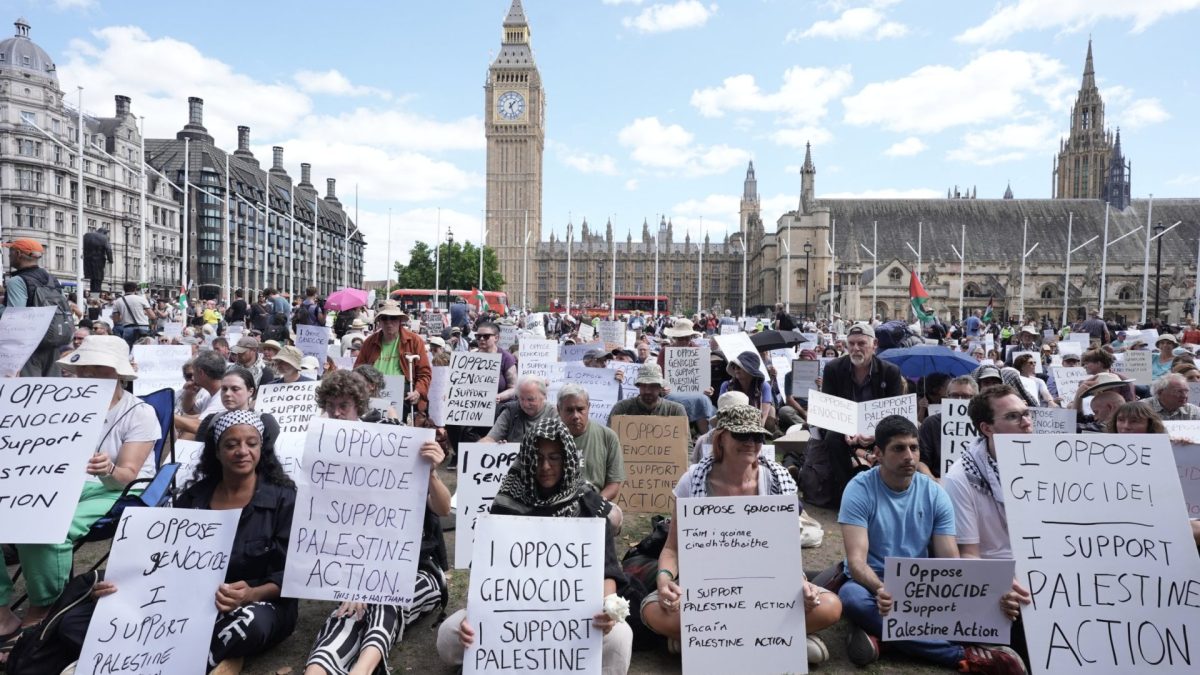
The average terror suspect arrested in Britain is now a white person in their 50s, following radical changes to the demographics of alleged terror offenders since the ban of Palestine Action. The designation of the group as a terrorist organisation in July last year has caused a year-on-year increase of almost 1,200 per cent in previously rare terrorism-related arrests, with the 2,800 made for supporting Palestine Action overtaking the total number in the previous decade. The vast majority of suspects have been arrested for holding signs reading “I oppose genocide, I support Palestine Action” at protests against the ban, under a law which was originally designed to criminalise the wearing of IRA uniforms during The Troubles. The volume of cases poses a significant challenge to the criminal justice system, where terror cases can only be dealt with by specialist prosecutors, with charges approved by the Attorney General and heard by senior judges in specific courts. Hundreds of officers from Counter Terrorism Policing (CTP) in London have been involved in each protest over the Palestine Action ban, working for weeks afterwards to progress investigations, according to the head of the unit. Commander Helen Flanagan, head of CTP London, told a press conference last September that a “streamlined process” had been created to reduce the impact on wider work. “It is bringing resources away from other elements of policing within counter-terrorism,” she said. “Palestine Action is a proscribed organisation, it’s not for us to decide who we police and how we police in terms of dealing with that. We are still managing all of those other threats.” Cmdr Flanagan said that Defend Our Juries, the group organising the sign-holding demonstrations, would not be able to overwhelm the police and criminal justice system. “The only thing that these individuals have achieved is to get themselves arrested, and are now facing the stark reality of being prosecuted under the Terrorism Act,” she added. “There are other legitimate ways to carry out protest activity which do not involve breaking counter terrorism laws.” A demographic shift A Home Office report published last month said the unprecedented number of arrests related to Palestine Action had caused a demographic shift in terror suspects, making them more likely to be white, British and female, and with a “considerably altered age profile”. Official figures for the year to March show that 92 per cent of terror arrests in Britain were for alleged Palestine Action supporters, and that the cohort had an average age of 59 and an even gender split between men and women. Outside the Palestine Action-related arrests, the vast majority of terror suspects were male, with an average age of 31. “Two years ago you wouldn’t have said police would be carrying grannies away for holding signs,” Serena, a woman in her late 50s who did not want her second name published, told The i Paper. “There’s a reason we are all old white people.” Serena said she felt that people her age were protesting against the Palestine Action ban because they would suffer less from the consequences of a terrorism conviction than younger protesters. “I bought my house 30 years ago, I can survive in a way others can’t,” she said. “It’s not just the long term impact, it’s the current impact on work and people’s livelihoods.” Carolyn, a retired teacher who did not want her second name published, said she was the daughter of a Holocaust survivor and has been arrested four times for holding signs displaying support for Palestine Action. “I’m 68 and I’ve been arrested with people in their 80s, so it’s kind of crazy,” she said. “It’s absolutely ridiculous, and I think it’s clearly backfired in terms of motivating people to get involved.” The Home Office found that 97 per cent of Palestine Action-related suspects were white, compared to 52 per cent of other terrorism arrests where ethnicity was known. A higher proportion of people arrested in relation to Palestine Action also considered themselves British nationals compared to people accused of acting for other causes. Not ‘typical terrorists’ People arrested at Defend Our Juries protests have included a vicar, an RAF veteran, a blind wheelchair user and doctors and nurses in scrubs. “No one at all looks at the pictures of the protests and says ‘oh they look like typical terrorists’,” said Chris Waites, a 39-year-old NHS worker who was arrested at a protest in Parliament Square in September He described a “polite” process where hundreds of people queued for hours to be processed by the police in tents and released on bail, adding: “It’s a very surreal thing where you’re a ‘terrorist’ in the afternoon and then go back to your boring normal life.” Reverend Sue Parfitt, 83, was among the protesters removed by the police at a Defend Our Juries protest in July 2025 (Photo: Jeff Moore/PA Wire) The case against him was dropped after a police officer lost the sign he had been holding, Mr Waites said, but a second incident in October where he held a banner on Westminster Bridge resulted in a charge. He has not yet had a court hearing. Out of the 2,819 Palestine Action-related arrests made by the end of March, only 484 had been prosecuted amid the ongoing legal battle over the lawfulness of the ban. An administrative hearing is to be held at Westminster Magistrates’ Court on 26 October where the management of all Palestine Action cases involving charges under section 13 of the Terrorism Act 2000 will be considered. The law prohibits displaying items “in such circumstances as to arouse reasonable suspicion that [a person] is a member or supporter of a proscribed organisation”. It can only be dealt with by magistrates’ courts and has a maximum punishment of up to six months’ imprisonment. Mr Waites said he hoped that the charge against him would be dropped if the Supreme Court rules the ban of Palestine Action unlawful. “I take responsibility for what I did,” he said. “But it’s so ridiculous that a piece of cardboard can get you a terrorism conviction.” Protests not predicted Palestine Action is the first group to be designated a terrorist organisation by the British government over property damage, rather than the use or threat of violence against people. The government has said that the group met Britain’s legal definition of terrorism, which covers “serious damage to property” to influence the government or the public for the purpose of advancing an ideological cause, and that Palestine Action’s activity was escalating. Before the ban came into effect, an assessment by the Joint Terrorism Analysis Centre said that three out of 385 actions by Palestine Action were judged to meet the terrorism definition, during which activists vandalised facilities operated by the Israeli weapons manufacturer Elbit Systems and linked defence firms. Palestine Action mainly targeted the Israeli weapons manufacturer Elbit Systems and companies it accused of links, including Barclay’s bank branches vandalised in June 2024 (Photo: Guy Smallman/Getty Images) One of those incidents was a break-in at an Elbit Systems factory near Bristol in August 2024, where a Palestine Action activist broke a police officer’s spine with a sledgehammer. Large demonstrations against the ban were not anticipated by the government or police. A document obtained by The i Paper shows that counter-terror police predicted that the move would be a “significant deterrent” against joining Palestine Action and that the threat of arrest under terrorism laws “would likely discourage and dissuade support”. The report, which was drawn up in March 2025 to provide the view of UK Counter Terrorism Policing on the potential ban, said it would “allow for preventative opportunities and disruption to safeguard national security”. But under the heading “disadvantages of proscription”, the document said the ban could also “bolster a popular narrative of state repression,” and noted that protests had already taken place over the “perceived misuse of counterterrorism powers”. Police to continue enforcement Leigh Evans, a 55-year-old former nurse and paramedic who has been charged for holding signs at several Defend Our Juries events, said the ban of Palestine Action was an “insult” to the victims of past terror attacks. “The ban made Palestine Action a more popular and a more celebrated movement than they could have achieved on their own,” he added. “They couldn’t have done them a bigger favour.” Steve, a 58-year-old nurse who did not want his second name published because of his work, said he did not think people would be deterred from joining continuing protests by the arrests. “I’d been on some [pro-Palestinian] marches before, but very often it was rather transitory,” he said. “The sun goes down and it feels like nothing has really moved on.” Steve said he felt that being arrested at a Defend Our Juries protest “had an impact” and made “a mockery of the law”. In a ruling that found the ban of Palestine Action lawful in June, the Court of Appeal said the people arrested at Defend Our Juries protests had knowingly committed a crime by “voluntarily holding a placard supporting Palestine Action which they know to be a proscribed organisation”. “As a matter of law, the proscription decision will not prevent public expressions of support for the Palestinian cause or opposition to Israel and to the Israel Defense Forces, or demonstrations targeted at Elbit,” judges added. The Supreme Court will hear the next stage of the legal battle later this year. At a press conference earlier this month, Laurence Taylor, the head of UK Counter Terrorism Policing, said the ban would continue to be enforced. “If this was Hezbollah or another proscribed organisation, we would do exactly the same,” he added. “Of course we have to put resources into doing that, but it’s wholly appropriate that we do because it’s wrong to support a proscribed organisation.”
How retired teachers, nurses and vicars became Britain’s newest terror suspects
Full Article
Original Source
Read the full article at Inews →KhanList aggregates and links to publicly available news content. We do not host full articles from third-party sources. Always verify important information with original sources.