
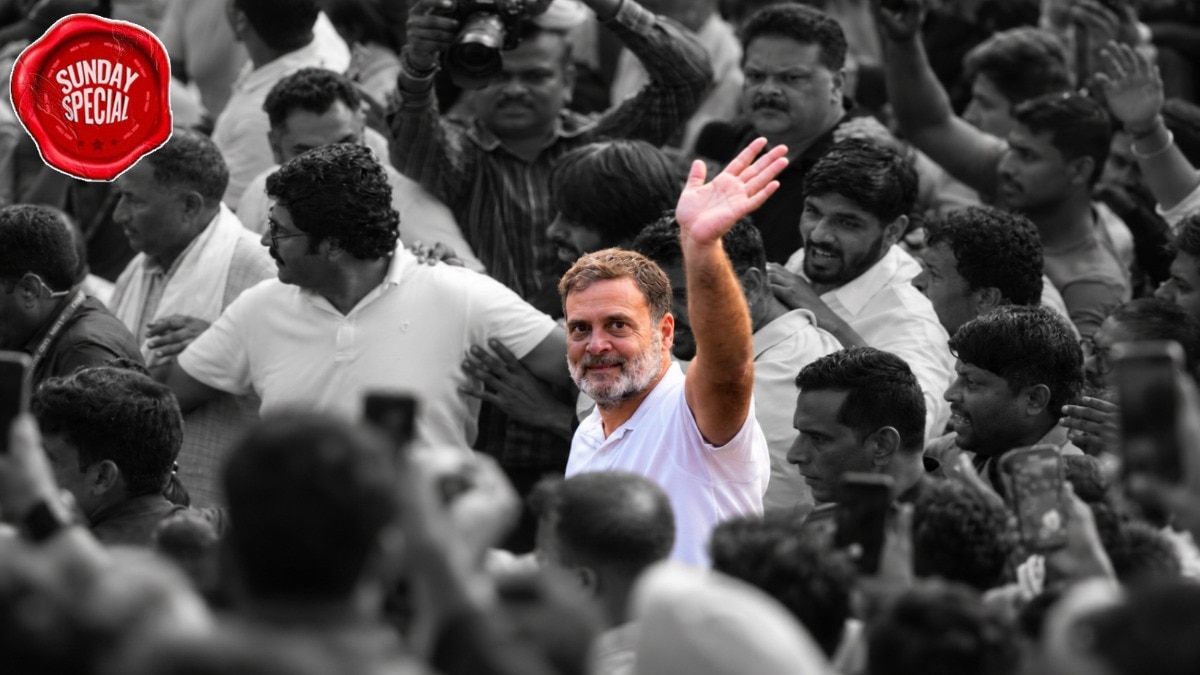
The first call of Rahul Gandhi's day is reserved for his sister, Priyanka Gandhi Vadra. Before the slogans, barricades and cameras take over, the two siblings discuss the day ahead, with Priyanka helping his brother set the agenda. Then comes a video conference with Rahul's dedicated team, "an inner circle" where political moves, messaging and optics are discussed. The meeting can stretch for hours before Rahul reaches out to senior Congress leaders. And, when an INDIA bloc show of strength is planned, Rahul personally contacts alliance partners. By the time Rahul Gandhi steps out on the mission, the day's script is taking shape, with the most dramatic act reserved for post-lunch, well in time for the prime-time.Towards the evening when newspaper editors are warming up for their front-page meetings, reporters are preparing to file their stories, television newsrooms are gearing up for prime-time debates and young Indians are returning from college and work and start to watch Instagram Reels or viral clips on X, a dharna (protest) begins in the heart of the national capital, with the spotlight on Rahul Gandhi.From a protest outside Prime Minister Narendra Modi's residence in July to successive demonstrations demanding Chief Election Commissioner (CEC) Gyanesh Kumar's resignation in October, Rahul's street politics has acquired a recognisable and apparent rhythm. There are confrontations, police barricades, slogans and prolonged sit-ins that begin post-lunch and keep the story alive well into the evening. Sometimes, there are also lunch meetings with Opposition MPs. These lunch and high tea gatherings in Connaught Place eateries become headlines themselves.The timing is a striking feature of the 56-year-old Congress leader's political strategy. It gives him and the Congress the chance to mobilise its cadre, stage visually compelling demonstrations and keep its issues in circulation through the evening news cycle. Even as television viewership patterns change, the mainstream media's ability to amplify a political narrative remains valuable and intact. On July 21, Rahul Gandhi invited around 25 Congress MPs to gather for a party at AICC President Mallikarjun Kharge's residence. Once assembled, the MPs were instructed to follow Rahul Gandhi's convoy without any idea of the destination. The group arrived near the Prime Minister's official residence in the evening and launched a sudden dharna. (Image: PTI) Senior journalist and author Rasheed Kidwai believes the timing is a "deliberate strategy of the Congress party to keep the slow-burn game going"."Timing matters in politics, particularly in the era of social media and TV," Kidwai, who has been following the Congress for decades, told India Today Digital. He recalled how Congress Working Committee meetings were held between 7 pm and 9 pm during the UPA rule (2004-2014). "Prime-time TV news would miss them. The newspaper got just sketchy reports the next day," Kidwai added. Senior journalist and author Neerja Chowdhury, who has covered national politics for at least four decades, believes the Congress under Rahul Gandhi has learnt from its earlier "communication failures". "Looking at Rahul Gandhi's and the party's strategy now, it is evident that the Grand Old Party has learnt fast and is correcting its mistakes," she said.Rahul Gandhi's new style can also be witnessed in how the party organises its events. Rahul Gautam, India Today TV's correspondent, who covers the Congress, said the Lok Sabha LoP has built a dedicated team that manages Rahul Gandhi's programmes, with little involvement from the All India Congress Committee (AICC) in their planning.Another senior journalist who closely tracks the Congress told India Today Digital on the condition of anonymity that "the emphasis is on the power of visuals".The change isn't just about when Rahul Gandhi appears before the cameras. It is also about how he does so. Once portrayed as an "impulsive politician", he now appears more assertive. He's willing to stay on the streets and turn a confrontation into a political message for his opponents.Has the Congress found a formula to set the news agenda? Is Rahul Gandhi trying to use the crowds, cameras and attention for long-term battles, electoral or otherwise?RAHUL GANDHI TOOK DHARNAS FROM PARLIAMENT TO THE STREETSFor decades, many of the Opposition's most visible protests in New Delhi followed Parliament's schedule. Leaders would gather during the day, raise slogans, hold demonstrations and address the media. By evening, the visuals from the Makar Dwar would fade from the news bulletins and mobile phone apps.The agitation by the Cockroach Janta Party (CJP) over examination irregularities, the first youth protest in the age of intensive social media, changed that trajectory. The protests had gathered momentum from June. Sonam Wangchuk gave it weight. Demonstrators demanded accountability and the resignation of then Union Education Minister Dharmendra Pradhan.Rahul backed the students' demands. But on July 21, he made a "surprise" move that marked a change in the Congress's approach to street protests. The Congress leader, accompanied by Priyanka and other Opposition leaders, staged a dharna outside Prime Minister Modi's residence, demanding action over alleged police excesses against protesting students on July 20. The demonstration continued for hours before Rahul, Priyanka and other leaders were detained as police cleared the site.Days later, Pradhan resigned on July 25. Rahul welcomed the development as a victory for the protesting students but maintained that other demands remained unresolved. The CJP beat the victory drum. Pradhan's resignation was its first success even as Rahul played a big role in amplifying the demands. On August 21, Rahul staged another dharna outside the Parliament Street police station, seeking an FIR over the use of pellet guns against a student protester. Rahul Gandhi held a sit-in for over six hours to demand an FIR be registered on a complaint from Sahil Lochab who had suffered pellet injuries during the CJP-led July 20 protest, at Parliament Street police station. (Image: India Today Group) By late September and early October, when the focus shifted to CEC Gyanesh Kumar, Rahul intensified his demand for his resignation over alleged irregularities in the Special Intensive Revision (SIR) of electoral rolls and concerns over the Election Commission's functioning. On October 6, Rahul led INDIA bloc MPs in a march towards the Election Commission headquarters. Police barricades halted the march, and the confrontation shifted to the Akashvani Bhavan premises, where Rahul and other leaders staged a prolonged sit-in. The protest continued into the evening, with detentions and heated moments adding to the political drama.The following day a lunch meeting of Opposition MPs was called in a Connaught Place eatery. Rahul and other INDIA bloc leaders attempted to march towards Jantar Mantar. Police stopped them, and several leaders were detained again. On October 12, Rahul joined an INDIA bloc march towards the Supreme Court, demanding judicial intervention over alleged irregularities in the SIR of electoral rolls and the functioning of the Election Commission.The demands differed, but the format is becoming familiar. A political grievance against the BJP-led government, a street protest, a confrontation with the police and a story for the evening content on TV and social media. With Congress and its allies and affiliates protesting in the afternoon and evening, television coverage, online updates and the next morning's newspaper reports can follow a different pace. Then there's always the possibility of a flash protest by Rahul Gandhi.THE PRIME-TIME CALCULATION BEHIND RAHUL'S PROTESTSRasheed Kidwai, who has authored several books on the Nehru-Gandhi family, argued that the timing of these protests by Rahul is not incidental. It isn't just a logistical convenience. He recalled how the Congress Working Committee (CWC) would often meet between 7 pm and 9 pm, with discussions running late into the night during the UPA rule. The result, he said, was often poor media coverage.Rahul's current approach, Kidwai believes, reflects a greater awareness of how newsrooms operate. "The mainstream media, otherwise seen as hostile to Rahul and the Opposition, is forced to cover him and to pick up the issues he raises in its 6 to 9 pm prime-time debates," Kidwai told India Today Digital. "Newspaper and online reporters, meanwhile, get more time and material to produce detailed stories rather than routine reports."He believes Rahul's team includes professionals who pay attention to such details and even factor in the Prime Minister's engagements of the day. The strategy, according to Kidwai, is designed to sustain political momentum rather than generate a single day's headlines.A dramatic image of Rahul climbing atop a police barricade, for instance, can get into the social media feed long after the demonstration ends. Rahul Gandhi climbing atop police barricades after being stopped during a protest march from Parliament towards the Election Commission of India office, demanding the resignation of CEC Gyanesh Kumar. (Image: PTI) THE ADVANTAGES OF RAHUL GANDHI'S POST-LUNCH PROTESTSNeerja Chowdhury, author of How Prime Ministers Decide, cautions against assuming that television remains the principal source of political information for younger audiences. Many young, middle-class Indians now consume news through social media. But she believes the Congress has become more adept at communicating its message. "Today, the Congress is setting a template that other parties might look at," Chowdhury told India Today Digital.There is also a practical advantage to holding demonstrations after noon. Chowdhury pointed out that organising marches requires time to assemble leaders and cadres, arrange transport and coordinate logistics. But she rejected the idea that afternoon protests are a new invention."In my four decades of covering national politics, political marches, demonstrations and press briefings have often taken place after noon," Neerja Chowdhury said. Rahul Gandhi's new style of street politics has made him more unpredictable, and he is emerging as a leader who is ready for confrontation. (Image: Reuters) She recalled a 1987 march led by VP Singh, then a former Union minister and Congress rebel who had turned against Prime Minister Rajiv Gandhi amid the Bofors scandal. Journalists had been asked to assemble at his residence at 6 am. Singh, who had broken with the Congress and was mobilising opposition to Rajiv Gandhi's government, was preparing for a major show of strength. When the crowd and caravan were ready at Teen Murti House, he simply said, "Chalein (Let's go)." Thousands joined the march to Uttar Pradesh's Muzaffarnagar."It was a massive protest march. Thousands gathered. I was on a dais that collapsed. I will never forget that post-noon protest," Neerja Chowdhury told India Today Digital.Big demonstrations have long been part of Indian politics. What has changed is how these protests now reach millions through television news and social media."The preparations by the Congress begin at around 9 am or 10 am. Mobilisation and logistical arrangements take place before Rahul arrives at the protest site. For a leader whose events depend heavily on crowd size and visuals, the time required to bring people together is crucial," India Today TV's Rahul Gautam said.The afternoon slot, therefore, offers the Congress both the time to organise and an opportunity to influence the evening's political conversation. Rahul Gandhi, AICC President Mallikarjun Kharge, Congress party leaders Priyanka Gandhi Vadra, KC Venugopal, and other leaders of the INDIA bloc addressing a joint press conference in New Delhi. (Image: PTI) RAHUL'S MORNING GRIND BEFORE THE STREET SPECTACLE"Behind the street spectacle is a more structured routine," said the senior journalist tracking the Congress, who sought anonymity. Rahul Gandhi begins his day at a normal hour, completes his fitness routine and has breakfast before speaking to Priyanka about the day's plans. He then attends a video conference with his dedicated team. The discussions could continue for hours, covering political strategy, messaging and the presentation of upcoming events, the journalist said.Senior Congress leaders are also brought into the process, while Rahul personally contacts INDIA bloc leaders when a joint programme is scheduled.India Today TV's Rahul Gautam said the direct outreach marks a change from the earlier arrangement, when Congress general secretary KC Venugopal would often handle coordination with Opposition allies. A protest involving the INDIA bloc requires more than a leader's decision to take to the streets. Parties must coordinate participation, agree on demands and organise an event which can deliver a coherent political message. Rahul Gandhi's press conferences have also followed a systematic rhythm. The Leader of Opposition in the Lok Sabha's briefings have also been a visual spectacle. (Image: X/@Congress) The Delhi-based senior journalist said Rahul had assembled a specialised team to handle these details, with considerable emphasis on planning and presentation. He also rejected claims that Rahul routinely wakes up late, describing him as a "fitness enthusiast".The account by the senior journalist suggests that it's a massive, coordinated operation in which the public appearance is only the most visible part. But, much of the preparation takes place before Rahul arrives at the protest site. Rahul Gandhi trying to get out of a police van after being detained during a protest by opposition parties demanding the resignation of Gyanesh Kumar. (Image: Associated Press) KHAN CHACHA ROLLS AND THE POLITICS OF LUNCHThere is also a lighter side to Rahul's protest routine. Food has become an unlikely supporting character in the Congress-led political drama.A Khan Chacha roll, a lunch at Sagar Ratna and a meal at Moets in Connaught Place have all found their way into coverage of the Opposition's protests against Gyanesh Kumar. Rahul even had a sip of Sting energy drink. He offered it to his sister Priyanka, who declined to take a sip.India Today Digital's Medha Chawla, who covers lifestyle and food, explored what Rahul and other Opposition politicians ate before heading out for their demonstrations. The restaurants in New Delhi's Connaught Place became a destination of political lunch and high tea for the Rahul Gandhi-led Opposition. (Image: PTI) At Sagar Ratna, Rahul had paneer butter masala with half a roti. At Moets, he joined nearly 100 INDIA bloc MPs for a vegetarian spread that included badam shorba, dahi bhalla, dal makhani, assorted breads and ice cream.The meals serve a political purpose beyond their menus. Opposition leaders get an opportunity to consult one another, coordinate their next moves and demonstrate unity by keeping the world waiting over what’s coming up.The photographs also offer a humane contrast to the confrontation that follows on the streets. One moment, leaders are sharing a meal. The next, they are facing police barricades. In an age when political news is also consumed through photographs, short videos, speeches, and moments. Even a half-roti lunch can become a talking point.RAHUL GANDHI'S ASSERTIVE IMAGE FACES THE ELECTORAL TESTThe senior journalist, who spoke on the condition of anonymity, highlighted that Rahul's public presentation has also improved. He described the Congress leader as someone who was always decent in his conduct but could be impulsive. He added that Rahul now appears more aggressive and assertive. The recent protests against Dharmendra Pradhan and Gyanesh Kumar have provided a stage for that change.Rahul's sit-ins for hours, confrontations with police and repeated street action even after being detained have helped establish a recognisable image of a leader willing to sustain a political fight. Yet visibility has its limits.Television coverage and viral images can amplify an issue, but they cannot establish that the wider public accepts the Congress's allegations or that the party can convert attention into votes. A crowded demonstration might reflect organisational strength without necessarily indicating broader electoral support.The expectations surrounding Rahul also make the stakes higher. Rahul Gandhi and the protests led by him have gained a different momentum with a renewed startegy and style of communication. (Image: File) Rasheed Kidwai pointed out that members of the Nehru-Gandhi family had all achieved major political milestones. Jawaharlal Nehru and Indira Gandhi became Prime Ministers, Rajiv Gandhi held the country's highest office and Sonia Gandhi led the Congress to consecutive Lok Sabha victories in 2004 and 2009. Party leaders, Kidwai said, now believe it is Rahul Gandhi's turn to make his mark.The expectation is an additional burden on his politics. He must demonstrate not merely that the Congress can attract attention, but that it can lead a broader Opposition, sustain a campaign and challenge the BJP beyond the news cycle."The young, middle-class electorate are beginning to look at Rahul differently," Neerja Chowdhury told India Today Digital. She credited the momentum generated by the CJP and Rahul's role in amplifying it.Rahul's routine offers a glimpse of a more deliberate political style. The first call to Priyanka. Video meetings to settle the day's plans. Party workers are mobilised, Opposition allies are brought together and, by afternoon, the action moves to Delhi's streets. Sometimes there is a barricade. Sometimes a prolonged dharna. And sometimes a bowl of paneer butter masala before the confrontation begins.Rahul Gandhi might have found a new way to keep the Congress in the headlines, but whether the attention on the streets translates into votes remains to be seen.- Ends
How Rahul Gandhi has reset protest clock to emerge as India's prime-time hero
Full Article
Original Source
Read the full article at Indiatoday →KhanList aggregates and links to publicly available news content. We do not host full articles from third-party sources. Always verify important information with original sources.