
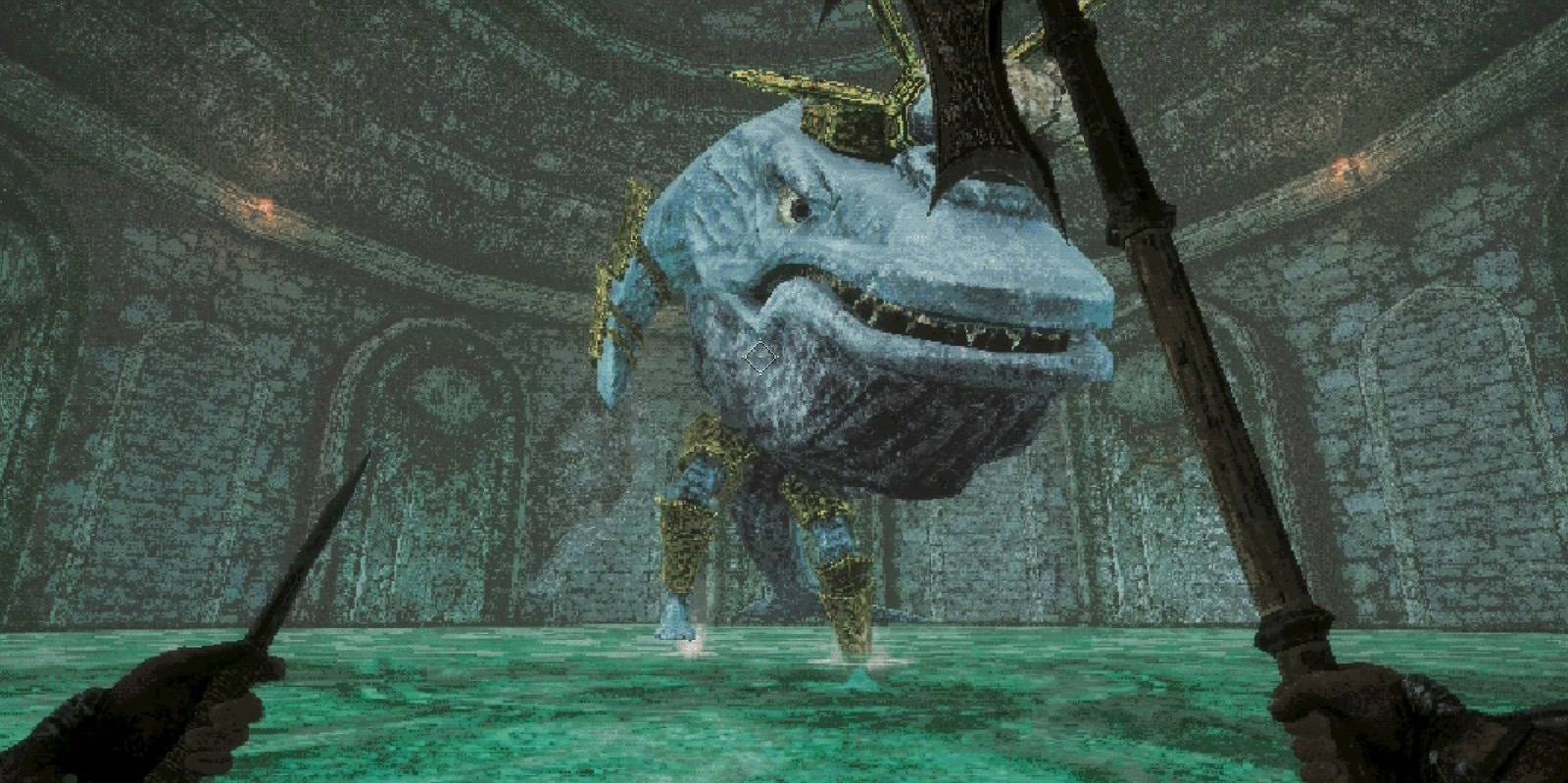
Eric Berger, the co-developer of viral hit Queen’s Domain, doesn’t exactly adore the video game industry, despite having worked in it for more than two decades. He got his start as a teenager creating maps and mods for Unreal Tournament before landing his first professional level design contract with Gearbox at just 19 years old. From there, he helped bring Advent Rising to life at GlyphX, worked on an unreleased project at Mad Doc Software, and spent years at Airtight Games honing his level design and environment art skills on games like Dark Void. After a stint at Final Strike Games working on Rocket Arena, Berger decided it was time to make a game he really wanted to play. At Final Strike Games, Berger met Bradley Boothe, a technical artist and former software engineer who shared a frustration with what could get done at a traditional studio. Together, they struck out on their own, founding the two-person indie studio Freshly Baked Games and trading the security of industry jobs for the creative freedom — and financial uncertainty — of building something entirely theirs. Many years later, the result was a prototype for a game… that was way too ambitious (but they fully intend to return to). So they went back to a different concept, a stripped-down first-person fantasy inspired by FromSoftware's cult-classic King's Field. That was supposed to take a year to build. Three years later, the game, Queen’s Domain, is an ambitious torrent of weaponry, monster encounters, and Berger’s patented 3D level design, all spread across an low-poly open-world map. Speaking for the first time since unleashing Queen’s Domain on the unsuspecting retro RPG sickos, Berger got into it with Polygon on building a vast interconnected fantasy world, making a game that rewards exploration, and why allowing players to grind their way to overpowered levels doesn’t have to be a bad thing. This interview has been edited and condensed for clarity. Polygon: What did you set out to accomplish with Queen's Domain? Was it born out of pure nostalgia for King's Field? Berger: I think our view on game design, why we're making games, is partly to get away from the idea that everything has to have a hook. What we both really enjoy when we play games, and what we want more of, is games that just go deep on exploring a good foundation. Like you were saying, I want another one of these, I want it to be good. I don't wanna spend a lot of time figuring out how to make it special and different. I just wanna make every aspect of it as good as we can figure out how to make it. So focusing on getting the level design to be really tight, really interesting to explore. If we have anything like a hook, obviously it's the sword dash, but I'm not gonna say I think there's anything revolutionary about multiple air dashes. Making good use of things versus getting a unique idea out and then going there. Going deeper on mechanics. Was there a risk in going independent? A little bit. The way the industry has turned since we left makes it feel like less of a bad decision. Tons of layoffs going on, really hard to find work from everyone I've talked to and heard about. At least we don't have to worry about that part of it. Bradley is married and has a very supportive partner, so he was given the go-ahead to give it a really good shot for a couple of years and see if it can work. And I did the old sacrifice at the ripe old age of 41. Like, “Hey mom, can I live in your basement?” So I've been here for like five or six years. Image: Freshly Baked Games via Polygon What makes a great level? What philosophy did you bring to Queen’s Domain? The high-level things that are important to me in any game are really understanding and making use of what the game is about. Not just things that are always correct, but making sure that each place you make reflects what the person playing this is gonna be wanting to do. What would they be thinking about? It's an RPG, so they're gonna be thinking about finding items, finding unique enemies, getting into new areas, “Where can I save?” Then things like making sure you can understand where you are in a space. Obvious things like landmarking, but making sure the lighting is just right so that when you look around, the things that are important are called out. Paths look like a path you should go on. Don't put a bunch of torches over on the side of a cliff if that's not a place you're supposed to make your way to. But the biggest one for me is creating interest in moving through a space, making it evident that it's not a video game box. I try to avoid creating too many facades of buildings. When I'm playing a video game and I see a building, I wanna go in there, and if the game keeps showing me you can't go in there, it starts to feel fake. So I try to keep the reality of the space very grounded. In building the map out, I might realize you could get on top of this other thing over here, and that's not what I wanted you to do. But instead of trying to fix it, I'm gonna make sure the way you get up there at some point in the game becomes clear, and I'm gonna put a suitable reward up there. That way, if you get up there, you're not just disappointed. The really easy example: On top of the shrine where you get the main sword, Endu, there's one of the silver skull collectibles. The first thing I would think of playing a game is: Is there anything on top of that? I can get on top of that. So if you jump off of anywhere high up and have enough dashes, you can get over there. Do you have a pantheon of great video game levels? Maybe not so much of a pantheon. I think the big ones are gonna be the same for a lot of game designers, but for me it's definitely Ico. The castle in that game is just incredible. It's such a real place that I love to just be there. Not particularly an inspiration for this game in the most direct ways, but Shadow of the Colossus as well, while we're on that topic of Ueda's stuff. And the most obvious possible thing, Dark Souls and King's Field 4 for me are huge, just because I love the way they feel like you're exploring a place and you could find things there. It's not just a level you're playing. The reverse of that is putting a hole to hell right in the beginning of the game. I made the mistake of going down the well. I was not prepared. For me that's creating the reality of the space, the sense that it's a world for you to explore, not video game levels. I trust you when you play the game to know that area's bad and maybe you don't wanna be there. But I'm not gonna stop you from pushing into it a little bit. Maybe you can get some loot out of there, or maybe you can manage to kill one guy and get a lot of XP. I really like when games tease me with a bunch of options. The best parts for me of Dark Souls 1 and Dark Souls 2 are where you're thinking, I know these five places I can go. I wanna go to all of them, and I'm not sure which one is the right choice. I know this one was really hard, but maybe I'm not strong enough yet. I know these two options exist over here and I really wanna find what's over there, or that area's theme seemed interesting. I just like the part where you get to choose what you're doing. That's just a way to let you choose what you're doing. I think one person in our Discord commented that they went down the well and came out at level 25. They just fought their way through it. Why go back to King's Field today, when even FromSoft has moved beyond that formula? I played [King's Field] on PS2 — I rented it when I was a teenager. And I was like, wow, this game's really interesting but I have no idea what I'm doing. I don't think I got terribly far in any of them. But they had a really raw sense of intrigue to the world. They are quite rough mechanically to play, with FromSoft's very strange old camera systems and all that, but they're really interesting. Wanting to revisit that seems like a pretty good thing: Take my inspiration from what I thought those games were, what I liked about those games, and do a modern take on it. Everyone knows about Lunacid, and I love that game. I thought it was really amazing to see not just that someone had made a really cool modern take on that style of game, but that people actually liked it. So I thought, if there's an audience for these games that I've always been interested in, that seems like a good place to start. Then the other part of it is just the modern FromSoft games. I love a lot of them, but they're trending away from the type of things I like in games. My favorite thing about those games is exploring their world, their incredible designs for weapons, for armor, for enemies. But I'm fucking old! The parrying is getting too much for me. My reflexes aren't as good. I can't deal with how hard they're tuning it for really hardcore action. I didn't want to make Queen's Domain easy, but I like the way the older style of RPG lets you just grow your power. It's not like they're trying to stop you. In the Souls games, the more you level up, the more your stats actually fall off on what they do. So while you can certainly get powerful in those games, you can't ever get to the point where you just overpower the whole game because you wanted to grind. If someone is having a hard time in an RPG and they want to grind, I feel like it's appropriate to make a game that rewards that. You can grind it out if you want to. You keep getting stronger in a very linear way and eventually one-shot everything. To me that's fun because you don't have to, but it's a nice option. How do you make leveling up consistently fun? I imagine that’s core to a great RPG. To me what makes a great RPG is respecting what the player's doing and their investment. Not just having a lot of stuff, but having a lot of stuff that actually does things. I don't, for example, love the new trend where the game is trying to balance itself around your level. I don't believe in that. I think that if you get “too strong” well, you need to make sure the player can't get that strong but not by cheating them. If I level up a lot and I hit a guy in the first area and he dies in one hit, that's how in my mind it's supposed to be. I don't want it to be a thing where it's comparing your level to the enemy level and then trying to adjust things around that. You could have gone a million directions – how did you come up with the creatures and visual identity to populate this world? It's a good question, and not one I ever put a lot of thought toward. I like to look through my inspirations, like the bestiary for Shadow Tower and older games. I value a lot how interesting the enemies are. They're not just 10 kinds of zombies and then a big zombie with a bubbly arm. There are different thematic reasons for different things. Like there's a golem because in a world with magic, obviously someone's gonna animate stones and make it come alive. We've got to do that one! Same with skeletons and bones. But for the more weird creature designs, just thinking about different things that I think are an interesting-looking animal or two and combining them together, or morphing them in a way that's trying to make things that aren't quite what I've seen before a lot of the time. I think my favorite thing in the game, and it's a bit later in the game, is probably the cuttlefish dog that makes bubbles. The first hour can be quite punishing. Or maybe I suck. How did you calibrate that difficulty, especially early on when people might bounce? I think it depends on who's playing, really. We've had any number of complaints that the game is too easy or too hard. For me that's part of how the numbers aren't faked. If you understand exactly how to play the combat, you're gonna level up much quicker than someone who's dying a lot, because you're getting all that XP and you're just gonna become more powerful. If you die a lot, it is gonna be harder. But I think it's important for someone who's playing this game and finding it really difficult to understand the importance of going back and saving, paying attention to the damage types, maybe not getting into every encounter and then dying and realizing you don't have to do that. You don't have to fight the centipede thing. I don't think [an enemy like the laser eyes] pay off at all if the first time you encounter them you just throw a dagger at them. I wanted to show you a problem and then let you feel good when you get the solution to that problem. Also teaching you how important it is to be observant in the game because there's no tutorials. You need to look around. I'm not gonna tell you where to go, so you need to get used to looking around. That's part of why we've stayed so strong on not highlighting things that enemies drop either. Anything I can do to make sure players feel like they have to be paying attention, I'm gonna do it. I have certainly missed a dropped elixir or two in the pixelated brush of the island. How did you decide on just how low-poly to go with the look of the game? Personally what I value when I'm looking at a game's art isn't how detailed it can be. It's the compositions of the spaces, variation in how it looks, the uniqueness to what I'm looking at. Same with enemies, weapons, all that kind of stuff. I'm more interested in big-picture stuff. Everyone these days can get Quixel or do photogrammetry or pay a thousand artists to ZBrush everything to perfection, but I want interesting stuff. Bringing everything to a lower resolution makes that way more possible. Obviously with two people, making everything super detailed is just a death sentence. We already tried that twice. If it takes four days to make a guy, I wanna be able to make the guy in four hours, so I can make eight different character models in a week rather than making one really good and everything rolls out from that. Rigging a much more dense model takes a lot more time. The expectations around the animations for a character when they're really detailed are a lot higher. You can't build a unique world and do that with fully modern art. You would spend forever making sure each spot has every brick and whatever. That flexibility means I can continue to edit it, and it's not a nightmare to keep it cleaned up and finished-looking. The target for finishing it is really low, so it's just easy to make everything perfect within its context. I'm not trying to get every crack and every rock on every surface how I want it. It's a tiled texture, so I can just cut a hole in a wall and make a cave. Even though we kept the art really low, it's one big connected world, so working on it now in the editor is really slowed down. The map takes like 20 minutes to load. If the game was modern detail level, I probably would need a better computer than I have, and I think we would have had to split up the map into multiple at the very least. Is there a dungeon or sequence of traversal that’s emblematic of the game you set out to make? Where all the elements come together? I think it's felt like a twist to a lot of people that you finish that first area and you can dash, and then you find that torch, and it's telling you, to get in here you need to light three fires. I think a lot of people assume, well, this is the way to the next level, I gotta go find all three. But there's a whole level in between you and one of the torches. That part for me is saying the game isn't just you're going stage by stage. You can do some of it earlier or you can do it later. It really depends on what a person happens to do. Falling down the well could be that moment for a lot of people. The other point would be if you happen to find the first entrance into the really dark underworld parts. It's right there in the first area. Another spot where you just walk in somewhere and you're like, nope, because there's really hard enemies in there. I think that stuff's interesting. It's a thing I would bookmark in my brain. Now that you’ve established this world, is Queen’s Domain the type of game you want to go back and build more on top of? Or do you and Brad want to do something totally different? I don't know if we're gonna necessarily do another one of these anytime soon. We both enjoy a wide variety of video games, and there's a lot of other, maybe underappreciated genres that we want to explore. One of my favorite games is probably Resident Evil 4. That very specific take on survival action — I love the tension and the horror, but also the resource farming. My favorite version of that formula was Resident Evil 5, because it just let you go nuts with it. You could go farm money in that game, and it's fun to me to just become powerful. We might want to make one of those. We might want to make more of a Soulslike game because my favorite time in those games is when they first made them. I think my favorite one still, for the gameplay side of it, might actually still be Demon's Souls. Diving into one of those with what I appreciate about those games. See if I feel like making 150 sets of armor. What would connect all these different types of projects? How would you describe what you and Bradley ultimately want to do in games or as an alternative to mainstream studio games? I would say nothing we're gonna make will have nothing to do with Queen's Domain. The gods that are over that universe are gonna be there in all of them. The storylines would thread together in various ways, whether this takes place a thousand years later. We'd still wanna keep them connected to each other. And a lot of my core design principles, and all the core things we both enjoy about games, aren't gonna change. I think we both really value real-time combat type gameplay. We're not gonna make a turn-based game. Probably we're just gonna turn anything that we make into this, but it's an RPG. I have to collect many things in a video game. I have to do it. I need to level up stuff in my character. I need to get items and choose my equipment. I need to collect a bunch of money and go shopping in a game. That's just what I love to do, and Bradley has pretty similar tastes. There are so many games I've played where I felt like this would be the most perfect game ever if I could just level up my character. Because again, I'm getting old, man! Maybe I need the game to let me get stronger in the game mechanically and not just get better at the game because sometimes it's just not gonna happen. Free sign-up Get Polygon’s Wishlister newsletter A weekly cheat sheet to what you’ll eventually love to play. No buying, no commitment — just saving for later. Sign up free Free. Unsubscribe anytime.
How Queen's Domain's 2-Person Team Remade Elden Ring's Legacy in a Basement
Full Article
Original Source
Read the full article at Polygon →KhanList aggregates and links to publicly available news content. We do not host full articles from third-party sources. Always verify important information with original sources.