
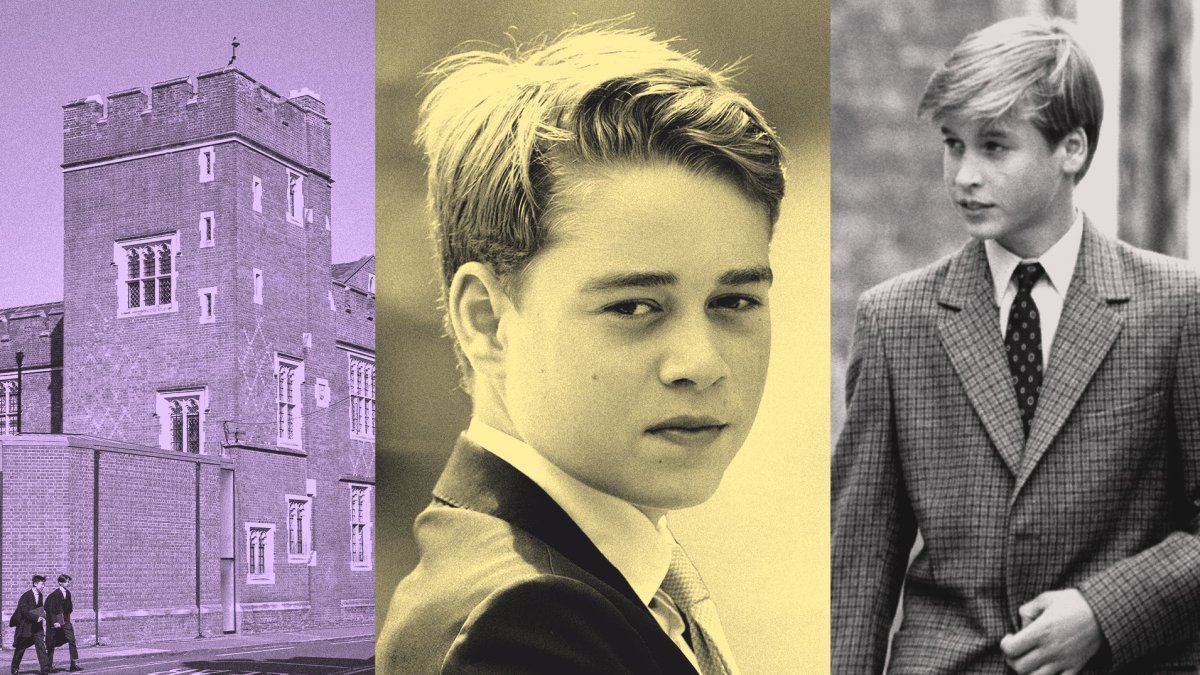
Prince George will be given greater protection than any heir in modern times when he begins studying at the world’s most prestigious school next week. The future King will be expected to pose for the customary photo call before his first day at £65,673 per year Eton College – echoing the photocall staged for his father in 1995, when Princess Diana walked Prince William to the school gates alongside Prince Charles and a young Prince Harry – but that might well be the last the public see of George at the 586-year-old public school until he leaves for university or chooses another path. It is likely that his cousins, Prince Archie and Princess Lilibet, will equally be left to get on with it when they start at preparatory school, despite the Duchess of Sussex speaking of her fears in a 2022 interview that she would be dogged by photographers while doing the school run. Shorts Archie, 7, and Lilibet, 5, will be spared the photocall and, if their parents get their wishes, the location of their school. In their case, even their faces might never be disclosed while they are children – Harry and Meghan, since stepping back as working royals, have chosen to raise their children largely as private citizens away from the public eye. For George, 13, and his siblings, Charlotte, 11, and Louis, 8, life in the public eye is a fact of life but for now it is severely limited and tightly controlled. The Prince and Princess of Wales’ plans might change but for now there appears to be no intention to give the public regular updates on the second in line to the throne’s progress at school or even announce his GCSE and A-Level results. ‘Trade-offs with the media unlikely’ There are unlikely to be pictures of him playing sport at the school or performing in plays or concerts, according to well-placed sources. We might not even be told which house he is in or the name of his house master. It’s a tighter approach than the one applied to his father and uncle. Under the “Gentleman’s Agreement” struck for William’s time at Eton, a handful of official photocalls (the annual Eton Tea Party, his role as a prefect, images of him playing rugby and water polo) were traded for the media otherwise leaving him alone. Harry’s arrival in 1998 was covered on broadly the same terms. His parents, the Prince and Princess of Wales, regularly speak about the second-in-line to the throne and his siblings when they are out on public engagements but, in spite of that, the British public probably knows less about George than any of his immediate predecessors as future monarch at the same age. New ‘no photography’ signs have gone up at Eton ahead of Prince George’s arrival (Photo: Maureen McLean / Alamy Stock Photo) We know he likes playing and watching football, tennis, and other sports; he plays guitar and likes history and charting his parents’ official overseas travel on maps for his siblings. But even his favourite subject at school is not entirely clear. For years it has been said to be earth sciences because of his interest in volcanoes but that stems back to an off-the-cuff remark to another parent by his mother six years ago when he was seven. By closely controlling the information that comes out about their children, the Waleses have protected the young royals’ childhoods like no member of the family who came before them. The bigger threat to the young prince’s privacy and security at Eton now comes from the public and the rise of phone cameras, Meta glasses and other smart spectacles with recording devices and social media. One of the issues for the 24-strong private security team at Eton and the police officers who are expected to be installed there to provide round-the-clock protection for George is the fact that the school buildings are dotted around the town. “The walk from his house to lessons, to the chapel, to the sports pitches, it’s not a confined campus,” Melanie Sanderson, managing editor at The Good Schools Guide, noted. “His family must have considered the implications of that and I guess it’s up to them to put the measures in place to support George as he moves around in his school life.” New ‘No Photography’ signs have been placed around the school warning the public and media against photographing pupils but, although media guidelines prevent coverage of children in education without consent, there is nothing similar to prevent the public or foreign tourists taking pictures or video in public places in the town without permission. George could ‘fade into a group’ “They can’t stop the general public doing it, which I suppose is the biggest challenge,” Sanderson said, although she thought George would be able to fade into a group of pupils and avoid being spotted most of the time. “It’s not like he’s got a shock of red hair.” Dai Davies, a former head of royalty protection at the Metropolitan Police, agreed it was a challenge for the team protecting George but thought tourists and others using smart glasses or phone cameras, especially repeat offenders, could be frightened off with anti-stalker legislation. “From a protection point of view, you’d have to have a very quick, sharp word and remind people that causing alarm or distress under various public order acts is a criminal offence. And if you constantly harass somebody now under the various bits of legislation that deal with harassment, there is an opportunity to remind anyone that it’s a criminal offence.” George, Princess Charlotte and Prince Louis (C) pictured on their first day at their Lambrook School in September 2022 (Photo: Jonathan Brady/Getty) With luck, any security concerns will bypass George, who must hope that he enjoys Eton as much as his father did and does not suffer the misery of his uncle Harry, who struggled academically and bunked off regularly. “I made some mates. It wasn’t easy,” he wrote in his memoir Spare. “I needed someone who’d treat me like normal, which meant ignoring the armed bodyguard sleeping down the hall whose job it was to keep me from being kidnapped or assassinated. (To say nothing of the electronic tracker and panic alarm I carried with me at all times.)” The Waleses looked at Marlborough, Oundle, and other schools but must think George is up to the very rigorous standards of Eton, according to Sanderson. “They clearly care deeply about their children’s health, mental health, wellbeing and to put a boy into Eton that wasn’t up to the challenge would seem to me to be at real odds with what we believe we know about them,” she said. George will be at Eton with family friends and several boys who have gone through Lambrook School with him, she said, noting that security concerns meant sending him to a comprehensive was out of the question. Around 10 per cent of pupils at Eton are on some form of financial assistance, Sanderson noted, and from comparatively modest backgrounds. “Wouldn’t it be great if he became friends with some of those people?” she said. “If he ended up going home for the weekend to someone’s very ordinary house in a very ordinary place, it’d be amazing, wouldn’t it?” Diana’s death sparked a shift Media coverage of the Royal Family has undergone a sea change since the 1990s, partly as a result of Diana’s death at the hands of a chauffeur – over the alcohol limit and driving erratically – who tried to evade pursuing paparazzi. Back then, there were regular clashes beyond the specific terms of the “Gentleman’s Agreement”, between Buckingham Palace and the press over coverage of the boys. The then media regulator, the Press Complaints Commission, issued its own guidelines in August 1995 and again in April 1999, asking a fiercely competitive media to exercise restraint and leave the boys alone at school – while also urging Buckingham Palace to provide regular updates on the princes’ progress at Eton. “It worked pretty well,” one royal source recalled. “In general the press stayed away. There were some photographers who used to park outside Eton but their pictures weren’t really used in British papers. There were almost monthly updates about the boys given to the newspapers that were most likely to be interested.” Others remember it slightly differently, particularly before Diana’s death. One photographer, while agreeing that the British press mainly respected the deal, recalled occasions when the media descended en masse. “We did William rowing and other sports events. We weren’t actually invited. We just turned up. That’s just what you did in those days,” he said. King Charles had to put up with more, according to the PCC back in 1999, when he was a pupil at Gordonstoun. “Before the code, newspapers would regularly publish pictures of royal children at school and information about them – not least about the Prince of Wales himself,” the commission said. Kensington Palace has not commented publicly yet and, although there might be a private plea to newspapers and broadcasters to leave George alone, it currently looks unlikely that anyone is going to need to broker a public deal offering the press regular material in return this time. Harry and Meghan may have faced sustained criticism but at the same time the British press has softened because of advances in privacy law, a tightening of media guidelines, and changes in public attitude – exam results, for example, now come in envelopes instead of being posted on school notice boards for all to see. Take a close look at pictures of Prince George released ahead of his first day at Eton. They may be the last we see of him for some time.
How Prince George’s Eton experience will be very different to William’s and Harry’s
Full Article
Original Source
Read the full article at Inews →KhanList aggregates and links to publicly available news content. We do not host full articles from third-party sources. Always verify important information with original sources.